Quick Answer
Selecting the correct wiring harness requires defining voltage and current loads, operating temperature range, environmental exposure, and the specific mating connector series—not just length and pin count. A properly specified harness matches conductor gauge to load current, insulation material to installation conditions, and connector interfaces to existing equipment, all while meeting applicable industry standards such as IPC/WHMA-A-620 for workmanship and RoHS for material compliance. Buyers who prepare a complete specification package before quoting reduce rework, avoid production delays, and receive assemblies that perform reliably over the equipment’s intended service life.
The Real Question Behind “What Wiring Harness Do I Need?”
When an OEM procurement manager or equipment engineer asks “What wiring harness do I need?”, the question runs far deeper than the casual phrasing suggests. Behind that simple inquiry sits a complex engineering decision that touches electrical design, mechanical packaging, connector compatibility, material science, and compliance documentation.
The most common misstep in harness procurement is reducing the requirement to two parameters: overall length and pin count. A harness built to only those specifications may fit physically but can fail electrically within hours of installation. Undersized conductors overheat under load. Insulation rated for indoor use cracks when exposed to -20°C conditions. Connector contacts with dissimilar platings develop fretting corrosion at the mating interface. These failures do not announce themselves during a visual check—they surface after equipment ships to the field, where corrective action costs multiples of the original assembly price.
A structured approach that captures electrical requirements, environmental conditions, connector specifications, and quality standards before the first quotation request transforms what could be a reactive purchase into an informed engineering procurement. This article walks through each decision layer that determines harness viability, providing the practical framework buyers need to communicate requirements accurately to their supply base.
Translating Electrical Parameters into Wire and Insulation Choices
Conductor selection is the first engineering decision in any harness specification, and it follows directly from the electrical loads the harness must carry. The relationship between current demand and conductor cross-section is straightforward in principle but frequently overlooked when buyers rely on generic “standard wire” assumptions.
American Wire Gauge (AWG) sizing determines both the current-carrying capacity and the voltage drop across a given circuit length. For low-voltage DC circuits common in control panels and sensor networks, voltage drop matters as much as thermal limits. A 20 AWG conductor carrying 5 amps over 3 meters may stay within its ampacity rating but drop enough voltage to affect sensor accuracy or relay pull-in voltage. The table below provides a practical reference for copper conductor sizing in typical OEM harness applications at moderate ambient temperatures.
| AWG Size | Typical Current Range (Amps, Copper, 30°C Ambient) | Common OEM Circuit Applications | Voltage Drop Consideration |
|---|---|---|---|
| 22 AWG | 0 – 3 A | Sensor signals, low-current control lines, LED indicators | High drop over long runs; limit to short branches |
| 20 AWG | 0 – 5 A | Relay coils, small solenoid valves, PLC I/O | Moderate; verify at runs over 2 m |
| 18 AWG | 0 – 8 A | Power supply distribution, motor control circuits | Manageable for most equipment-scale runs |
| 16 AWG | 0 – 12 A | Main power feeds, heating elements, DC motor drives | Low; suitable for chassis-level routing |
| 14 AWG | 0 – 17 A | Battery connections, high-current bus wiring | Minimal; use for primary power entry |
Insulation selection follows current and voltage requirements but also anticipates the physical environment. Standard PVC insulation provides adequate dielectric strength for circuits under 300V in dry, indoor conditions and represents the most cost-effective option for benign environments. Cross-linked polyethylene (XLPE) offers improved thermal performance and abrasion resistance for circuits operating above 80°C, while silicone rubber jackets maintain flexibility at temperatures down to -50°C. Each insulation type carries a temperature rating recognized under UL component standards, and matching that rating to the harness operating environment prevents premature embrittlement or softening.
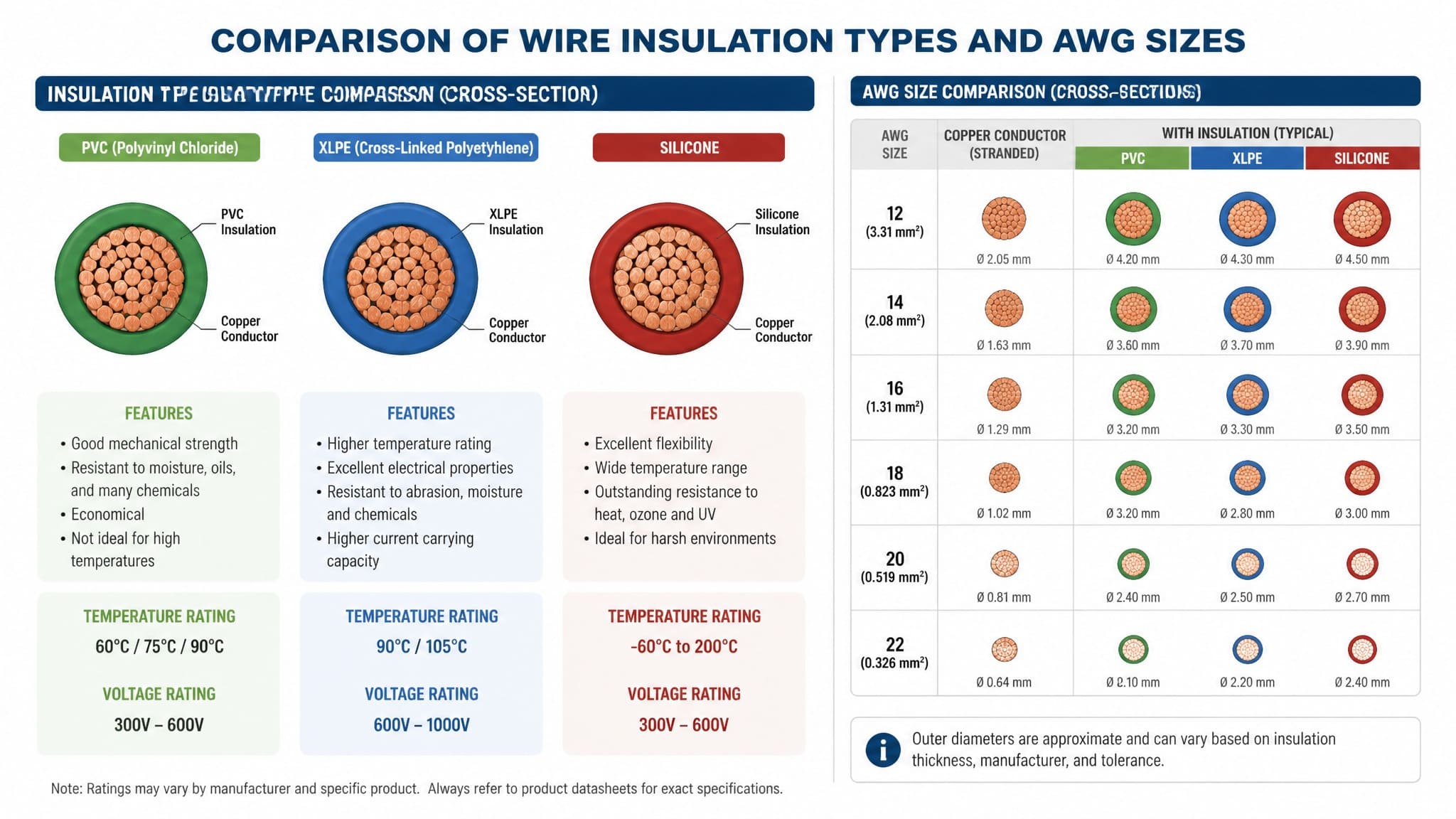
During drawing review, the buyer should verify that the proposed wire gauge aligns with both the circuit’s steady-state current and any inrush or surge conditions. A conductor that handles steady-state 8 amps may see 25 amps during motor startup, and while the duration may be brief, repeated thermal cycling can degrade conductor-to-insulation adhesion. Experienced harness manufacturers raise these questions during specification review, but the buyer’s engineering team owns the final determination of operating conditions.
Mating Connectors: Why the Series Dictates Harness Viability
A harness is only as reliable as its termination points. Connector selection determines mateability, contact retention, environmental sealing, and long-term electrical stability at every interface the harness touches. The decision cannot be deferred to the supplier without risking mismatches that stop production lines.
The starting point for connector specification is identifying what the harness must plug into. If the harness connects to existing equipment, the buyer must document the connector series, pitch, number of positions, gender, locking mechanism, and keying features present on each mating device. A 4-position rectangular connector may be a Molex Mini-Fit Jr., a JST VH series, or a TE Connectivity Mate-n-Lok—all physically incompatible despite similar appearance and pin count. Photographs alone are insufficient; part numbers, manufacturer markings, or dimensional verification are essential.
Terminal selection within the connector housing adds another layer of engineering choice. Crimp contacts are specified by wire range compatibility, plating material, and contact design. A terminal rated for 18-22 AWG cannot reliably crimp onto 16 AWG wire, and the result of forcing the mismatch is a weak crimp with poor contact retention and elevated resistance. Contact plating matters most in applications where the connector sees frequent mate/unmate cycles or operates in condensing humidity. Tin-plated contacts work well in dry, low-cycle applications; gold plating over nickel underplate provides the corrosion resistance and low contact resistance needed for signal-level circuits in variable environments.
Harness manufacturers that offer connector matching support help buyers navigate these decisions by cross-referencing existing equipment connectors against available supply. The process includes verifying that the proposed connector housing, terminal, and seal combination works as a system, not just as individual components that happen to fit the same catalog page.
Environmental Conditions and Their Impact on Harness Materials
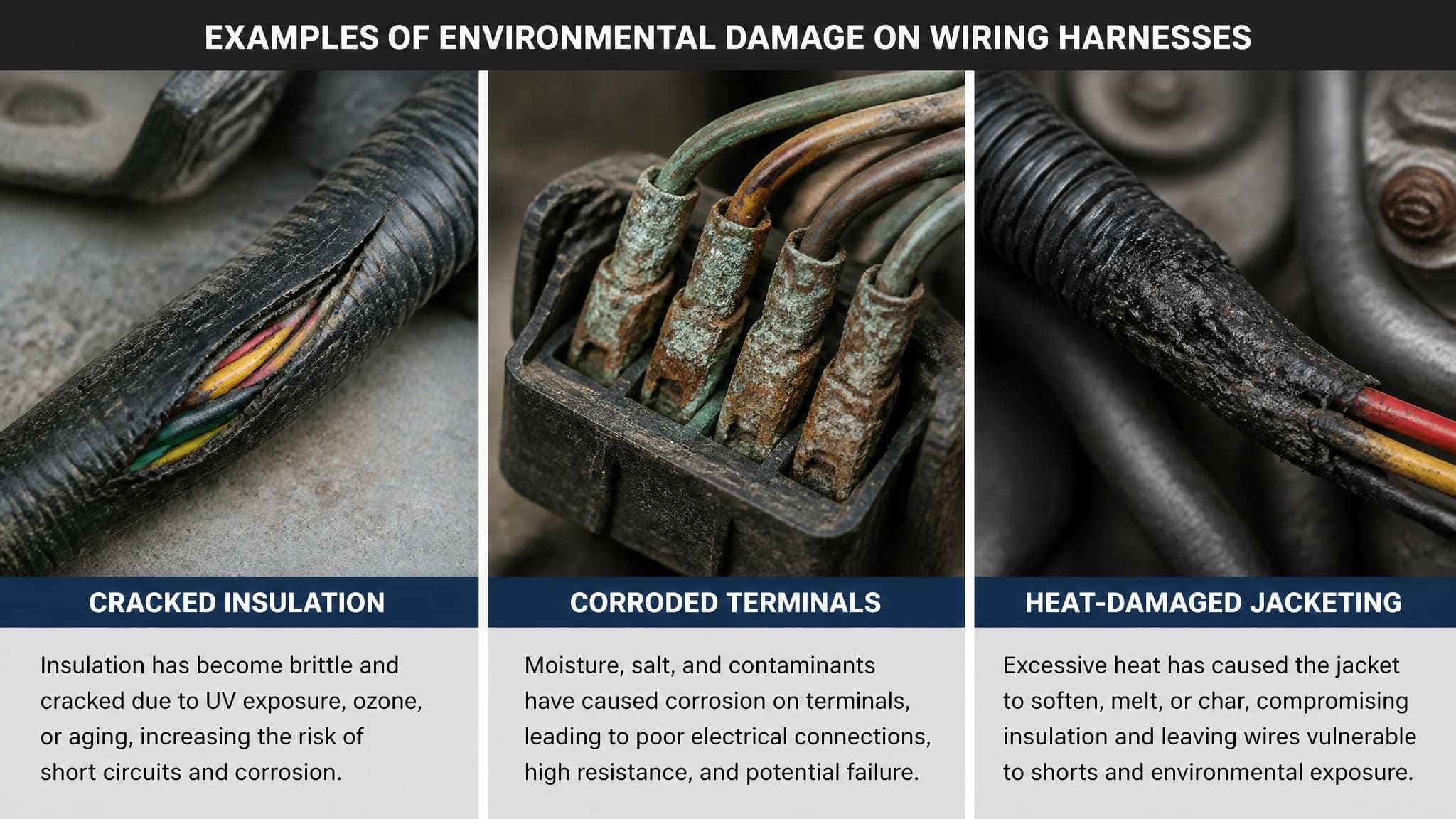
Harness materials that perform perfectly in a climate-controlled factory may degrade rapidly when the equipment moves to its actual operating environment. The specification must account for temperature extremes, moisture, chemical exposure, UV radiation, mechanical flexing, and abrasion risk—not the conditions of the assembly bench.
Temperature drives insulation and jacketing decisions. Under-hood automotive and off-highway equipment harnesses routinely see ambient temperatures exceeding 100°C, requiring insulation systems rated for 125°C or higher. At the opposite extreme, freezer-warehouse material handling equipment needs jacketing that stays flexible at -30°C without developing stress cracks at bend points. SAE J1128[1] provides a widely referenced performance specification for low-tension primary cable used in surface vehicle electrical systems, defining temperature grades, abrasion resistance, and fluid compatibility requirements that apply well beyond automotive into industrial equipment design.
Moisture and chemical exposure introduce sealing and material compatibility requirements. A harness routed through a food processing machine encounters washdown chemicals, steam, and continuous high humidity. Connector seals, grommets, and jacket materials must resist swelling, cracking, or leaching when exposed to these agents. UL 94 flammability ratings also become relevant when the harness routes through enclosed electrical compartments where fire propagation resistance matters for equipment-level certification.
The consequences of underrated materials are not theoretical. Outdoor machinery harnesses specified with indoor-rated PVC jacketing can develop circumferential cracks at flex points within two years of UV and thermal cycling exposure. Those cracks admit moisture, which wicks along conductor strands, reaches the crimp zone, and initiates corrosion that eventually increases contact resistance beyond the circuit’s tolerance. The repair involves replacing the entire harness—at a cost far exceeding the original material savings.
Industry Standards That Shape Wire Harness Quality and Compliance
Compliance standards provide the common language between buyer specifications and supplier deliverables. Three frameworks matter for the majority of OEM harness procurements: IPC/WHMA-A-620 for workmanship, UL component recognition for safety, and RoHS for material restrictions.
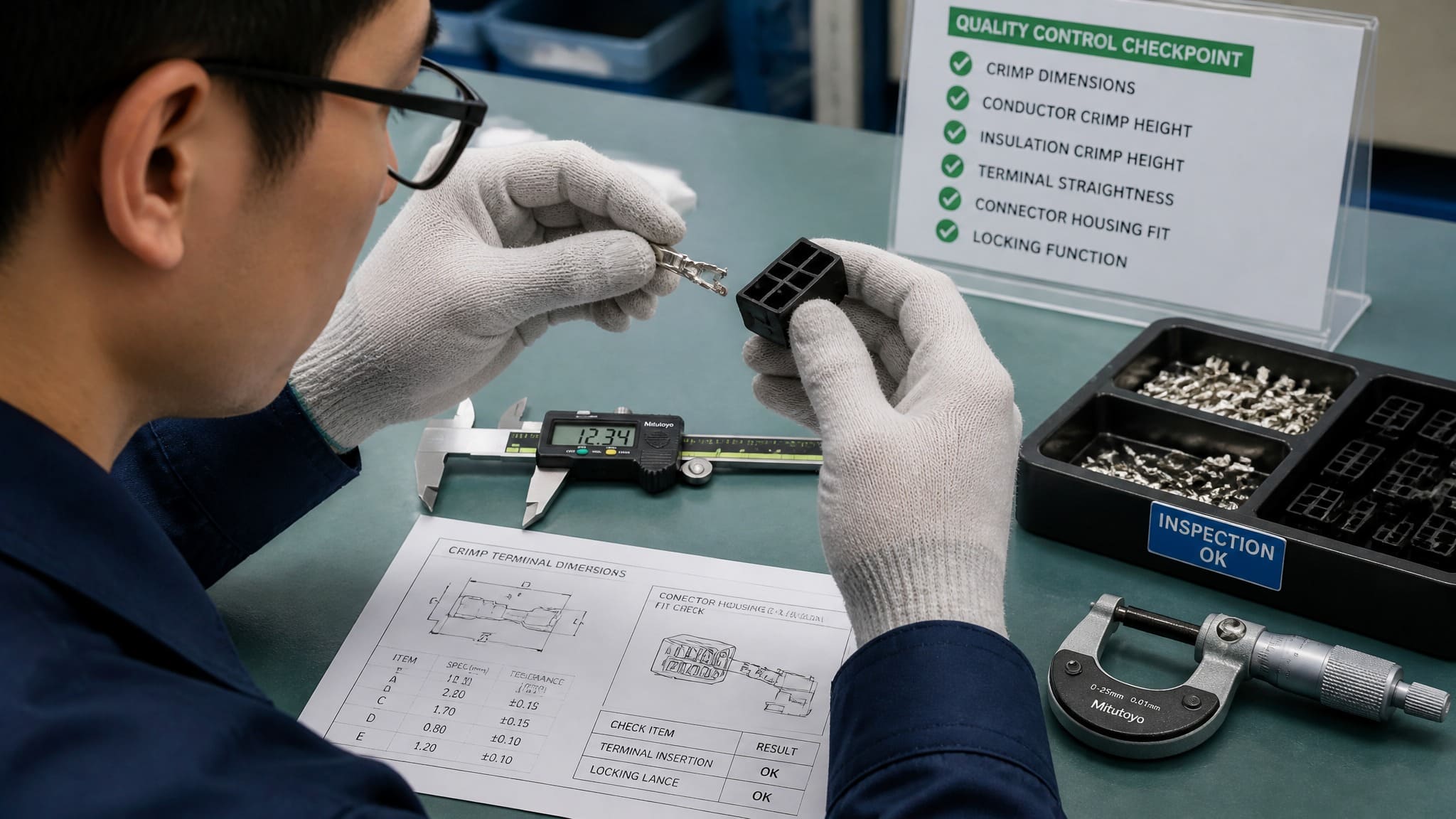
IPC/WHMA-A-620 is the consensus standard for cable and wire harness assemblies, co-developed by IPC and the Wiring Harness Manufacturer’s Association. It defines acceptance criteria for crimping, soldering, routing, lacing, and overall assembly quality across three classes: Class 1 for general electronic products, Class 2 for dedicated service products, and Class 3 for high-reliability applications. For buyers, specifying IPC/WHMA-A-620 Class 2 or Class 3 acceptance means the supplier must verify crimp height, pull-force values, insulation clearance, and strain relief positioning to documented criteria—not just visual approximation. The standard also defines first-article inspection requirements that provide objective evidence of process control before volume production begins.
UL recognition of harness components carries different implications than full UL listing. Individual wires, connectors, and insulating materials typically carry UL recognized component marks that confirm their performance to specific standards. When those components are assembled into a finished harness, the assembly may need to demonstrate compliance as part of the end equipment’s UL listing. Buyers exporting equipment to North American markets should confirm during specification whether their harness requires UL-listed construction using only recognized components, as this affects the supplier’s material sourcing and documentation obligations.
RoHS compliance (Restriction of Hazardous Substances) restricts lead, mercury, cadmium, hexavalent chromium, and certain flame retardants in electrical and electronic equipment sold into the European Union and many other regulated markets. For harness buyers, RoHS affects conductor plating (lead-free tinning), PVC jacketing compounds (phthalate-free plasticizers), and connector contact finishes. Compliance is verified through supplier declarations and material test reports, not visual inspection alone. Buyers should request RoHS compliance documentation proactively rather than assuming it, particularly when sourcing from supply chains where legacy non-compliant materials remain available.
| Standard | What It Covers | Why It Matters for Harness Buyers | Documentation to Request |
|---|---|---|---|
| IPC/WHMA-A-620 | Workmanship acceptance criteria for cable and harness assemblies | Defines measurable quality levels for crimps, routing, soldering, and strain relief | First-article inspection report, process control documentation |
| UL (Component Recognition) | Wire, connector, and insulation safety performance | Required for equipment UL listing in North American markets | UL file numbers for recognized components, traceability records |
| SAE J1128 | Low-tension primary cable for surface vehicles | Applicable to industrial and mobile equipment operating in harsh environments | Conformance certificate from wire supplier |
| RoHS | Restriction of hazardous substances in electrical equipment | Mandatory for EU and many global market access requirements | Supplier RoHS declaration, material composition data |
From Requirements to Production: The Documents and Specs Buyers Must Prepare
A supplier can only build what the buyer specifies. Gaps in the specification package create an information vacuum that the supplier must fill with assumptions—and those assumptions may not match the application reality. The following checklist outlines the minimum documentation set that transforms a vague inquiry into a production-ready requirement:
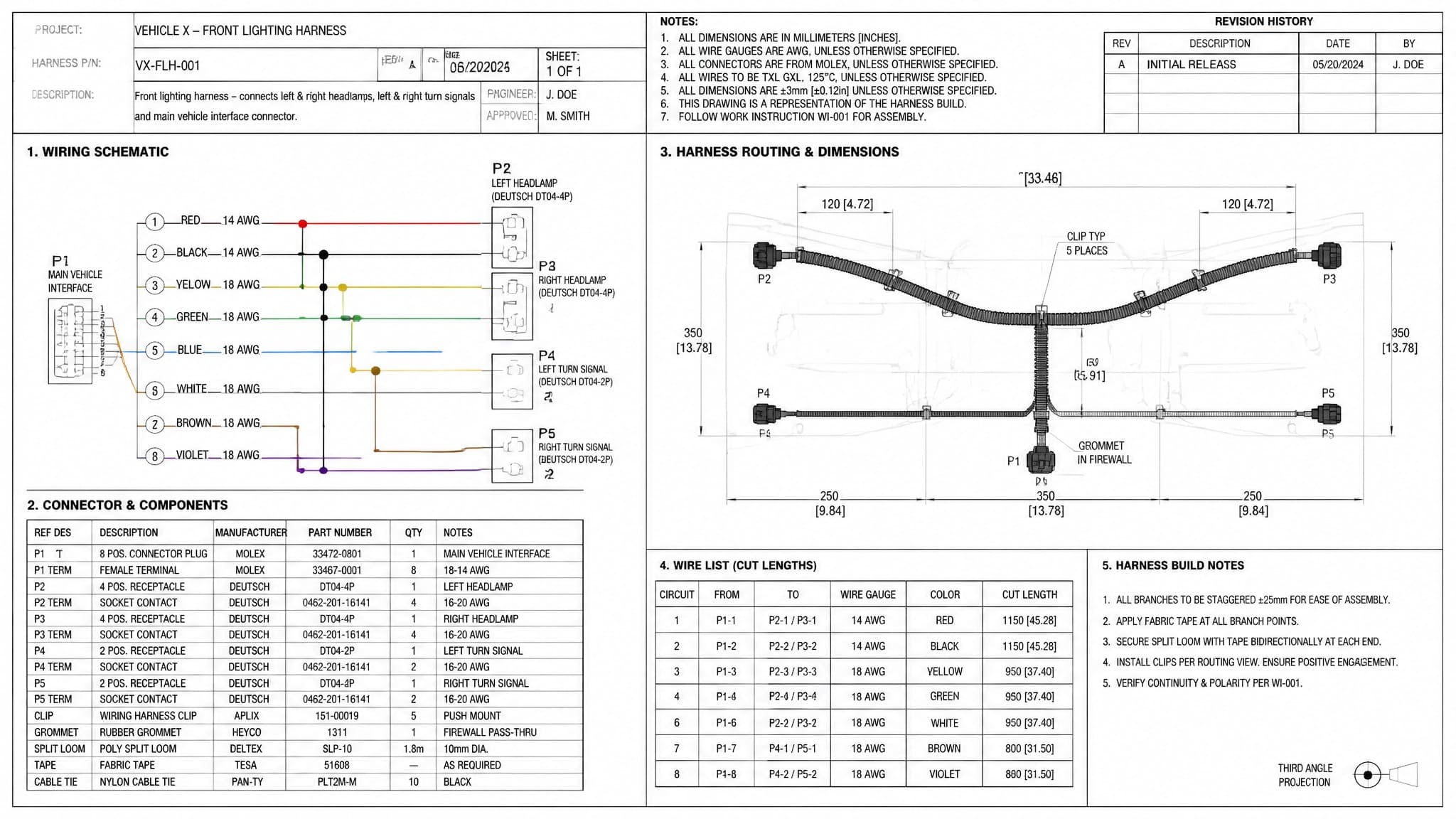
- Electrical schematic or connection diagram: Shows which pins connect to which, wire colors, and circuit functions. A hand-drawn sketch with clear labels is sufficient for simple harnesses; complex assemblies benefit from formal schematics.
- Connector part numbers and mating interfaces: Document both ends of every connection, including manufacturer part numbers or verified equivalents. Note if connectors must be supplied, or if the harness builds onto customer-supplied connectors.
- Environmental operating limits: Minimum and maximum temperature, moisture exposure, chemical contact, flex cycle requirements, and any UV exposure.
- Routing requirements: Branch point locations, breakout lengths, and any routing constraints such as minimum bend radius or routing path restrictions. Provide dimensioned drawings or marked-up photographs where 3D models are unavailable.
- Labeling and identification: Wire numbering, harness tags, barcode requirements, and label durability expectations.
- Testing and inspection criteria: Which circuits require continuity testing, any hipot test voltages, pull-force sampling requirements, and the acceptance standard (e.g., IPC/WHMA-A-620 Class 2).
- Packaging and shipping specifications: Coil diameter limits, bag-and-tag requirements per kit, moisture-sensitive packaging needs, and any labeling required for customs or inventory tracking.
When buyers present this information at the quoting stage, the supplier can move directly into drawing review, BOM verification, and sample planning. The alternative—starting with a rough description and iterating through weeks of clarification—delays both quotation and delivery and increases the likelihood that a critical requirement surfaces only after samples are built. For OEMs managing complex equipment programs, structured specification preparation is not busy-work; it is schedule protection. For more information on how production requirements translate into finished assemblies, explore our custom cable assembly support process.
Prototyping, Sample Confirmation, and What to Inspect Before Full Orders
The sample phase is the buyer’s best opportunity to catch specification gaps before they become production problems. A disciplined sample approval process pays for itself many times over by preventing the scenario where a container-load of harnesses arrives with a connector mismatch or a routing error that requires field rework.
Sample inspection should follow a structured sequence, not a casual visual check:
- Dimensional verification: Measure overall length, branch lengths, and breakout positions against the drawing. Confirm connector orientation at each branch. A harness that passes electrical test but routes incorrectly in the equipment can cause interference, abrasion, or assembly line slowdowns.
- Continuity testing: Verify every circuit path per the schematic, and confirm that no unintended connections exist between circuits. Automated continuity testers catch wire swaps and mis-wired connectors that are invisible to the naked eye.
- Pull-force sampling: Destructive pull testing on a sample of crimp terminations confirms that the crimp meets the specified retention force. IPC/WHMA-A-620 defines pull-force values by wire gauge, and the buyer should confirm that the supplier’s results meet the specified class.
- Mate/unmate cycling: For connectors that will see repeated connections, manual cycling confirms engagement force, locking feel, and contact stability. A connector that mates loosely on the bench will likely disconnect in the field.
- Appearance and workmanship: Inspect sleeving placement, label legibility, strain relief positioning, and overall routing neatness. These details affect installability and service life.
First-article inspection (FAI) reports aligned with IPC/WHMA-A-620 provide documented evidence that the production process can meet the specification. For higher-volume or safety-critical applications, requesting an FAI report with dimensional data, crimp cross-section photographs, and continuity test records adds cost to the sample phase but reduces risk substantially when moving to volume. Suppliers such as EDOM Electronics support OEM buyers through this stage with coordinated sample review, inspection documentation, and preliminary batch testing, bridging the gap between engineering specification and production-ready assembly. Buyers who invest in thorough sample qualification typically see fewer production line interruptions and reduced post-delivery quality issues. For further detail on how inspection integrates with order fulfillment, see quality inspection and export packaging processes.
Frequently Asked Questions
What information do I need to provide to get an accurate wiring harness quote?
At minimum, provide an electrical schematic or connection diagram showing all circuits, connector part numbers or detailed photographs of mating interfaces, operating temperature range and environmental conditions, overall length and branch-point dimensions, and any labeling or testing requirements. Incomplete specifications lead to assumptions that may not match your application.
Can I substitute a different connector series if the pin count and pitch match?
Substituting connectors without verifying mechanical mateability, contact retention, and housing keying is not recommended. Connectors with matching pin count and pitch may have different locking mechanisms, contact designs, or housing dimensions that prevent proper mating with your equipment. Always verify substitute proposals against your existing interface before approving.
How do I know if my harness needs to meet IPC/WHMA-A-620 Class 2 or Class 3?
Class 2 applies to products where continued performance is required but interruption is tolerable—this covers most industrial and commercial equipment. Class 3 applies to products where performance on demand is critical and downtime cannot be tolerated, such as medical devices, military equipment, and safety systems. The class designation affects inspection criteria, documentation, and manufacturing process controls.
What does UL recognition mean for my harness, and do I need it?
UL recognition applies to individual components (wire, connectors, insulation) that have been tested to specific UL safety standards. If your end equipment requires UL listing for North American market access, the harness must typically be built from UL-recognized components and may need to be listed as part of the overall equipment. Confirm this requirement with your certification body early in the design process.
How do I specify a harness when I don’t have a 3D CAD model of the routing path?
Provide a dimensioned 2D drawing showing branch-point locations, breakout lengths, and connector positions relative to identifiable reference points on the equipment. Supplement with photographs showing the intended routing path where possible. A clear hand-drawn sketch with measurements is more useful than a verbal description and allows the harness manufacturer to build an accurate assembly.
Key Takeaways
- Specify electrical parameters first: Conductor gauge and insulation type must match load current, voltage, and operating temperature—not just physical length and pin count.
- Document connector interfaces thoroughly: The connector series, pitch, gender, and locking style determine whether the harness will mate correctly with your existing equipment.
- Account for the real operating environment: Temperature extremes, moisture, chemicals, and mechanical flexing dictate material choices that prevent field failures and warranty claims.
- Use industry standards as quality benchmarks: IPC/WHMA-A-620, UL component requirements, SAE J1128, and RoHS compliance provide measurable criteria that align supplier deliverables with your internal quality expectations.
- Invest in disciplined sample approval: Structured inspection of samples—dimensional, electrical, mechanical, and visual—catches specification gaps before volume production, protecting your production schedule and equipment reliability.
For OEM buyers seeking production-ready harness manufacturing with structured specification review, connector matching, and quality inspection aligned to IPC/WHMA-A-620 criteria, learn more about wire harness OEM manufacturing support.