I see buyers chase low prices. Then they fight late deliveries and returns. I face this every week. The fix is simple. Set proof first. Then set price.
Pick a wire harness manufacturer by proof, not by quote. Set test coverage, FAI/PPAP gates, and crimp control before you talk price. These checks cut total cost and protect delivery dates.

I work in pre-sales and projects at EDOM Electronics in China. I handle RFQs through to mass production. I sit between your RFQ and our floor. When I push for test matrices, FAI gates, and crimp windows, projects run smooth. When I skip them, I pay for it. You pay more. Your customer waits. I do not want that for you. So I will show what I ask, what I provide, and what has passed in real projects. I will keep it simple. I will keep it useful.
Why should I start an RFQ with a test-and-inspection matrix?
You want a firm quote fast. But missing test coverage kills projects later1. I have seen “good samples” fail hi-pot during pilot runs. The line then stops. Everyone loses.
Define tests first. Set coverage, limits, and report formats at RFQ stage.2 I can then quote the true plan. I can also prove we can deliver the data you need in mass production.
Make coverage clear before price
From my factory and project view, a simple matrix changes outcomes. It blocks gaps that cause rework and delays. It also makes factory time stable. Here is the structure that works for EU/US OEM and trading clients I support:
- Coverage
- Evidence
- Continuity and hi-pot CSV/PDF with lot and time stamps.
- Pull-test summary with min/avg/max by terminal.
- Microsection photos for new terminals and after tool change.6
- Templates
- Provide your report template or accept ours at RFQ stage.
| Checkpoint | What I ask from you | What I provide in RFQ stage | Why it matters |
|---|---|---|---|
| Continuity | 100% or AQL? Limit values? | Sample report with serial format | No debate later on pass/fail |
| Hi-pot | Voltage, dwell, leakage threshold | Test screen and sample output | Prevent late insulation disputes |
| Pull test | Force per terminal and wire AWG | Data summary from past builds | Proof we hit the crimp window |
| Microsection | Which joints and when | Anonymized cross-section images | Shows strand bite and bellmouth |
When we agree this matrix first, my price reflects real work. Your approval risk drops. Your delivery dates hold.
How do I prevent sample-to-mass-production gaps?
A pretty sample is easy. A stable line is hard. I have shipped great-looking prototypes that later failed pull tests in mass runs because tooling was not locked.
Gate releases. Tie shipments to passing FAI and PPAP outputs, not to one “good sample.”7 Make each gate clear, with named documents and golden parts.
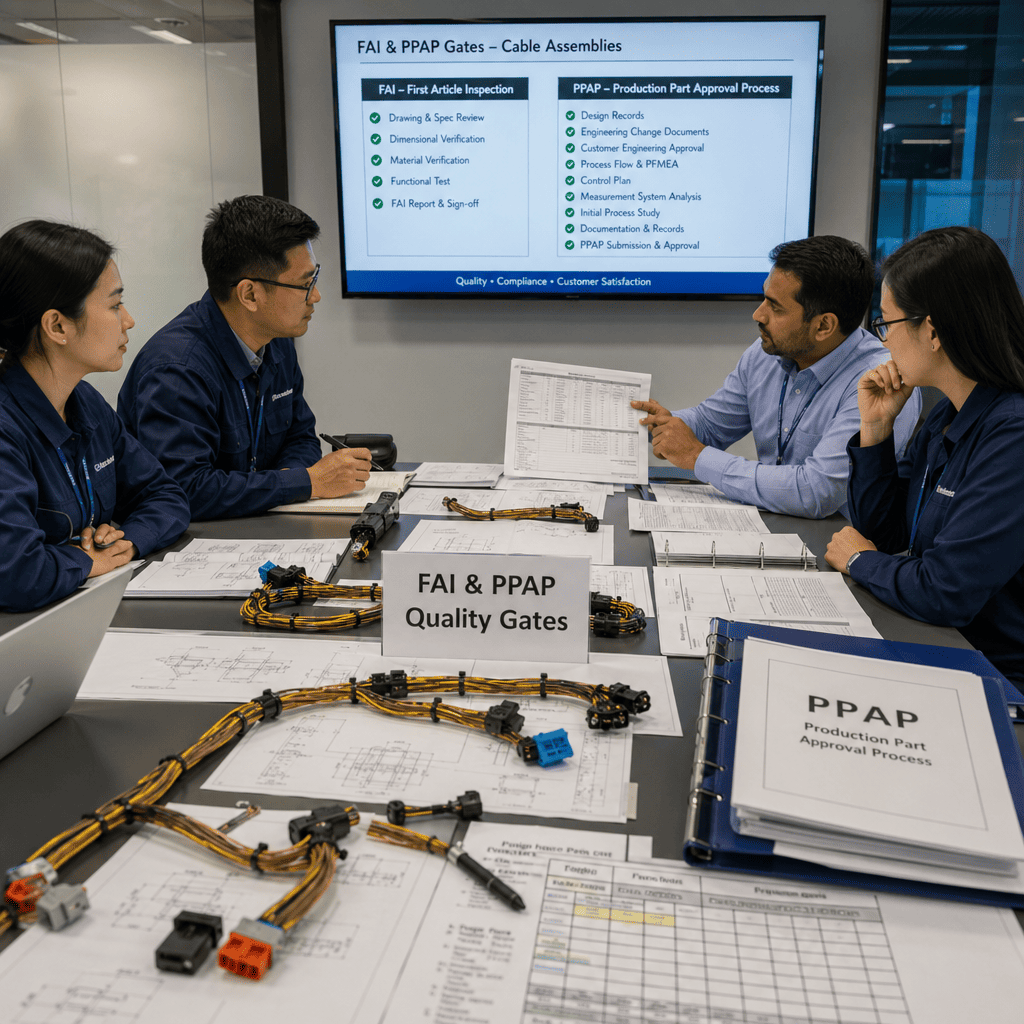
Lock releases with named artifacts
From my project desk, a gated plan removes drama. It puts proof before volume. It also gives your team leverage without fights. I use three gates as a base:
- Gate 1: Sample Release
- Outputs: Approved drawing, BOM, labeled golden samples, draft control plan.
- Evidence: Initial pull tests, first microsections, basic continuity data.
- Gate 2: FAI/PPAP Release
- Outputs: FAI report, finalized control plan, PFMEA (if required), tooling list with IDs, run-at-rate plan.8
- Evidence: Pull-test batch data, microsections per terminal and wire size, hi-pot results, key dimension checks.
- Gate 3: Mass Production Release
- Outputs: Run-at-rate record, packaging spec, label samples, training records, final golden sample set.
- Evidence: 2–4 hour line run, yield report, rework log, calibration list.
| Gate | Must-Have Outputs | Evidence I Share | Ship Allowed? |
|---|---|---|---|
| 1 | Drawing/BOM, golden samples, draft CP | Pull test, microsection, continuity | No |
| 2 | FAI report, final CP, PPAP elements | Batch data, hi-pot, dimension check | No |
| 3 | Run-at-rate, packaging, training proof | Yield and capacity data | Yes |
When we follow this, the “good sample” is not the end. It is the start of stable flow. I have cut start-up issues by half using this plan.
What crimp process evidence should I demand before I buy?
Bad crimps look fine to the eye.9 They fail on your line. I have seen field returns because a vendor hid crimp drift behind pretty heat-shrink.
Ask for crimp windows, pull-test summaries, microsections, and tool maintenance records before you issue a PO.10 This is not overkill. It is total cost control.
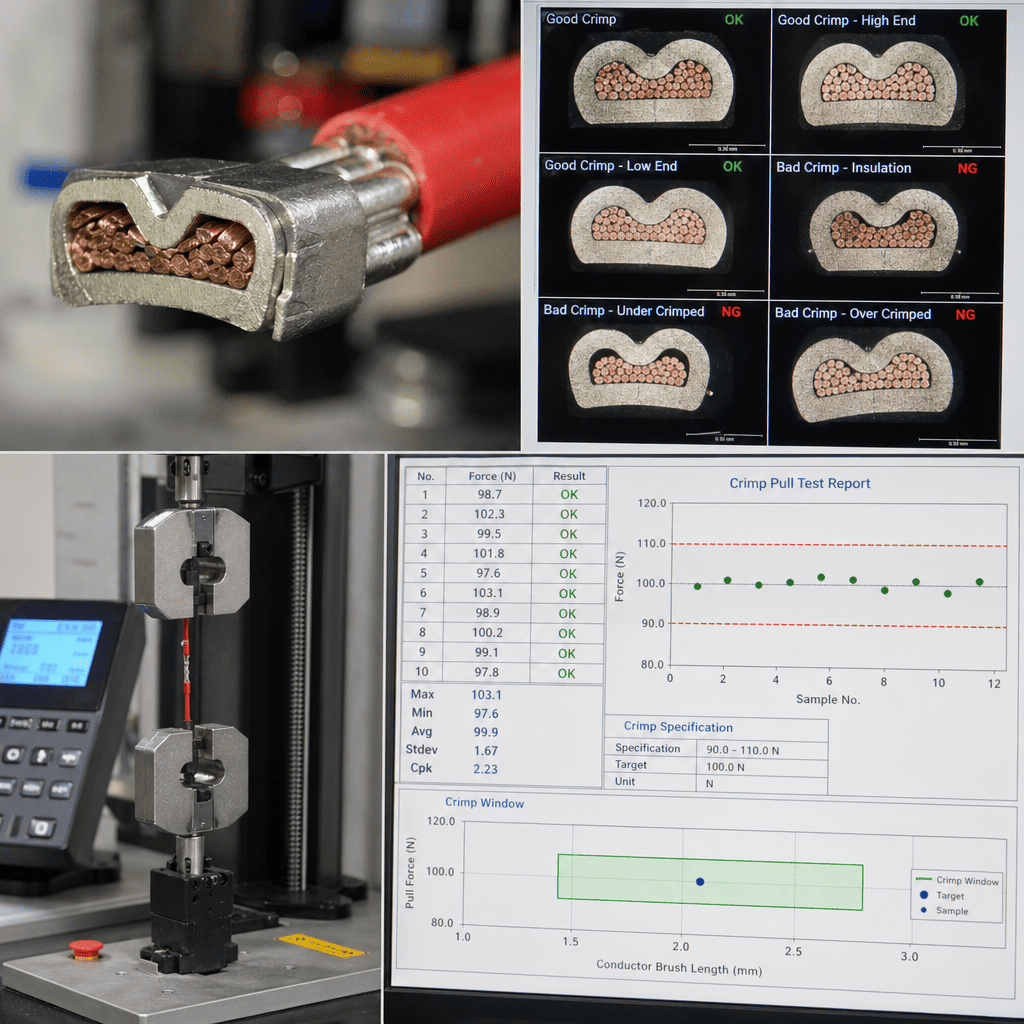
Make crimp control visible and verifiable
From the factory floor and my project files, crimp control is the lever that saves money. Here is what I ask my team to prepare for you at RFQ and sample stages, and why it works:
- Crimp Window Sheet
- Shows target, upper/lower force limits, and monitor settings per terminal and wire.
- Links to pull-test acceptance per IPC/your spec.
- Pull-Test Summary
- Shows min/avg/max by terminal and wire AWG across a sample lot.
- Flags any outliers with action taken.
- Microsection Set
- Clear photos with measurements of crimp height, width, bellmouth, and strand spread.
- At least one per set-up and after tool change.
- Tooling Care
- Crimper model and serial, applicator ID, last maintenance date, next due date.
- Calibration records for pull tester and crimp force monitor.11
| Artifact | What I show you | What you confirm | Result on TCO |
|---|---|---|---|
| Crimp window | Limits and control method | Limits meet your spec | Less drift, fewer line stops |
| Pull-test summary | Data by part and wire size | Forces meet or exceed minimum | Lower rework and returns |
| Microsections | Photos with dimensions and notes | Geometry matches acceptance | Stable quality in mass |
| Tooling maintenance | Dates, IDs, calibration list | Intervals fit your policy | Fewer surprises on long runs |
When I present these items early, buyers see the stability. They also see why a slightly higher unit price can win on total cost. I prefer this honest talk. It keeps projects safe.
How do I de-risk delivery with tooling and ramp planning?
Tooling lead times are real. So are material delays.12 I have seen a perfect plan miss ship dates because a jig took two extra weeks.
Make a dated tooling and ramp plan part of the RFQ. Tie it to your forecast. Add triggers for demand or material changes. Keep it live as we ramp.

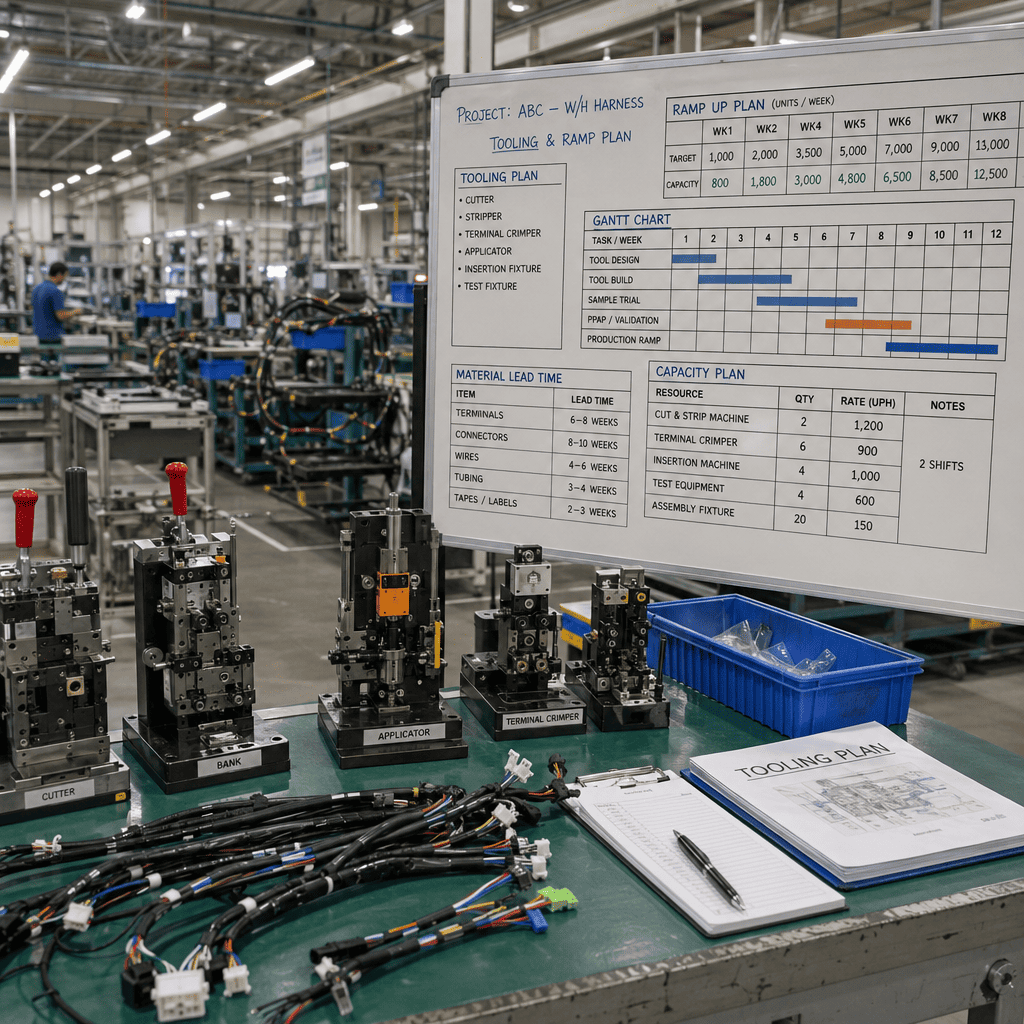
Treat tooling and ramp as a project, not a hope
From my ramp handovers, a simple, dated plan avoids last-minute surprises. I use this pattern with EU/US buyers who run multiple SKUs:
- Tooling Plan
- List each jig, fixture, applicator, and test box with design, build, and validation dates.
- Set owner names and backup options.
- Material Plan
- Show long-lead items: terminals, connectors, custom cables, labels with UL marks.
- Align PO dates to lead times and buffer needs.
- Capacity Plan
- Map stations, headcount, and batch cadence to your forecast.
- Add overflow plan for peaks and second shift options.
- Triggers and Escalation
- Define what happens if demand changes by ±20%.
- Set who decides and how fast we shift capacity or pull-in materials.
| Plan Area | What I map | Typical Range I see | What you get |
|---|---|---|---|
| Tooling | Design/build/validate dates per item | 1–6 weeks by item complexity | Clear dates and owners |
| Materials | Lead times and PO placement windows | 2–12 weeks by supplier | Aligned buys and buffers |
| Capacity | Stations, operators, hours, run-at-rate data | 1–3 weeks to ramp stable | Realistic start and growth plan |
| Triggers | Demand/material change rules | ±20% common trigger | Faster response when things move |
When we agree on this in RFQ, I can price and plan the truth. I can also protect your delivery dates with clear actions when things move. This is how I keep promises.
Conclusion
Pick proof over price. Set tests, gates, crimp control, and a dated ramp plan. Your total cost drops. Your delivery dates hold. Your customer stays happy.
"[PDF] IJUN 14 201 - DSpace@MIT", https://dspace.mit.edu/bitstream/handle/1721.1/73417/810338183-MIT.pdf?sequence=2&isAllowed=y. Quality-management literature on production process controls identifies defined inspection and test criteria as a way to reduce nonconforming output and downstream corrective action. Evidence role: expert_consensus; source type: paper. Supports: Incomplete test coverage in an RFQ can create later production problems, rework, or delays.. Scope note: This supports the general quality-control mechanism, not the author's specific project experience. ↩
"[PDF] INSPECTION BASICS FOR QUALITY ACCEPTANCE AND SAFETY ...", https://www.waketech.edu/sites/default/files/page-file-uploads/Quality%20Acceptance%20Inspection%20Basics%20Rev%205.pdf. ISO 9001 purchasing and production-control requirements emphasize defining product requirements, acceptance criteria, and records before or during supplier control activities. Evidence role: expert_consensus; source type: institution. Supports: Test coverage, acceptance limits, and record formats should be defined early in supplier engagement.. Scope note: ISO 9001 gives general supplier-control principles rather than wire-harness-specific RFQ instructions. ↩
"[PDF] nasa-std-8739.4a.pdf", https://s3vi.ndc.nasa.gov/ssri-kb/static/resources/nasa-std-8739.4a.pdf. Wire-harness workmanship standards and NASA cable-harness guidance describe electrical continuity testing as a required verification for assembled harnesses. Evidence role: expert_consensus; source type: government. Supports: Continuity testing is a standard verification step for wire harness assemblies.. Scope note: The source supports continuity testing as standard practice; it may not require 100% testing for every commercial SKU. ↩
"Dielectric withstand test - Wikipedia", https://en.wikipedia.org/wiki/Dielectric_withstand_test. Electrical safety and cable-test references define dielectric withstand, or hi-pot, testing by specified voltage, duration, and leakage-current criteria to verify insulation integrity. Evidence role: definition; source type: institution. Supports: Hi-pot testing for insulation-sensitive assemblies should specify voltage, dwell time, and leakage criteria.. Scope note: The source supports the parameters of hi-pot testing; applicability depends on product design and governing safety standard. ↩
"IPC/WHMA-A-620 requirements for crimped terminations", https://www.superengineer.net/blog/ipc-a-620-crimped-terminations. Crimp-connection standards specify tensile or pull-force testing and minimum acceptance values that vary by conductor size and terminal configuration. Evidence role: expert_consensus; source type: institution. Supports: Pull-test sampling and acceptance limits should be defined by terminal and wire type.. Scope note: Exact force limits and sampling frequency vary by standard, terminal manufacturer, and customer specification. ↩
"[PDF] WORKMANSHIP STANDARD FOR CRIMPING ... - NASA NEPP", https://nepp.nasa.gov/files/27631/nstd87394a.pdf. Crimp-quality guidance uses cross-section or microsection analysis to assess internal crimp geometry, strand distribution, compression, and related defects that are not fully visible externally. Evidence role: mechanism; source type: research. Supports: Microsection images are useful evidence for validating new terminal setups and tool changes.. Scope note: The source supports microsection analysis as a diagnostic or validation method; required frequency may be customer- or industry-specific. ↩
"Production part approval process - Wikipedia", https://en.wikipedia.org/wiki/Production_part_approval_process. First Article Inspection and Production Part Approval Process frameworks require documented evidence that production processes can meet design and customer requirements before full production release. Evidence role: expert_consensus; source type: institution. Supports: Production release should be based on documented FAI/PPAP evidence rather than acceptance of a single sample.. Scope note: FAI and PPAP are formalized most strongly in aerospace and automotive contexts; other industries may adapt them selectively. ↩
"(PDF) Production Part Approval Process (PPAP) Manual Level 2 ...", https://www.academia.edu/39357032/Production_Part_Approval_Process_PPAP_Manual_Level_2_Document_Rev_Date_Originator_Section_s_Change_Description. PPAP and advanced product quality planning practices commonly include control plans, process FMEA, tooling identification, and production-capacity or run-at-rate evidence as part of production readiness evaluation. Evidence role: definition; source type: institution. Supports: PFMEA, tooling identification, and run-at-rate planning are recognized production-readiness artifacts.. Scope note: The exact PPAP element set depends on submission level, customer-specific requirements, and industry sector. ↩
"[PDF] WORKMANSHIP STANDARD FOR CRIMPING ... - NASA NEPP", https://nepp.nasa.gov/files/27631/nstd87394a.pdf. Workmanship and reliability references note that visual inspection alone cannot fully verify crimp integrity because internal compression, strand capture, and gas-tight contact conditions may require mechanical testing or section analysis. Evidence role: mechanism; source type: government. Supports: A crimp can appear acceptable externally while still having internal or mechanical defects.. Scope note: The source supports the limitation of visual inspection generally; some severe crimp defects are visually detectable. ↩
"[PDF] QUALITY CRIMPING HANDBOOK Order No. 63800-0029 - Molex", https://www.molex.com/content/dam/molex/molex-dot-com/products/automated/en-us/commercialcrimpbookpdf/638/63800/TM-638000029-001.pdf. Crimp-process control guidance links validated crimp settings, tensile testing, cross-section evaluation, and maintained tooling to repeatable electrical and mechanical connection quality. Evidence role: expert_consensus; source type: institution. Supports: Crimp windows, pull-test data, microsections, and tooling records are relevant evidence for supplier qualification.. Scope note: The source supports these controls as quality practices; whether they are required before purchase order placement is a procurement-policy decision. ↩
"Metrological Traceability: Frequently Asked Questions and NIST Policy", https://www.nist.gov/metrology/metrological-traceability. Measurement-system standards require inspection and test equipment to be calibrated or verified at specified intervals against traceable standards when used to determine product conformity. Evidence role: expert_consensus; source type: institution. Supports: Pull testers and crimp-force monitors should have calibration records when used for acceptance decisions.. Scope note: The source supports calibration control generally; it does not prescribe a specific interval for every pull tester or crimp-force monitor. ↩
"Why Focusing on Lead Time—Not Just Efficiency—Drives Success", https://interpro.wisc.edu/lead-time-drives-manufacturing-success/. Supply-chain research and manufacturing planning literature describe tooling availability and component lead-time variability as common constraints affecting production start dates and delivery performance. Evidence role: general_support; source type: paper. Supports: Tooling and material lead times can affect production schedules and delivery reliability.. Scope note: This supports the general delivery-risk mechanism, not the specific lead-time ranges stated later in the article. ↩