When a potential customer sends us an RFQ for multiple wiring harnesses, we know speed and clarity matter. If we respond slowly or vaguely, they move on. If we deliver a structured quote, packaging data, and realistic lead times within 48 hours, we earn trust—and often the order.
To handle an RFQ for wiring harnesses effectively, provide EXW1 pricing for all SKUs within 24–48 hours, share packaging dimensions immediately to help freight estimates, state sample and mass production lead times clearly, and offer engineering notes on original versus equivalent components. Transparent communication and fast turnaround convert inquiries into orders.
Most new customers face the same challenge: they need a reliable supplier who can quote fast, manufacture to standard, and scale across many SKUs. This case walks you through exactly how we turned a 13‑SKU RFQ from Customer A into a sample order in just 12 days.
What Information Does a Complete RFQ for Wiring Harnesses Include?
An RFQ for wiring harnesses asks for pricing, lead times, quality certifications, and logistics data. Customers want to know if we can meet their volume, timeline, and cost targets before they invest time in sampling.
A complete RFQ for wiring harnesses includes part numbers or drawings, annual volumes, initial order quantities, lead-time requirements, quality standards such as IPC or ISO, commercial terms like EXW or FOB2, and packaging details for freight calculations. Complete RFQs help us quote accurately and fast.
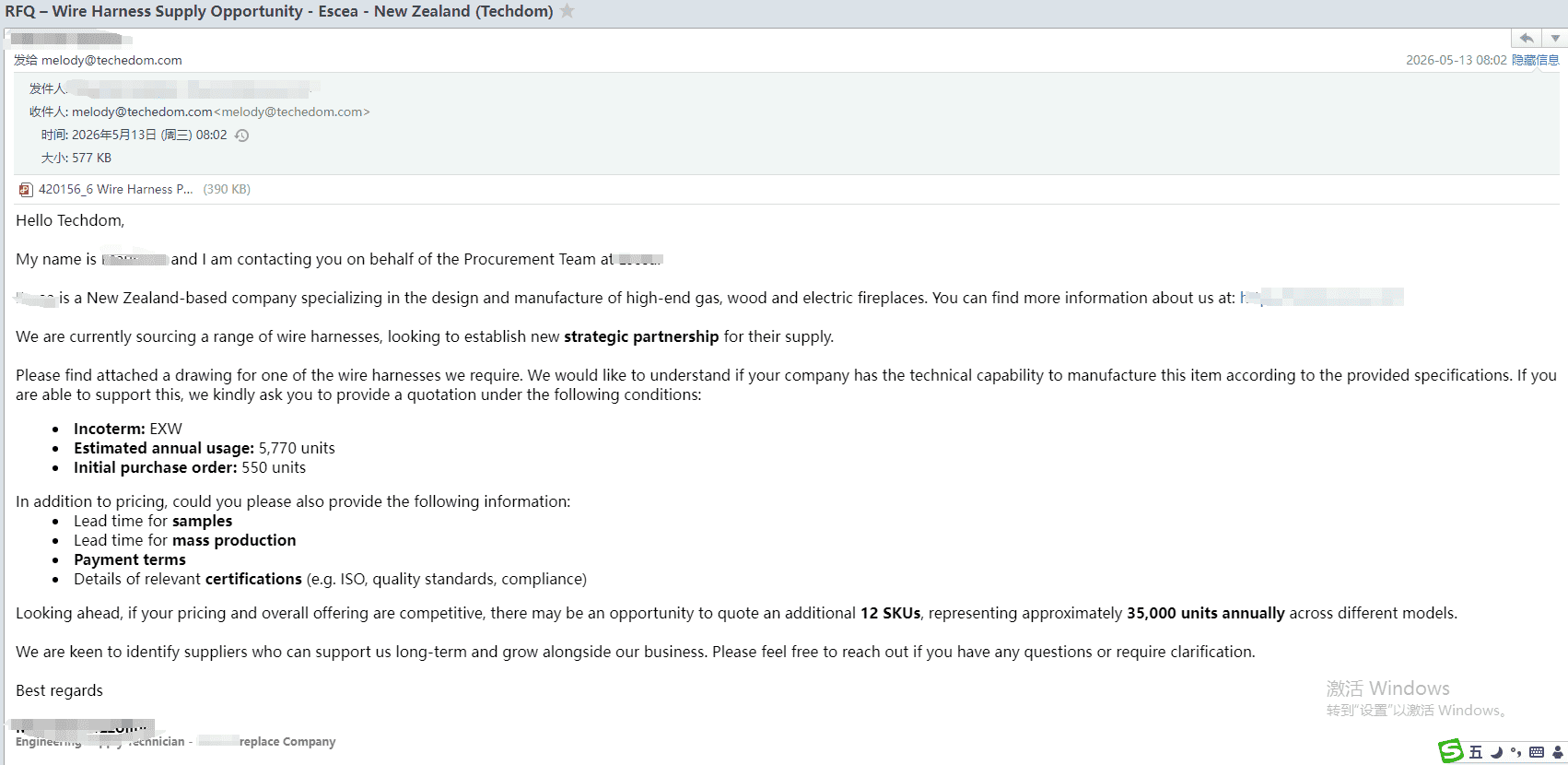
When Customer A sent us their request on May 13, they included 13 part numbers, annual usage per SKU, EXW Shenzhen as the commercial term, and specific asks about manufacturing standards. They also asked for packing dimensions and weight early, because they needed to model landed costs back home. That level of detail allowed us to respond in under 48 hours with a target SKU quote, then deliver the full 13‑SKU EXW pricing the next day.
We review every RFQ for six critical elements. First, we check the drawings or BOM to verify connector availability and cable specs. Second, we note annual and initial volumes to determine pricing tiers and MOQ. Third, we align our manufacturing schedule with their lead-time expectations—typically 1–2 weeks for samples and 3–5 weeks for mass production3. Fourth, we confirm which quality standards apply, such as IPC-6204 or ISO 90015. Fifth, we clarify commercial terms, quoting EXW by default unless they request FOB or CIF. Sixth, we share packaging specs immediately: box dimensions, pieces per carton, and gross weight, so they can run freight scenarios in parallel with engineering review.
Customer A's RFQ checked every box. They gave us clear part numbers, realistic volumes, and an open question: can we scale from 2 sample SKUs to 13 production SKUs if quality passes? That clarity let us build a structured response that addressed engineering, pricing, and logistics all at once. On May 15, two days after their initial inquiry, we sent the first quote and included sample lead time of 1–2 weeks and mass production lead time of 3–4 weeks. That same day, they asked for packaging info. We replied within hours: 150 pcs per box, 46×30×26 cm, approximately 13 kg gross weight.
How Quickly Should You Deliver the Full Multi‑SKU Quote?
Speed is a competitive advantage, but rushing a quote with missing data wastes everyone's time. We aim to quote within 48 hours for initial SKUs and within 24 hours for consolidated multi‑SKU packages once we have complete information.
You should deliver a full multi‑SKU wiring harness quote within 24–48 hours after receiving complete drawings and BOMs. Fast quoting shows reliability and keeps the customer's decision timeline on track. For multi‑SKU requests, provide a structured spreadsheet with part number, description, annual usage, reorder quantity, EXW price, lead time, and engineering notes in one document.
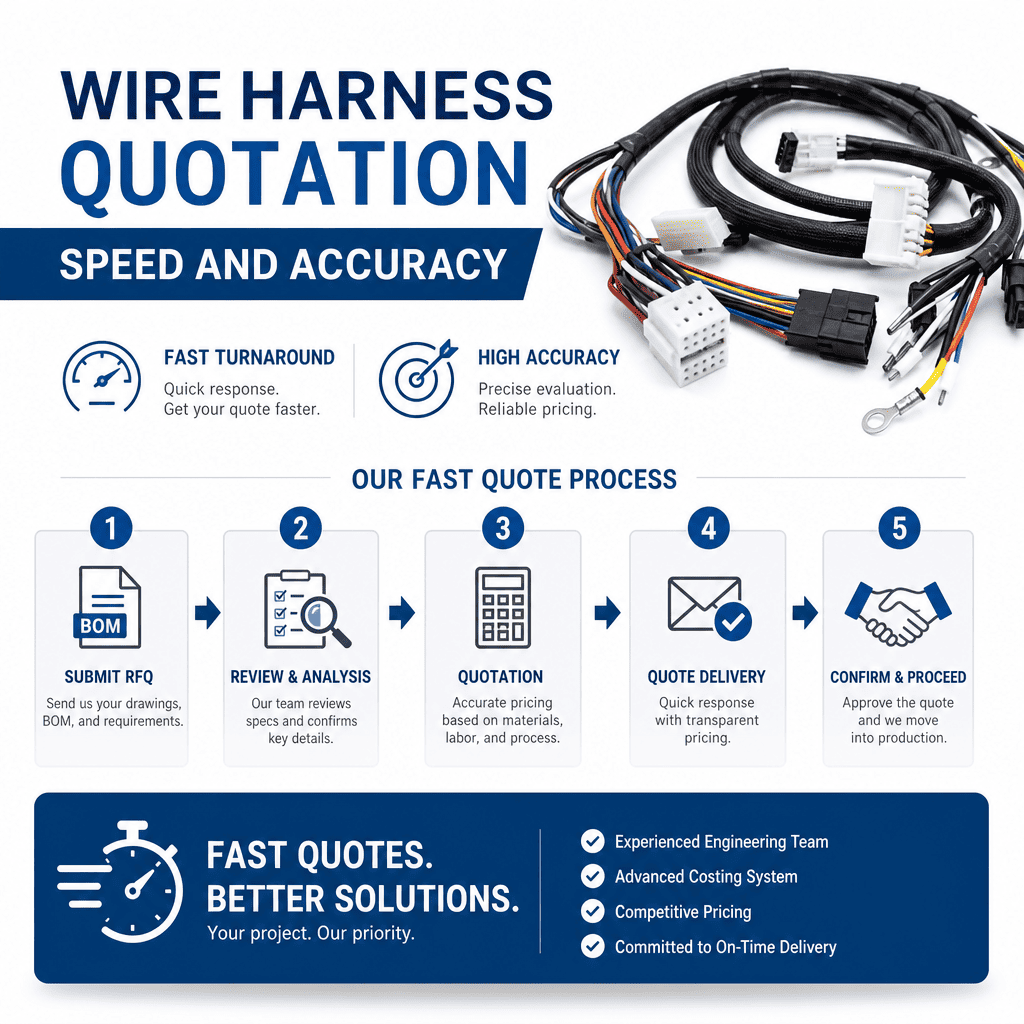
On May 18, Customer A requested the full 13‑SKU EXW quote. We delivered it by May 19—less than 24 hours later—with SKU-specific lead times ranging from 3 to 5 weeks depending on material availability. We structured the quote as a single Excel file with one row per SKU. Columns included part number, short description, annual usage, typical reorder qty, EXW price in USD, lead time in weeks, and a notes column flagging any engineering alternatives or long-lead components. At the top of the sheet, we repeated the key terms: EXW Shenzhen, payment by T/T with 30% deposit and 70% before shipment6, samples FOC for the first 2 SKUs.
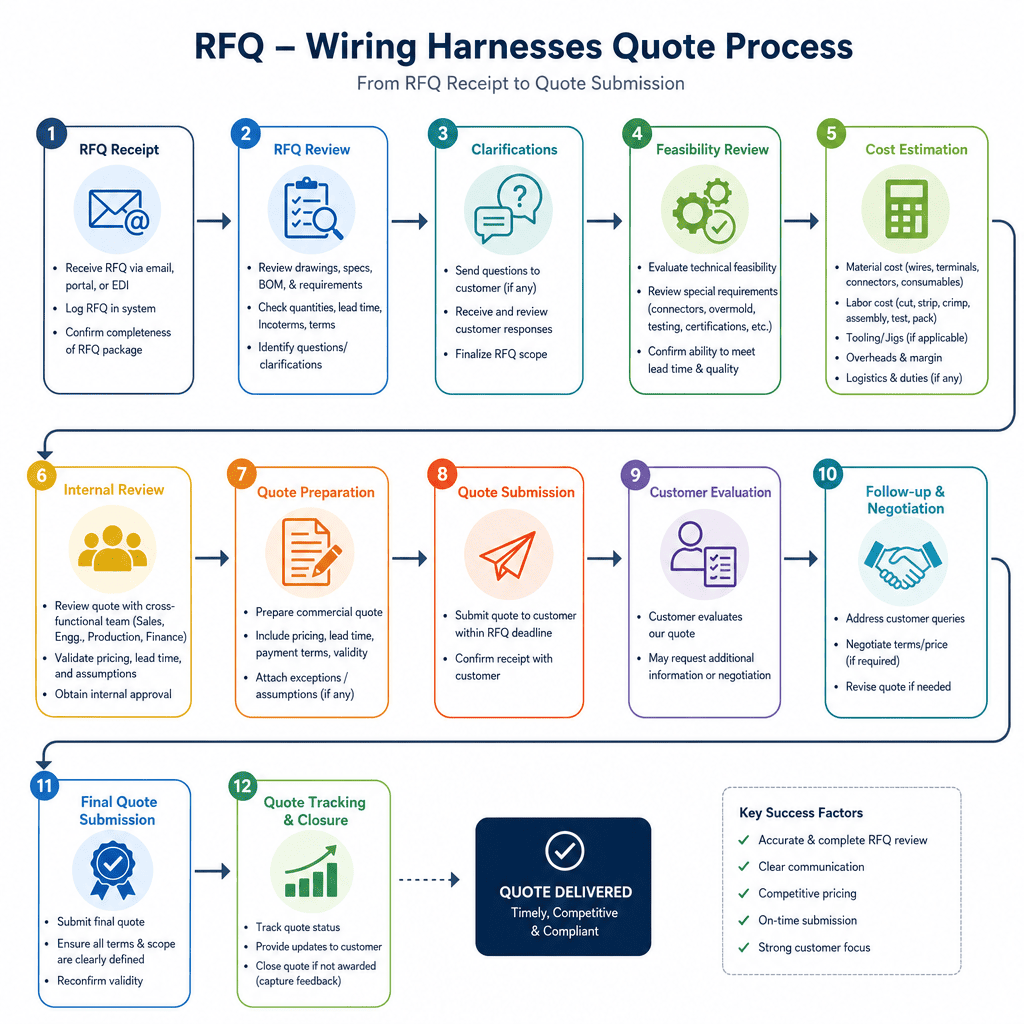
Our internal workflow runs in parallel tracks. Engineering validates drawings and checks component feasibility within 4 hours. Procurement verifies connector and terminal stock and flags lead times within 6 hours. The costing team calculates EXW pricing by volume tier within 12 hours. The project manager drafts the quote, adds engineering notes, and routes it for QA review. The entire cycle from RFQ receipt to quote delivery takes 24 to 48 hours. For Customer A, we noted in the quote that we could use original connectors with equivalent terminals where appropriate. This gave them flexibility: original connectors met their engineering spec, but equivalent terminals from approved manufacturers could lower cost and shorten lead time. That dual-path approach builds trust and shows we understand global sourcing realities.
What Sample Policy Closes the RFQ Fastest?
Customers want to validate quality before committing to volume orders. A clear sample policy—lead time, cost, and what's included—removes friction and speeds the qualification process.
Offer samples within 1–2 weeks of drawing and BOM approval. For new customers qualifying you as a supplier, consider free-of-charge samples for 2 sets per SKU. Include a verification package: BOM, drawing revision, certificate of conformance, continuity and hi-pot records7, pull-test data, visual inspection report, and optional microsection for crimp quality8.
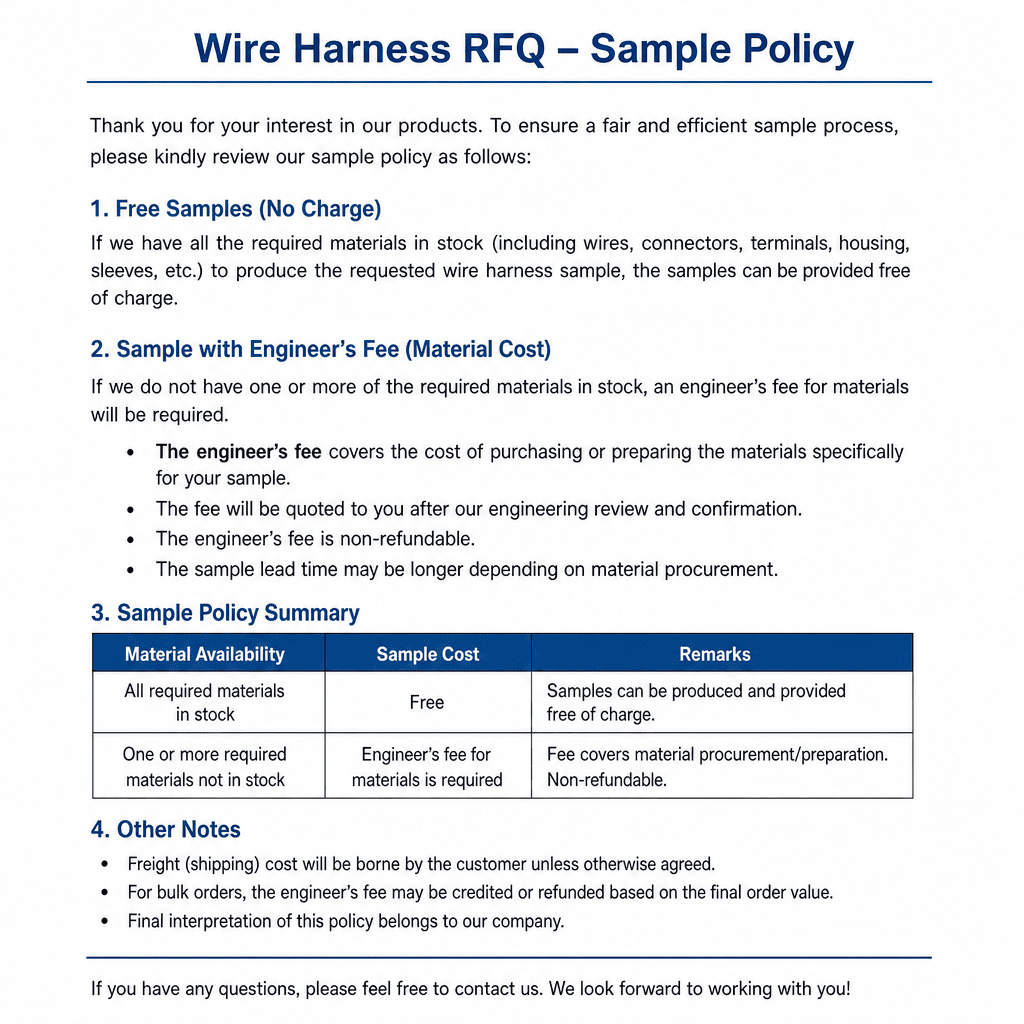
On May 25, Customer A confirmed they wanted to proceed to sampling for two SKUs. They asked about lead time and whether samples could be FOC. We replied that we could provide FOC samples for 2 sets of each SKU as part of mutual qualification, and that the lead time would be 1–2 weeks from drawing freeze. We also confirmed they could arrange their own pickup in Shenzhen, which saved them freight charges and sped delivery.
We completed the entire sample cycle in 10 days from drawing approval to ready-for-pickup. Each sample shipment included a verification package. First, we provided the BOM and drawing revision to confirm we built to the correct spec. Second, we attached a certificate of conformance showing RoHS and REACH compliance9. Third, we included continuity test records proving no open circuits. Fourth, we shared hi-pot test data confirming insulation integrity at rated voltage. Fifth, we documented pull-test results for each terminal per IPC-620 standards10. Sixth, we sent a visual inspection report with AQL pass/fail data11 and photos of the finished harnesses next to the reference drawing.
Customer A's quality team wanted to see pull-test data and visual inspection reports for both sample SKUs. We provided those documents within 3 days of sample shipment. This level of detail gave them confidence to approve the samples and move toward mass production for those two SKUs, with the remaining 11 SKUs queued for later qualification. The 2‑day margin in our sample schedule gave us buffer for any last-minute component substitution or re-crimp if a pull test failed, which keeps our on-time delivery rate above 95%12.
Conclusion
We turned Customer A's 13‑SKU RFQ into a sample order in 12 days by quoting fast, sharing packaging data immediately, offering FOC samples, and including full verification documentation. That process is now our standard playbook.
"Know Your Incoterms - International Trade Administration", https://www.trade.gov/know-your-incoterms. Ex Works (EXW), defined in Incoterms published by the International Chamber of Commerce, places minimum obligation on the seller, who makes goods available at their premises; the buyer assumes all costs and risks from that point, including loading, transportation, insurance, and customs clearance. Evidence role: definition; source type: institution. Supports: EXW (Ex Works) is an Incoterm defining seller and buyer responsibilities. ↩
"Know Your Incoterms - International Trade Administration", https://www.trade.gov/know-your-incoterms. Free on Board (FOB), defined in Incoterms, requires the seller to deliver goods on board the vessel nominated by the buyer at the named port of shipment; risk transfers when goods are on board, and the seller bears costs and risks until that point, unlike EXW where transfer occurs at the seller's premises. Evidence role: definition; source type: institution. Supports: FOB (Free on Board) is an Incoterm with different risk transfer than EXW. ↩
"Why Focusing on Lead Time—Not Just Efficiency—Drives Success", https://interpro.wisc.edu/lead-time-drives-manufacturing-success/. Custom wire harness and cable assembly manufacturers typically quote 1-2 weeks for prototype or sample production and 3-6 weeks for volume production, depending on component availability and complexity; lead times vary by connector sourcing, wire specifications, and assembly complexity. Evidence role: general_support; source type: research. Supports: Short sample lead times and 3-5 week production cycles are common in custom cable assembly. Scope note: Lead time benchmarks vary significantly by product complexity, component availability, and manufacturer capacity; the cited range represents typical scenarios rather than guaranteed standards. ↩
"IPC-620 Wire Harness Assembly and Inspection | Long Beach City ...", https://programmap.lbcc.edu/academics/interest-clusters/40e8babd-d8af-4a5e-91ee-2b5b24544be8/programs/f3c46c18-e7b5-42d2-5377-885aaf3a3c82. IPC/WHMA-A-620, developed jointly by IPC and the Wire Harness Manufacturers Association, establishes acceptability criteria for cable and wire harness assemblies including crimping, soldering, and assembly workmanship; the standard is widely adopted in electronics manufacturing for quality assurance. Evidence role: definition; source type: institution. Supports: IPC-620 (IPC/WHMA-A-620) is an industry standard for cable and wire harness assemblies. ↩
"ISO 9001:2015 - Quality management systems — Requirements", https://www.iso.org/standard/62085.html. ISO 9001, published by the International Organization for Standardization, specifies requirements for quality management systems and is applicable to organizations in any industry, including manufacturing; certification demonstrates systematic approaches to meeting customer and regulatory requirements. Evidence role: definition; source type: institution. Supports: ISO 9001 is an internationally recognized quality management standard. ↩
"Methods of Payment - International Trade Administration", https://www.trade.gov/methods-payment. International manufacturing transactions commonly use payment structures requiring 30-50% deposit upon order confirmation and the balance before shipment or against shipping documents; this approach manages risk for both parties when letter of credit terms are not used, though specific percentages vary by relationship, order value, and negotiation. Evidence role: general_support; source type: other. Supports: Deposit and balance-before-shipment payment structures are common in international manufacturing. Scope note: Payment terms vary widely based on buyer-supplier relationship, order size, credit history, and negotiating power; the 30/70 split represents one common structure but is not a universal standard. ↩
"DIY: Testing for Continuity with a Multimeter - YouTube",
. Continuity testing verifies complete electrical paths and detects open circuits in wire assemblies, while hi-pot (high-potential) testing applies voltage above the rated level to verify insulation integrity and detect potential breakdown points; both tests are standard quality control procedures in cable and harness manufacturing. Evidence role: mechanism; source type: education. Supports: Continuity and hi-pot testing are electrical verification methods used in cable assembly quality control. ↩"Micrograph: The inner values of a crimp - Wiring Harness News", https://wiringharnessnews.com/micrograph-the-inner-values-of-a-crimp/. Microsection analysis involves cutting, mounting, polishing, and microscopically examining a cross-section of a crimped terminal to evaluate wire strand compression, metal-to-metal contact area, insulation support, and potential defects such as strand breakage or incomplete crimp; this destructive test provides detailed quality verification beyond electrical testing. Evidence role: mechanism; source type: education. Supports: Microsectioning is a destructive analysis technique for crimp connections. ↩
"EU REACH - International Trade Administration", https://www.trade.gov/eu-reach. RoHS (Restriction of Hazardous Substances) restricts lead, mercury, cadmium, and other hazardous materials in electrical and electronic equipment sold in the EU, while REACH (Registration, Evaluation, Authorization and Restriction of Chemicals) regulates chemical substances; both frameworks require manufacturers to demonstrate compliance through documentation and testing. Evidence role: definition; source type: government. Supports: RoHS and REACH are European regulatory frameworks restricting hazardous substances. ↩
"IPC/WHMA-A-620 requirements for crimped terminations", https://www.superengineer.net/blog/ipc-a-620-crimped-terminations. IPC/WHMA-A-620 specifies minimum pull force requirements for crimped terminals based on wire gauge and terminal type, with acceptance criteria that verify mechanical integrity of the crimp connection; pull testing is a required verification method for Class 2 and Class 3 assemblies. Evidence role: mechanism; source type: institution. Supports: IPC-620 includes pull-test specifications for crimped terminals. ↩
"Acceptable quality limit - Wikipedia", https://en.wikipedia.org/wiki/Acceptable_quality_limit. Acceptable Quality Limit (AQL), standardized in ISO 2859 and ANSI/ASQ Z1.4, defines the maximum percentage of defects considered acceptable in a production lot; AQL sampling plans specify how many units to inspect and the maximum allowable defects for lot acceptance, balancing inspection cost with quality assurance. Evidence role: definition; source type: institution. Supports: AQL is a statistical sampling method for quality acceptance decisions. ↩
"Top On Time Delivery Performance Metrics Every Manufacturer ...", https://www.lillyworks.com/blog/top-on-time-delivery-performance-metrics-every-manufacturer-should-track/. Manufacturing industry benchmarks for on-time delivery (OTD) vary by sector, with high-performing electronics and component manufacturers typically achieving 95-98% OTD rates; factors affecting OTD include supply chain stability, production planning accuracy, and buffer management. Evidence role: general_support; source type: research. Supports: On-time delivery rates above 95% represent strong performance in manufacturing. Scope note: On-time delivery benchmarks vary significantly by industry segment, product complexity, and how 'on-time' is defined; the 95% threshold represents strong performance but is not a universal standard. ↩