You see "HDMI AOC" in a product list or cable specification, and you wonder if it is just another marketing name or if it actually means something that matters for your project. The confusion is real because most HDMI cables look similar on the outside, but the technology inside can be very different.
AOC in an HDMI cable means Active Optical Cable. It is an HDMI cable that uses optical fiber and built-in active electronics to transmit video and audio signals, instead of relying only on copper wire conductors like ordinary HDMI cables do.
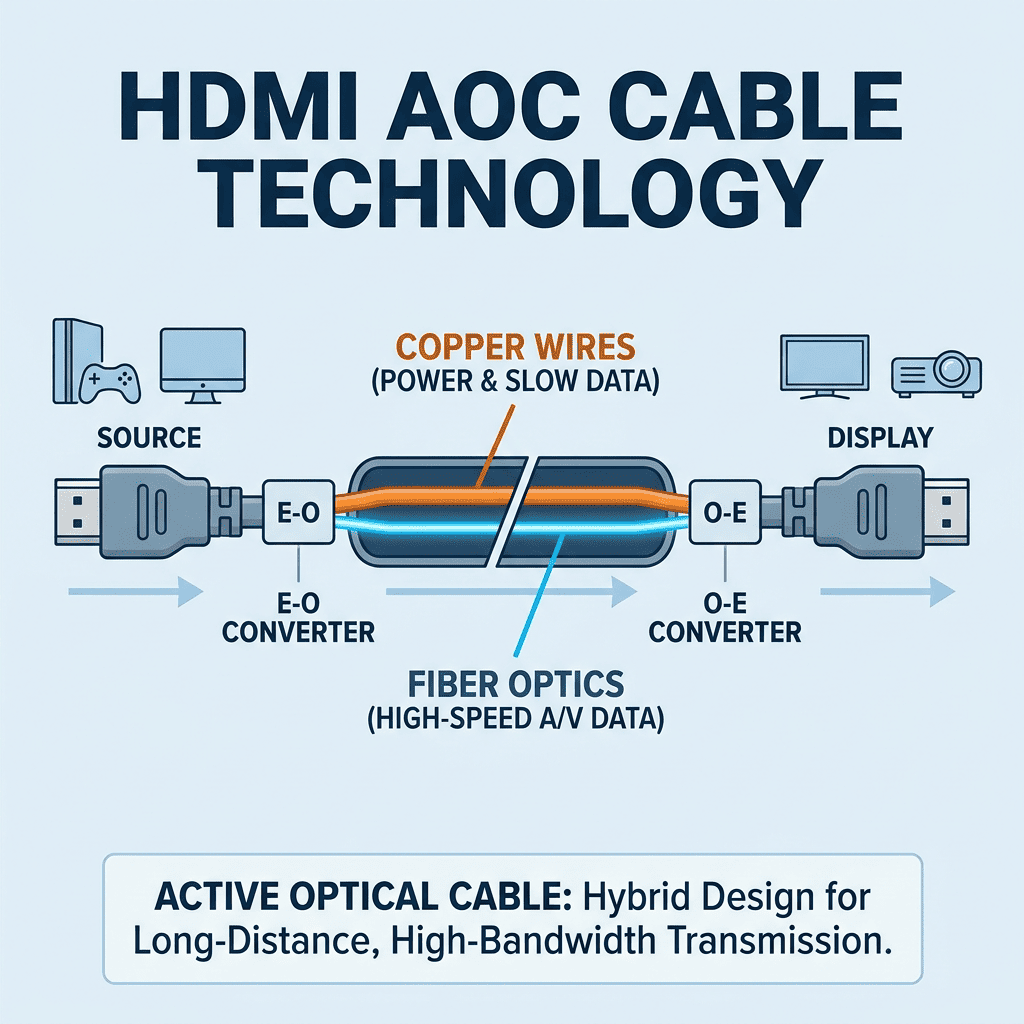
The real question is not just what AOC means, but whether your HDMI installation actually needs it. Let me walk you through the decision logic I use when I help customers choose between different HDMI cable types for their projects.
Why does HDMI AOC exist if ordinary HDMI cables already work?
You already know that standard HDMI cables work fine for most home and office setups. So why did manufacturers create HDMI AOC in the first place? The answer is simple: distance and signal integrity.
HDMI AOC exists because ordinary copper HDMI cables struggle with long-distance transmission. When you need to run HDMI signal beyond 10 to 15 meters reliably, copper conductors face signal degradation1, and AOC solves this by converting electrical signals into light pulses that travel through optical fiber.
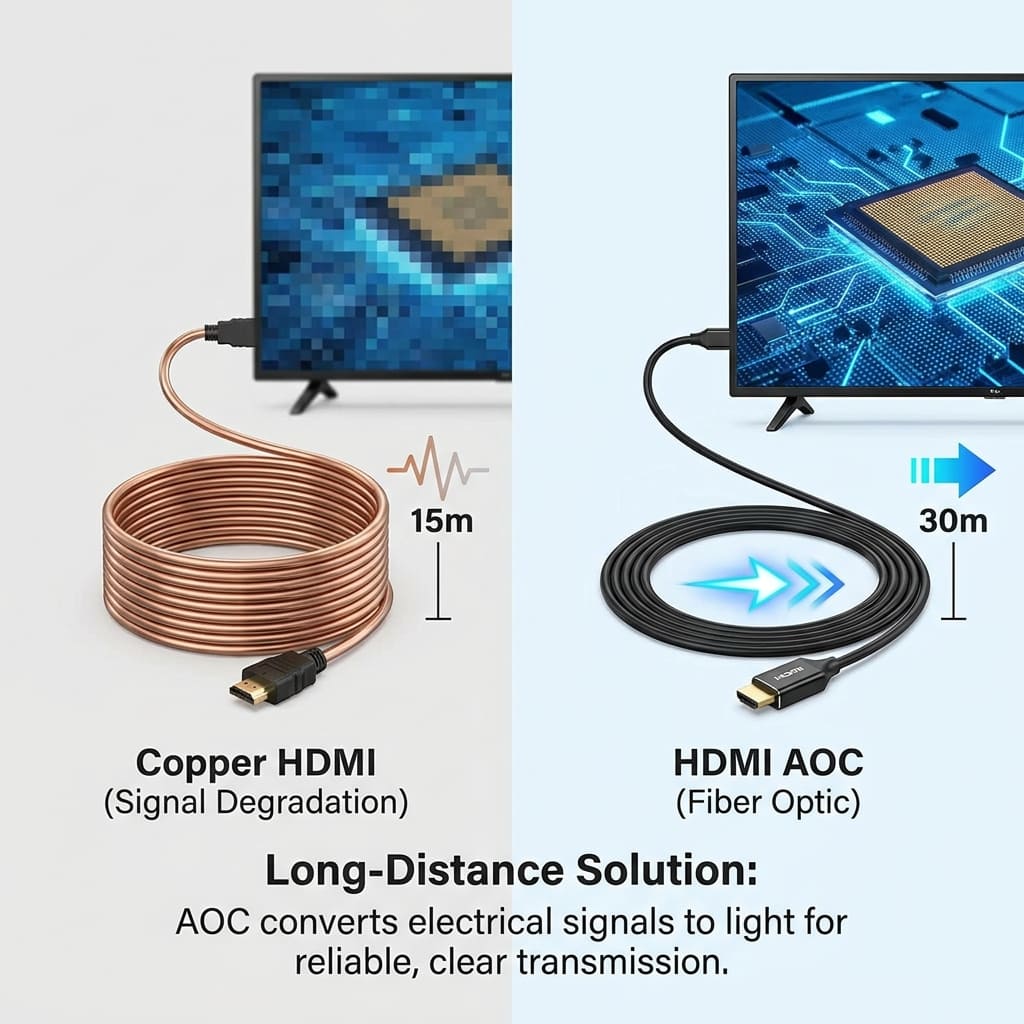
I work with customers who install display systems in conference rooms, digital signage networks, and equipment integration projects. Many of them first try standard copper HDMI cables because the price is lower. But when the cable run exceeds 10 meters, they start seeing problems: flickering screens, signal drop, or no display at all. This is where HDMI AOC becomes relevant.
How does distance affect copper HDMI cables?
Copper conductors have electrical resistance. The longer the cable, the more resistance the signal faces. For HDMI, which carries high-bandwidth video data, this resistance weakens the signal. Beyond a certain distance, the signal becomes too weak or distorted for the receiving device to process correctly.
Standard passive copper HDMI cables work reliably up to about 5 to 7 meters for 4K resolution2. Some thicker cables with better shielding can reach 10 to 12 meters, but beyond that, you need active signal boosting or a different transmission method.
What makes optical fiber different?
Optical fiber transmits data as light, not electricity. Light does not suffer from electrical resistance in the same way3. This means optical fiber can carry HDMI signal much farther without degradation. HDMI AOC cables use optical fiber for the main data transmission, with small active circuits at both ends to convert electrical HDMI signals into light at the source, and convert light back into electrical signals at the destination.
This is why HDMI AOC cables can reach 30, 50, or even 100 meters without signal loss4, while maintaining full 4K or 8K resolution and high refresh rates.
| Cable Type | Maximum Reliable Distance (4K) | Signal Transmission Method | Active Components |
|---|---|---|---|
| Standard Copper HDMI | 5-10 meters | Electrical through copper | No |
| Active Copper HDMI | 10-15 meters | Electrical with signal boost | Yes (one or both ends) |
| HDMI AOC (Active Optical) | 30-100+ meters | Optical fiber with electrical conversion | Yes (both ends) |
Should I choose HDMI AOC for my installation?
This is the question I hear most often from distributors and equipment buyers. They want to know if HDMI AOC is always better, or if ordinary HDMI cables are still good enough. The answer depends on your specific installation scenario.
You should choose HDMI AOC when your HDMI cable run is longer than 10 to 15 meters, when you need consistent signal quality for commercial or professional installations, or when your installation environment makes copper cables impractical. For short, simple connections under 5 meters, standard copper HDMI cables are usually sufficient.
I do not recommend HDMI AOC for every project. It costs more than standard copper HDMI cables, and for short-distance connections, the extra cost does not give you any real benefit. If you are connecting a laptop to a monitor on the same desk, or a streaming device to a TV in a living room, standard copper HDMI works perfectly well.
When does HDMI AOC become necessary?
From my experience working with equipment integrators and commercial installation projects, HDMI AOC becomes necessary in these situations:
Long-distance installations: When you need to connect a video source to a display that is 15 meters or more away. This is common in conference rooms, auditoriums, retail signage, and building-wide display systems.
High-resolution requirements over distance: If your project requires 4K at 60Hz or 8K resolution, and the cable run is longer than 10 meters, copper cables may not maintain the bandwidth. HDMI AOC handles high bandwidth over long distances without compromise.
Thin, flexible cable needs: Optical fiber is thinner and lighter than thick copper conductors. If your installation requires cable to run through narrow conduits, wall cavities, or around tight corners, HDMI AOC cables are easier to route.
Electrical isolation: Optical fiber does not conduct electricity5. In environments where electrical interference, ground loops6, or lightning protection matters, HDMI AOC provides natural isolation between source and display.
When is standard copper HDMI still the right choice?
Standard copper HDMI cables remain the best choice for short-distance connections. If your HDMI run is under 5 meters, copper cables are more cost-effective, easier to source, and simpler to replace if needed. They also do not require external power, which makes installation easier in some cases.
I also recommend copper HDMI when you need easy field termination or repair. HDMI AOC cables are factory-terminated with active modules at both ends. If a connector breaks, you usually need to replace the entire cable. Copper HDMI cables can sometimes be repaired or re-terminated more easily.
What should I check before buying HDMI AOC?
Once you decide that HDMI AOC fits your installation needs, you still need to check several specifications to make sure the cable works for your project. Not all HDMI AOC cables are the same, and choosing the wrong specification can lead to compatibility or performance issues.
Before buying HDMI AOC, check the cable length, HDMI version support, resolution and refresh rate specifications, power requirements, and connector orientation. These factors directly affect whether the cable works reliably in your installation.
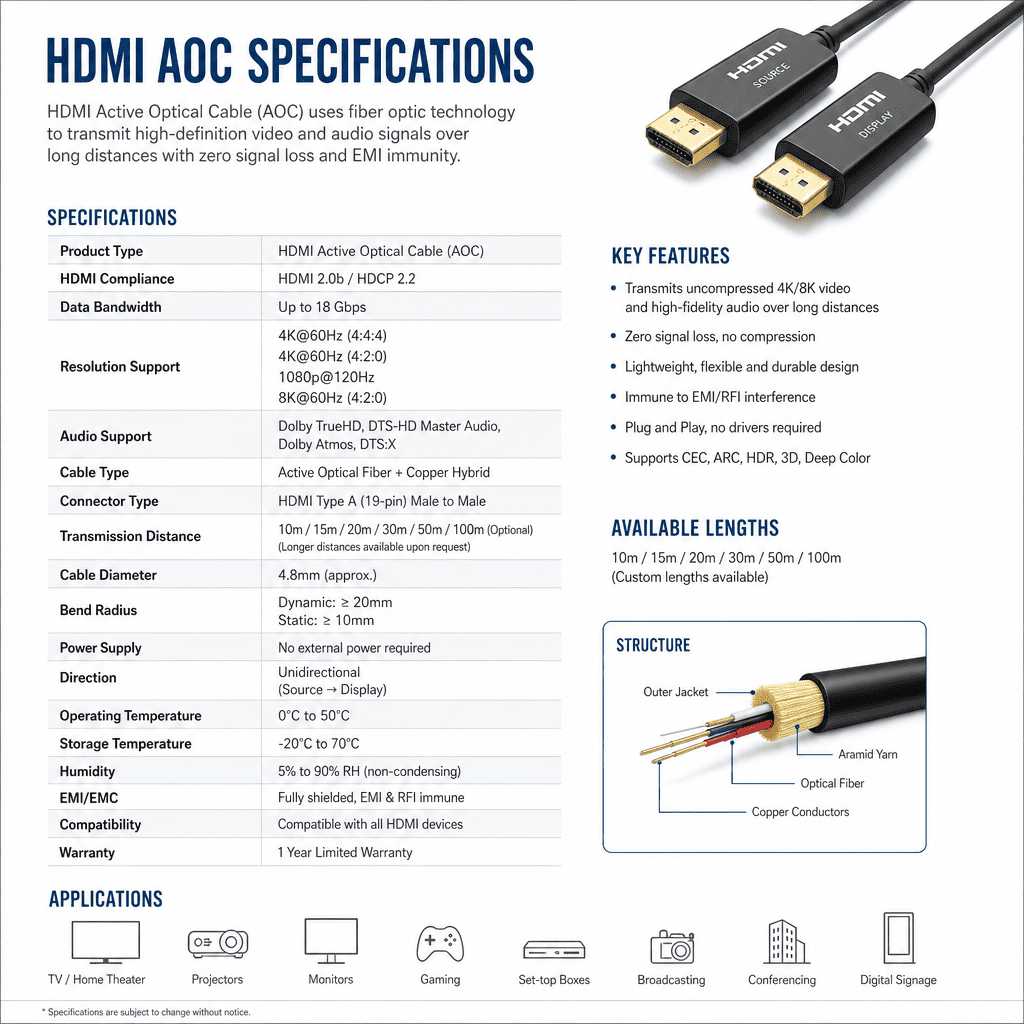
I have seen customers buy HDMI AOC cables that were too short, too long, or incompatible with their equipment's HDMI version. These mistakes are avoidable if you check the specifications carefully before ordering.
Cable length and installation planning
HDMI AOC cables are manufactured in fixed lengths. Unlike copper cables, which you can sometimes cut and re-terminate in the field, optical cables must be factory-terminated. This means you need to measure your cable route accurately before ordering.
When I help customers plan cable runs, I always recommend adding 10 to 15 percent extra length to account for routing around obstacles, connector reach, and future flexibility. If your measured run is 30 meters, order a 35-meter cable. The extra length prevents installation headaches.
HDMI version and bandwidth support
HDMI AOC cables support different HDMI versions, just like copper cables. The HDMI version determines the maximum resolution, refresh rate, and feature support. Common HDMI versions you will see in AOC cables include HDMI 2.0 and HDMI 2.1.
HDMI 2.0 supports 4K at 60Hz7, which is sufficient for most commercial display and conference room applications. HDMI 2.1 supports higher bandwidth, including 4K at 120Hz, 8K at 60Hz8, and advanced features like Variable Refresh Rate (VRR)9 and Enhanced Audio Return Channel (eARC)10.
If your source and display equipment both support HDMI 2.1, and you need those features, make sure the HDMI AOC cable you buy also supports HDMI 2.1. Otherwise, you will not get the full performance your equipment can deliver.
Power requirements and connector modules
HDMI AOC cables have active electronics at both ends. These modules need power to operate. Most HDMI AOC cables draw power from the HDMI port itself, using the HDMI standard's built-in power supply pins11. This is the most convenient option because you do not need external power adapters.
However, some HDMI AOC cables, especially very long ones, may require external power at one or both ends. Before buying, check whether the cable needs external power, and make sure you have power outlets available at the installation locations if needed.
Connector orientation and installation space
HDMI AOC cable connectors are often larger than standard HDMI plugs because they house the active conversion modules. Some connectors are straight, some are angled. Check the connector design and orientation before ordering, especially if you need to install the cable in tight spaces behind wall-mounted displays or in equipment racks.
I have seen installation projects delayed because the HDMI AOC connector did not fit into the recessed HDMI port on the back of a display. Checking connector dimensions and orientation in advance avoids these problems.
Is HDMI AOC more reliable than copper HDMI for commercial projects?
Reliability is a major concern for commercial and professional installations. When you install cables in walls, ceilings, or conduits, you do not want to replace them frequently. So the question becomes: is HDMI AOC more reliable than copper HDMI over the long term?
HDMI AOC is generally more reliable than long copper HDMI cables for commercial installations because optical fiber is immune to electrical interference, does not degrade over long distances, and performs consistently over time. However, HDMI AOC cables have active electronics that can fail, so cable quality and manufacturer reputation matter.
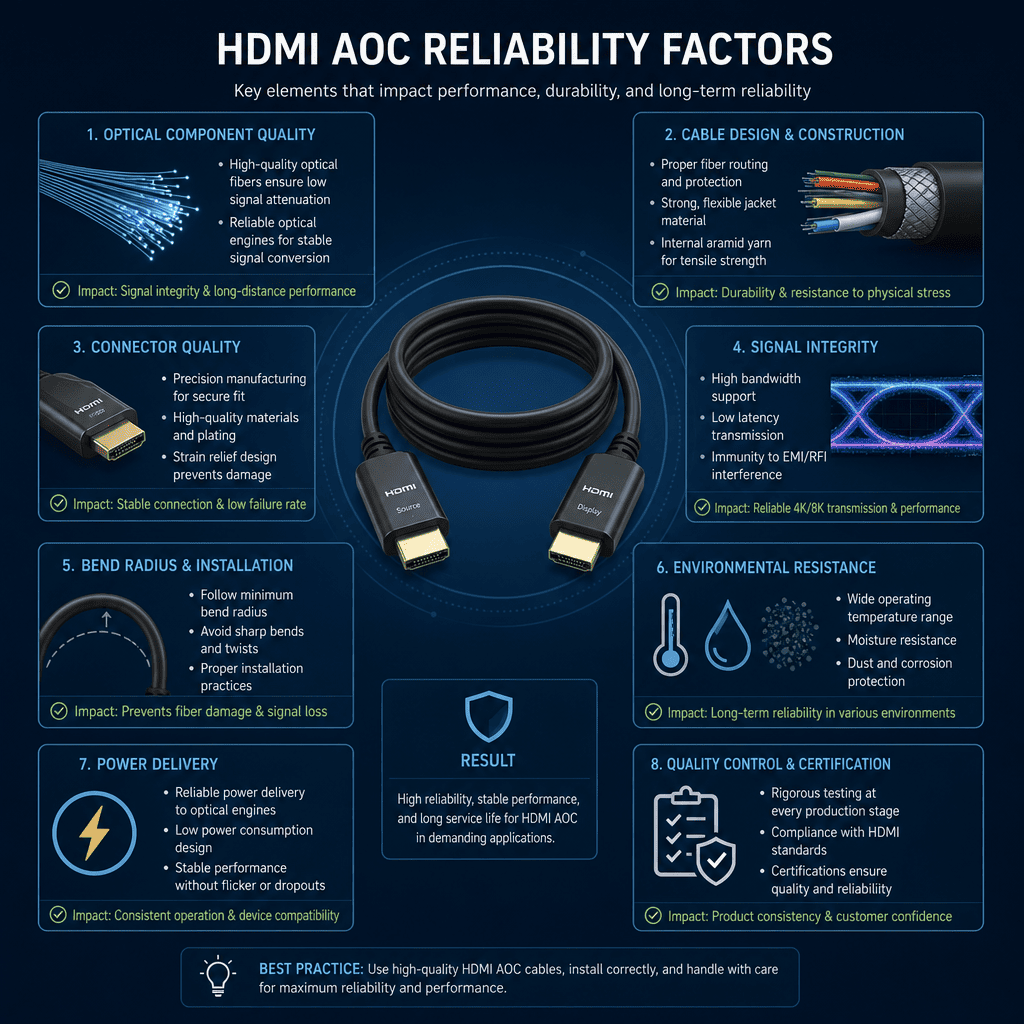
In my work with commercial projects, I have seen both copper and AOC HDMI cables succeed and fail. Reliability depends on cable quality, installation conditions, and proper specification matching. Let me break down the reliability factors for HDMI AOC.
Immunity to electrical interference
Optical fiber does not conduct electricity, so it is immune to electromagnetic interference (EMI) and radio frequency interference (RFI). In commercial buildings, HDMI cables often run near power cables, fluorescent lights, motors, and other sources of electrical noise. Copper HDMI cables can pick up interference from these sources, causing signal degradation or display issues. HDMI AOC does not have this problem.
This is especially important in industrial environments, hospitals, and buildings with complex electrical systems. If your installation environment has high electrical noise, HDMI AOC provides more reliable signal transmission than copper.
Active electronics and potential failure points
HDMI AOC cables contain active electronics at both ends. These modules include optical transmitters, receivers, and signal processing chips. Any active electronic component can fail. This means HDMI AOC cables have more potential failure points than passive copper HDMI cables.
However, quality HDMI AOC cables from reputable manufacturers use reliable components and proper design, so failure rates are low in normal use. The key is to buy from manufacturers who test their cables properly and stand behind their products with reasonable warranties.
Installation handling and cable durability
Optical fiber inside HDMI AOC cables is more fragile than copper wire. If you bend the cable too sharply, crush it, or pull it too hard during installation, you can damage the optical fiber. Once the fiber is damaged, the cable stops working.
This is why proper installation handling matters. I always remind installation teams to follow the cable's minimum bend radius12 specifications and avoid excessive pulling force. With proper handling, HDMI AOC cables are durable and reliable.
Where can I find HDMI AOC options for my project?
If you are planning a long HDMI run for commercial displays, conference rooms, equipment integration, or project cabling, you now understand when HDMI AOC makes sense and what to check before buying. The next step is finding the right HDMI AOC cable options that match your project requirements.
If you are comparing HDMI cable options for a longer run or project installation, you can review our AOC HDMI fiber optic cable options here: https://techedom.com/hdim-fiber-optic-cable/
I work directly with factory and technical colleagues who can help check product details, confirm specifications, and support custom length or connector requirements for commercial and integration projects. If your project needs more than standard off-the-shelf cables, we can discuss options that fit your specific installation conditions.
Conclusion
HDMI AOC means Active Optical Cable, and it solves long-distance HDMI transmission challenges that copper cables cannot handle reliably. Choose HDMI AOC when your installation needs it, not just because it sounds advanced. Match the cable specifications to your project requirements, and you will get reliable performance.
"Maximizing HDMI Cable Length Without Sacrificing Quality - cabletime", https://cabletimetech.com/blogs/knowledge/maximizing-hdmi-cable-length-without-sacrificing-quality?srsltid=AfmBOorOpJoNIlSEsfUxNn_vv_-zRgXP7eEcAzMJ_RD3vVhBbLJZfMXM. Copper conductors exhibit increasing electrical resistance with length, causing signal attenuation in high-bandwidth applications like HDMI, with degradation becoming significant beyond certain distances depending on conductor gauge and signal frequency. Evidence role: mechanism; source type: research. Supports: the relationship between copper conductor length and HDMI signal degradation. Scope note: The exact distance threshold varies by cable quality, resolution, and HDMI version rather than being a universal 10-15 meter limit. ↩
"HDMI - Wikipedia", https://en.wikipedia.org/wiki/HDMI. HDMI cable performance depends on bandwidth requirements, with higher resolutions requiring shorter cable lengths or active signal processing to maintain signal integrity within acceptable bit error rates. Evidence role: general_support; source type: institution. Supports: distance limitations for passive HDMI cables at 4K resolution. Scope note: Official HDMI specifications do not mandate specific maximum lengths, as performance depends on cable construction quality and testing methodology. ↩
"Four Key Benefits of Fiber Optic Transmission - ATEN", https://www.aten.com/us/en/resources/feature-articles/4-key-benefits-fiber-optic-transmission/. Optical fibers transmit data as light pulses through glass or plastic medium, avoiding the electrical resistance and electromagnetic interference that affect copper conductors, though optical signals experience different attenuation mechanisms such as absorption and scattering. Evidence role: mechanism; source type: encyclopedia. Supports: the fundamental difference between optical and electrical signal transmission regarding resistance. ↩
"How Long Can an HDMI Cable Be? - HDMI Cable Max Length", https://www.cablematters.com/Blog/HDMI/how-long-can-an-hdmi-cable-be?srsltid=AfmBOop7tfpM4HtrDwEOpt4uFE-3yc90HXuJ5qSEPCZARDncKt7OMKBk. Active optical cables using fiber optic transmission can support significantly longer distances than passive copper cables for high-bandwidth video signals, with actual maximum distance depending on optical transceiver power, fiber quality, and signal processing implementation. Evidence role: general_support; source type: research. Supports: extended transmission distances achievable with active optical HDMI cables. Scope note: Specific distance claims vary by manufacturer and product design rather than being standardized across all HDMI AOC implementations. ↩
"Optical fiber - Wikipedia", https://en.wikipedia.org/wiki/Optical_fiber. Optical fibers are typically made from glass (silica) or plastic materials that are electrical insulators, providing inherent electrical isolation between connected devices and immunity to electromagnetic interference. Evidence role: definition; source type: encyclopedia. Supports: the non-conductive property of optical fiber. ↩
"Ground loop (electricity) - Wikipedia", https://en.wikipedia.org/wiki/Ground_loop_(electricity). Ground loops occur when multiple electrical devices are connected through signal cables and have different ground potentials, creating unwanted current flow that can introduce noise, hum, or interference in audio and video signals. Evidence role: definition; source type: education. Supports: the nature of ground loops as an electrical interference phenomenon. ↩
"HDMI - Wikipedia", https://en.wikipedia.org/wiki/HDMI. HDMI 2.0 specification, released in 2013, increased bandwidth to 18 Gbps, enabling support for 4K resolution (3840×2160) at 60 frames per second with 8-bit color depth. Evidence role: statistic; source type: institution. Supports: the resolution and refresh rate capabilities of HDMI 2.0. ↩
"HDMI - Wikipedia", https://en.wikipedia.org/wiki/HDMI. HDMI 2.1 specification, announced in 2017, increased maximum bandwidth to 48 Gbps, enabling support for 8K resolution at 60Hz and 4K at 120Hz, along with additional features like Variable Refresh Rate and enhanced Audio Return Channel. Evidence role: statistic; source type: institution. Supports: the enhanced resolution and refresh rate capabilities of HDMI 2.1. ↩
"Variable refresh rate - Wikipedia", https://en.wikipedia.org/wiki/Variable_refresh_rate. Variable Refresh Rate (VRR) is an HDMI 2.1 feature that allows the display's refresh rate to synchronize dynamically with the source device's frame rate, reducing screen tearing and stuttering particularly in gaming applications. Evidence role: definition; source type: institution. Supports: Variable Refresh Rate as an HDMI 2.1 feature. ↩
"HDMI 2.1 eARC Technology - Lattice Semiconductor", https://www.latticesemi.com/en/Solutions/Solutions/Standards/HDMI21eARC. Enhanced Audio Return Channel (eARC) is an HDMI 2.1 feature that increases audio bandwidth and supports higher-quality audio formats including object-based audio, improving upon the original Audio Return Channel (ARC) introduced in HDMI 1.4. Evidence role: definition; source type: institution. Supports: Enhanced Audio Return Channel as an HDMI 2.1 feature. ↩
"HDMI - Wikipedia", https://en.wikipedia.org/wiki/HDMI. HDMI connectors include a +5V power pin (pin 18 on Type A connectors) that can supply limited power for active cable electronics and other low-power functions, though the available current is typically limited to several hundred milliamps. Evidence role: mechanism; source type: institution. Supports: the HDMI standard's provision for powering active cable components. Scope note: Power availability varies by source device implementation, and longer or higher-performance active cables may require external power supplementation. ↩
"What are the Min and Max bend radius : r/FiberOptics - Reddit", https://www.reddit.com/r/FiberOptics/comments/11mccse/what_are_the_min_and_max_bend_radius/. Optical fibers have minimum bend radius specifications because excessive bending causes increased optical attenuation, potential fiber breakage, and mechanical stress that can lead to long-term reliability issues, with specific limits depending on fiber type and cable construction. Evidence role: mechanism; source type: research. Supports: the importance of minimum bend radius for optical fiber integrity. ↩