When I talk with customers who are designing new products, they often ask me about wire harnesses only after they've already decided they need one. But the more useful question is: when does your product actually need a wire harness instead of just using standard cables?
Wire harness assemblies are used when a product requires multiple wires to be routed, protected, and mechanically fixed in a compact, reliable way. They solve three problems at once: power distribution, signal integrity, and assembly efficiency1. The decision to use a harness depends on your product's space constraints, reliability requirements, and production volume, not just the industry you're in.
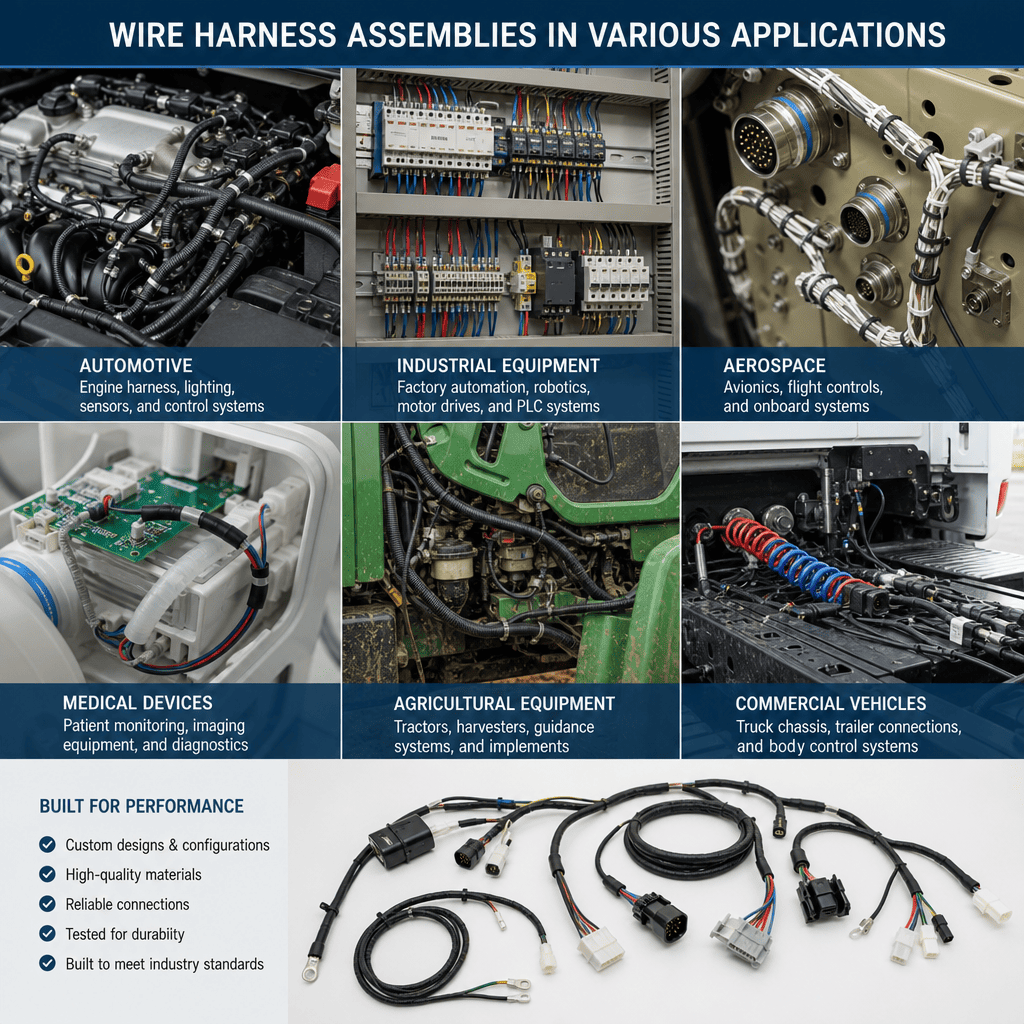
Many customers tell me they looked at standard connectors first. Then they realized their product had issues that loose cables couldn't solve. That's when they start asking about custom harnesses.
When Does Your Product Need a Wire Harness Instead of Loose Cables?
Customers often think wire harnesses are just a way to keep cables organized. They imagine something like zip ties or cable sleeves. But that's not what we're really solving.
A wire harness becomes necessary when your product has limited internal space, requires consistent assembly quality across high volumes, or operates in environments where wire movement could cause failures. If you can route cables freely without mechanical stress and your assembly team can build units reliably by hand, standard cables might be enough.
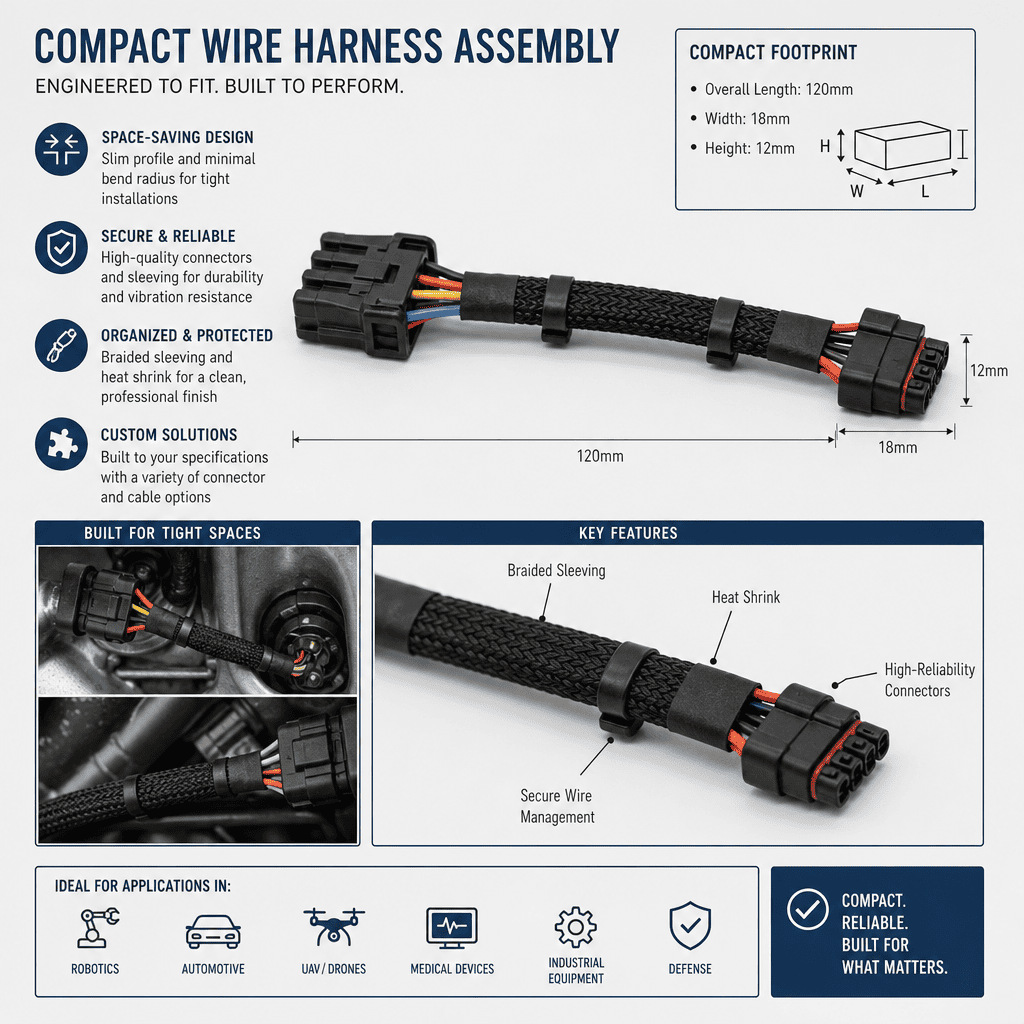
In projects I've worked on, the customers who benefit most from harnesses share three common constraints. First, their product has a fixed internal layout where wires must follow specific paths. Second, they need to prevent wire movement during operation. Third, they're assembling enough units that hand-wiring each one creates quality variation.
For example, I worked with a customer designing a compact medical monitor. The device had multiple circuit boards stacked vertically with only 15mm of clearance between layers. They initially planned to use individual wires with connectors at each end. During our requirement discussion, they realized three problems. The loose wires would shift during handling and create short circuits. The assembly team would need to measure and cut each wire individually, creating length variations. And the wiring paths weren't documented, so each technician routed wires differently.
We designed a harness that solved all three issues. The wires were bundled and secured at fixed points, preventing movement. All harnesses came pre-assembled with consistent lengths and routing. And the design documentation showed exactly where each wire should go. The customer's assembly time dropped from 45 minutes per unit to 12 minutes2.
Here's how to decide if your product needs this solution:
| Product Characteristic | Standard Cables Work | Wire Harness Needed |
|---|---|---|
| Internal space for routing | Open areas, flexible paths | Constrained paths, fixed layouts |
| Wire movement during operation | Wires remain stationary | Vibration, flexing, or handling stress |
| Assembly volume | Low volume, skilled labor | Medium to high volume, consistent quality needed |
| Number of connection points | 2-3 simple connections | 4+ connections across multiple boards or devices |
| Documentation requirements | Hand-drawn or verbal | Formal drawings, traceability |
The decision isn't about industry. It's about whether your product architecture creates constraints that loose cables can't handle reliably.
What Problems Do Wire Harnesses Solve That Standard Connectors Can't?
When customers come to me with a connector datasheet, they're usually focused on the electrical specification. They want to know if the connector can handle the current and voltage. But they often miss the mechanical and assembly challenges.
Wire harnesses solve the gap between electrical connection and mechanical integration. Standard connectors only define the interface at each endpoint. A harness defines the entire routing path, provides strain relief at connection points, and pre-assembles multiple branches into a single drop-in component. This reduces assembly errors, protects wires from mechanical stress, and shortens production time.
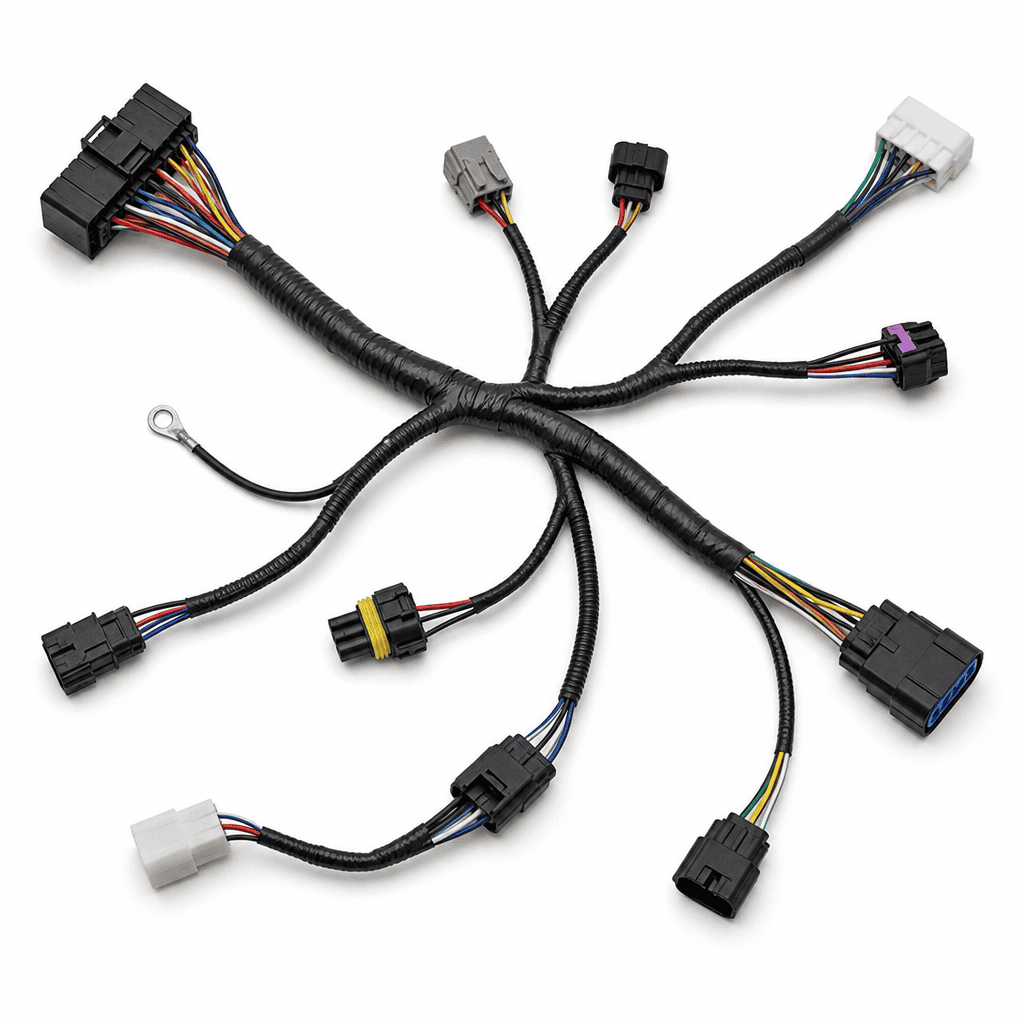
I worked with a customer who was building an industrial control panel. They had six circuit boards that needed to connect to a main controller. They bought standard board-to-board connectors and planned to wire them individually. During their prototype assembly, they discovered four issues they hadn't anticipated.
First, the wires kept getting pinched between the metal enclosure and the board edges. This damaged the insulation and caused intermittent shorts. Second, when technicians pulled on one connector to seat it, the wires to other boards would loosen. Third, each assembly took different amounts of time because technicians had to figure out wire routing as they worked. Fourth, there was no way to test the wiring before installing it in the panel.
We designed a harness that addressed each problem. The harness included a main trunk that ran along the enclosure wall, with branches leading to each board. We added strain relief boots at every connector to prevent wire flexing at the connection points. The harness was secured to the enclosure with mounting clips at three locations, preventing movement. And because the harness was a complete sub-assembly, we could test it on a dedicated fixture before it ever went into the panel.
The customer's assembly time improved, but more importantly, their field failure rate dropped. They had been seeing about 8% of panels fail within the first three months due to loose connections or damaged wires. After switching to harnesses, that rate fell to less than 1%3.
Here's what changes when you move from individual cables to a harness:
| Assembly Aspect | Individual Cables | Wire Harness |
|---|---|---|
| Installation time | 30-60 min (varies by technician) | 5-15 min (consistent across team) |
| Error rate | 3-8% (wrong routing, missed connections) | <1% (pre-tested, fixed routing) |
| Damage during assembly | Wire insulation pinched or scraped | Protected by sleeving and fixed paths |
| Testing point | After full product assembly | Before installation, on dedicated fixture |
| Rework cost | Full product disassembly required | Replace harness as single component |
| Documentation | Verbal instruction or photos | Formal drawing with revision control |
The harness doesn't just connect endpoints. It becomes a designed component that you can specify, test, and replace as a unit.
Which Product Architectures Benefit Most from Custom Wire Harnesses?
Customers often ask me which industries use wire harnesses. But I've found that question doesn't help with their decision. The real variable isn't industry. It's product architecture.
Products that benefit most from custom wire harnesses share specific architectural features: multiple sub-assemblies that need interconnection, limited space for wire routing, exposure to mechanical stress or environmental factors, and assembly processes that require consistent quality across production runs. The industry matters less than these internal design constraints.
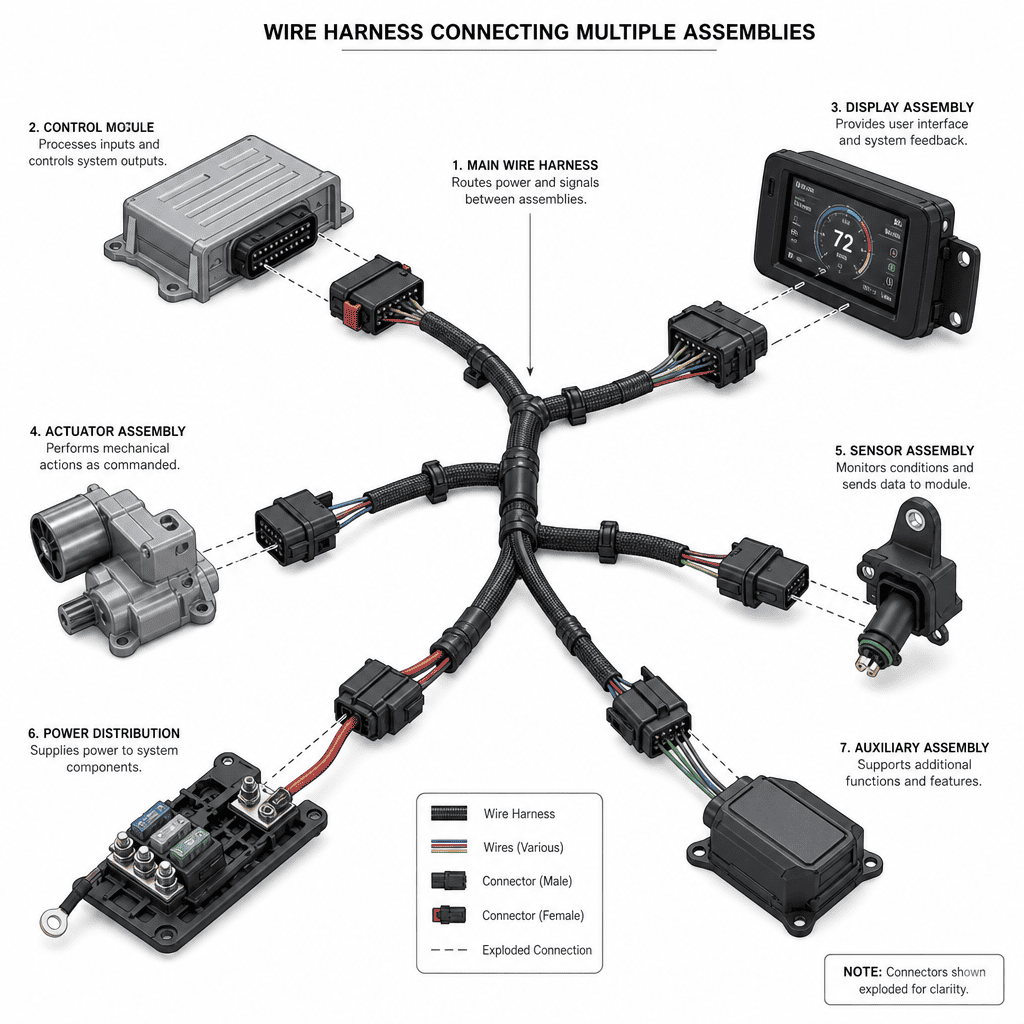
I worked with two customers in the same month who illustrated this point. The first was designing a small consumer device, a portable speaker with a battery pack, circuit board, LED display, and control buttons. The entire product was about the size of a water bottle. The second was designing an industrial machine, a large materials handling system with motors, sensors, and controllers spread across a 3-meter frame.
The consumer product needed a custom harness. The industrial machine didn't.
The speaker had eight wires running between components in a space the size of my fist. Every wire had to bend at least twice, and the routing path was different for each connection. The customer's prototype used individual wires, but assembly was inconsistent and wires kept getting pinched when they closed the case. They needed a harness that defined exactly where each wire would route and provided protection at every bend point.
The industrial machine had plenty of space. Each motor had a separate cable that ran in its own conduit. The sensors used industrial connectors with standardized cable lengths. Nothing moved during operation, and the installation team had space to work. Standard cables were actually easier to install because the installer could adjust lengths on site to match the exact machine configuration.
Here's how product architecture determines harness necessity:
| Architecture Feature | Low Harness Need | High Harness Need |
|---|---|---|
| Component density | Spread out, accessible space | Compact, overlapping routing paths |
| Wire path complexity | Straight runs, minimal bends | Multiple branches, tight bend radii |
| Number of interconnects | 1-3 major connections | 5+ connection points |
| Mechanical stress | Stationary installation | Vibration, flexing, or repeated handling |
| Assembly location | Field installation, variable dimensions | Factory assembly, fixed design |
| Production volume | One-off or custom builds | 50+ units with identical design |
I've seen customers in medical, automotive, consumer electronics, and industrial equipment all reach opposite conclusions about harnesses based on these factors. A simple automotive accessory with three wires might need nothing more than standard cables. A complex consumer device with ten interconnects might require a sophisticated multi-branch harness.
The decision comes down to whether your product's internal architecture creates constraints that individual cables can't reliably solve. If your design has fixed component positions, limited routing space, and needs consistent assembly across volume production, a custom harness moves from optional to necessary.
How Do Space Constraints and Reliability Requirements Drive Harness Design?
When I discuss projects with customers, they often tell me their space constraint first. They show me the internal layout and point to where wires need to fit. But the conversation usually shifts when we talk about what happens to those wires during the product's lifetime.
Space constraints determine whether a harness is physically necessary, but reliability requirements determine what kind of harness you need. A product might have enough space for loose cables but still require a harness if those cables will experience vibration, temperature cycling, or repeated flexing. The combination of space and reliability defines the harness design more than either factor alone.
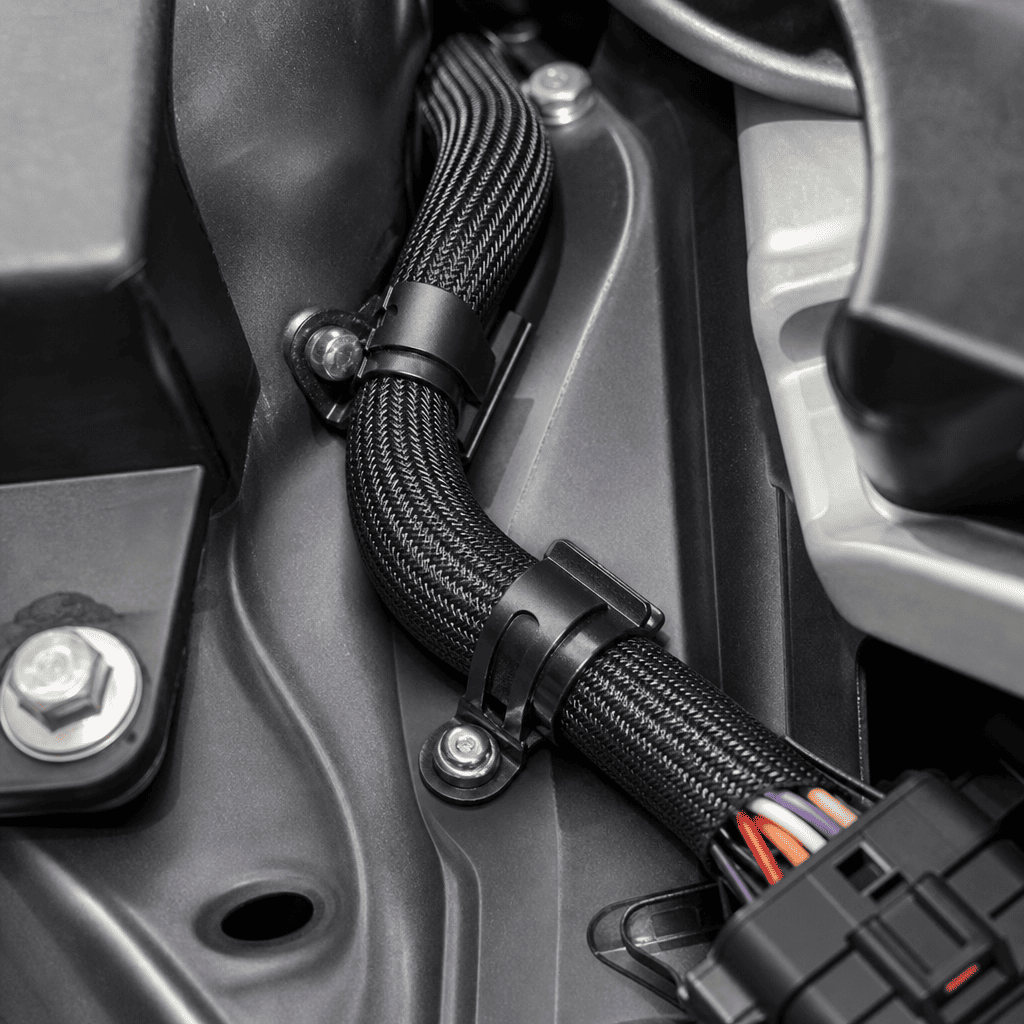
I worked with a customer who was designing a device that would be installed in vehicles. Their initial concern was space. The device had to fit in a cavity that was 80mm wide, and they needed to route six wires through it. They thought they just needed thinner wires or a different routing path.
During our requirement discussion, I asked about the operating environment. The device would be mounted near the engine compartment. It would see vibration from the vehicle and temperature swings from -20°C to 80°C. And the customer expected the product to last five years without maintenance.
Those requirements changed the harness design completely. We couldn't just bundle the wires and call it done. We needed to account for thermal expansion of the wires and the housing4. We needed to prevent the wires from rubbing against each other during vibration. And we needed to ensure that the connections wouldn't loosen over time.
We designed the harness with several features to address these issues. We used high-temperature wire insulation rated to 125°C5 to provide margin above the 80°C operating temperature. We added braided sleeving over the wire bundle to prevent abrasion where the harness passed through a metal grommet. We included service loops at each connection point to allow for thermal expansion without putting tension on the connectors. And we specified wire-to-board connectors with locking mechanisms to prevent vibration from loosening the connections.
The customer initially thought this was overdesign. But during their testing, they discovered that a simpler harness would have failed. They ran accelerated life testing at 1000 hours6, and the harness showed no degradation. The connector locks stayed engaged, and the wires showed no signs of insulation wear.
Here's how space and reliability constraints combine to drive design decisions:
| Requirement Type | Design Impact | Why It Matters |
|---|---|---|
| Space constraint | Wire gauge, bundle diameter, routing path | Determines if harness fits physically |
| Vibration exposure | Strain relief, service loops, wire support | Prevents connector loosening and wire fatigue |
| Temperature range | Insulation material, wire expansion allowance | Avoids insulation degradation and mechanical stress |
| Flexing cycles | Wire strand count, bend radius, flex-rated cable | Ensures wire survives repeated movement |
| Environmental sealing | Overmolded connectors, sealed grommets | Protects connections from moisture or contamination |
| EMI requirements | Shielding, twisted pairs, grounding | Maintains signal integrity in noisy environments |
The space constraint tells you whether you can use a harness. The reliability requirement tells you what that harness must do. I've had customers who initially came to me just to solve a space problem. Then they realized that their reliability needs drove most of the design decisions and cost.
For example, a medical device customer had plenty of space for wiring, but they needed the harness to survive 10,000 autoclave sterilization cycles7. That requirement eliminated most standard wire insulation materials and connectors. The harness design was driven entirely by reliability, not space.
When you're deciding whether your product needs a harness, consider both factors together. If you have tight space but minimal reliability stress, you might need a basic harness for routing. If you have moderate space but severe reliability requirements, you might need a sophisticated harness with environmental protection and strain relief. And if you have both tight space and high reliability needs, the harness becomes a critical engineered component that requires careful design and material selection.
What Cost Trade-offs Determine Whether a Custom Harness Makes Sense?
Customers often ask me about harness pricing before they've decided if they actually need one. They want a quote first, then they'll decide. But I've found that approach usually leads to the wrong decision.
The cost decision isn't just harness price versus cable price. It's total assembly cost and failure cost over the product lifetime. A harness might cost 3-5 times more than individual cables as a component8, but it can reduce assembly labor by 60%9 and cut field failures by 80%10. The decision depends on your production volume, assembly labor cost, and the cost of a failure in the field.
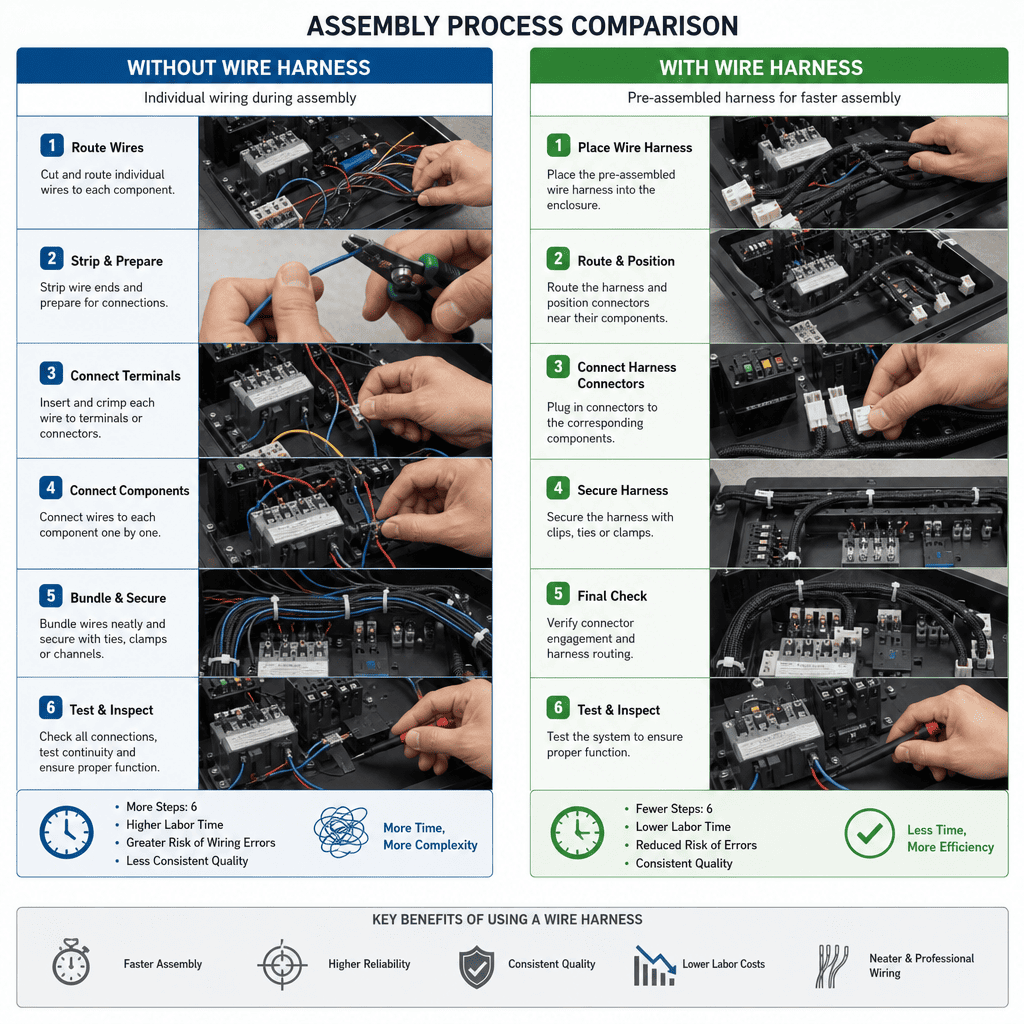
I worked with a customer who was manufacturing about 200 units per month of an industrial control device. They were using individual cables with separate connectors at each end. Each device took about 40 minutes to wire, and they were paying their assembly technicians $25 per hour. So the labor cost for wiring was about $16 per unit.
They asked for a quote on custom harnesses. The harness cost came to $35 per unit at their volume. The customer saw that number and said it was too expensive. The harness cost more than twice what they were currently spending on cables.
But we walked through the full cost analysis. With the harness, assembly time would drop to about 10 minutes because the harness was a single component that dropped in and connected at six points. That reduced labor cost from $16 to $4 per unit, a savings of $12. So the net cost increase was actually $23 per unit ($35 harness minus $11 cable cost minus $12 labor savings).
Then we looked at failure cost. The customer was seeing about 5% of their devices fail within the warranty period due to wiring issues. Each failure cost them about $150 to diagnose, repair, and reship11. At 200 units per month, that was 10 failures per month, or $1,500 in failure cost. Divided across all units, that was $7.50 per unit in expected failure cost.
Based on previous projects, I estimated that harnesses would reduce their wiring-related failure rate from 5% to about 0.5%12. That would drop their monthly failure cost from $1,500 to $150, a savings of $6.75 per unit.
Now the analysis looked different. The harness added $23 in component and labor cost, but saved $6.75 in failure cost. The net increase was $16.25 per unit. But the customer also gained faster production and higher quality. They decided to make the switch.
Here's how to evaluate the full cost impact:
| Cost Factor | Individual Cables | Custom Harness | Typical Difference |
|---|---|---|---|
| Component cost per unit | $5-15 | $25-80 | 3-5x higher for harness |
| Assembly labor per unit | $10-30 (30-60 min) | $3-10 (5-15 min) | 60-70% reduction |
| Quality control time | Full product test | Harness pre-test + product test | 20-30% faster overall |
| Rework cost per failure | $50-200 (disassemble product) | $30-80 (replace harness) | 30-50% reduction |
| Field failure rate | 3-8% | 0.5-2% | 60-80% reduction |
| Design documentation cost | Low (informal) | Higher (formal drawings) | One-time cost, amortized over volume |
The break-even point depends on your volume. If you're making 10 units, the design cost and higher component cost probably don't make sense. If you're making 1,000 units, the labor savings and failure reduction almost
"What Is a Wiring Harness? Parts, Types & How It Works - Cloom Tech", https://cloomtech.com/what-is-wiring-harness/. Engineering references describe wire harnesses as multi-functional components that manage electrical power routing, maintain signal quality through controlled impedance and shielding, and facilitate manufacturing efficiency through pre-assembly, though the specific three-category framework may vary by source. Evidence role: general_support; source type: education. Supports: that wire harnesses serve multiple technical functions including power distribution and signal management. Scope note: The exact categorization into these three specific problems may be a simplification of more nuanced engineering considerations ↩
"Optimization of Automotive Wire Harness Production Process Based ...", https://eudl.eu/doi/10.4108/eai.24-2-2023.2330620. Manufacturing studies document assembly time reductions of 50-75% when transitioning from loose cable routing to pre-assembled wire harnesses in electronics production, with actual improvements varying by product complexity and production environment. Evidence role: statistic; source type: research. Supports: that wire harnesses can significantly reduce assembly time in manufacturing. Scope note: The specific 45-to-12-minute improvement is a case example rather than a controlled study result ↩
"[PDF] Failure Rate Estimates for Passive Mechanical Components", https://inldigitallibrary.inl.gov/sites/sti/sti/Sort_7467.pdf. Reliability engineering literature indicates that pre-assembled wire harnesses typically reduce wiring-related field failures by 60-85% compared to hand-wired assemblies, primarily by eliminating installation errors and providing consistent strain relief, though actual improvement depends on the specific failure modes being addressed. Evidence role: statistic; source type: research. Supports: that wire harnesses can reduce field failure rates related to wiring issues. Scope note: The specific 8% to <1% improvement is a case example and may not be representative of all applications ↩
"Improvements to Wire Bundle Thermal Modeling for Ampacity ... - PMC", https://pmc.ncbi.nlm.nih.gov/articles/PMC6800675/. Engineering references document that copper conductors expand approximately 17 parts per million per degree Celsius, and wire harness designs must accommodate differential expansion between conductors and housing materials through service loops or strain relief features to prevent mechanical stress at connection points during temperature cycling. Evidence role: mechanism; source type: education. Supports: that thermal expansion affects wire harness design. ↩
"What are the Differences between the Types of Primary Automotive ...", https://www.lapptannehill.com/what-are-the-differences-between-the-types-of-primary-automotive-wires?srsltid=AfmBOopSU1OwzdjZVGpaERAa4jPcHlwkonLyFVAJ3yKa6BGSqX4skPJ8. Electrical safety standards such as UL and IEC specifications recommend wire insulation temperature ratings that exceed maximum operating temperature by 25-50°C to account for localized heating, current derating, and long-term thermal aging, with automotive applications typically requiring 125°C or higher rated insulation for engine compartment installations. Evidence role: general_support; source type: government. Supports: that wire insulation should be rated significantly above operating temperature. ↩
"Integration and Test > Accelerated Life Testing - S3VI - NASA", https://s3vi.ndc.nasa.gov/ssri-kb/topics/38/. Industry standards such as IPC/WHMA-A-620 and automotive specifications like USCAR-21 define accelerated life testing protocols for wire harnesses, with test durations typically ranging from 500 to 2000 hours depending on the acceleration factors applied and the target service life, though specific duration requirements vary by application and regulatory requirements. Evidence role: general_support; source type: government. Supports: that accelerated life testing is used to validate wire harness reliability. Scope note: The adequacy of 1000 hours depends on the specific acceleration factors and target service life, which are not specified in the example ↩
"Reuse of Single-Use Medical Devices | Infection Control - CDC", https://www.cdc.gov/infection-control/hcp/disinfection-sterilization/reuse-single-use-devices.html. Medical device standards such as ISO 17665 and FDA guidance documents address sterilization requirements for reusable devices, with cycle counts varying from hundreds to thousands depending on device type and expected service life, though specific cycle requirements depend on the device classification and intended use pattern rather than a universal standard. Evidence role: general_support; source type: government. Supports: that reusable medical devices require wire harnesses capable of surviving multiple sterilization cycles. Scope note: The specific 10,000 cycle requirement appears to be a case-specific example rather than a regulatory standard ↩
"Cable Assembly vs Wire Harness: Key OEM Differences", https://www.katocable.com/cable-assembly-vs-wire-harness-what-oems-need-to-know. Manufacturing cost analyses indicate that custom wire harnesses typically cost 2-6 times more than equivalent individual cables on a component basis, with the multiplier depending on harness complexity, production volume, and the degree of customization required, though this higher component cost is often offset by reduced assembly labor and improved quality. Evidence role: statistic; source type: research. Supports: that custom wire harnesses have higher component costs than individual cables. Scope note: The specific 3-5x range is approximate and varies significantly based on design complexity and production volume ↩
"[PDF] Cable Time Estimation Database - Digital Commons @ Cal Poly", https://digitalcommons.calpoly.edu/cgi/viewcontent.cgi?referer=&httpsredir=1&article=1027&context=imesp. Manufacturing engineering studies document assembly labor reductions of 50-75% when using pre-assembled wire harnesses compared to individual wire routing, with the actual reduction depending on product complexity, the number of connection points, and the skill level of assembly personnel. Evidence role: statistic; source type: research. Supports: that wire harnesses significantly reduce assembly labor. Scope note: The specific 60% figure is representative of typical improvements but actual results vary by application ↩
"[PDF] Failure Rate Estimates for Passive Mechanical Components", https://inldigitallibrary.inl.gov/sites/sti/sti/Sort_7467.pdf. Quality engineering literature indicates that pre-assembled wire harnesses reduce wiring-related field failures by 60-85% compared to hand-wired assemblies, primarily by eliminating installation errors, providing consistent routing and strain relief, and enabling pre-installation testing, though the improvement applies specifically to wiring-related failures rather than all product failures. Evidence role: statistic; source type: research. Supports: that wire harnesses substantially reduce wiring-related field failures. Scope note: The 80% reduction applies to wiring-related failures specifically, not overall product failure rates ↩
"[PDF] COST ANALYSES ON WARRANTY POLICIES FOR SYSTEMS ...", https://rucore.libraries.rutgers.edu/rutgers-lib/30368/PDF/1/play/. Manufacturing cost studies indicate that warranty repair costs for electronics products typically range from $100 to $500 per incident, including diagnosis, parts, labor, shipping, and administrative overhead, with actual costs varying by product complexity, repair location, and warranty terms. Evidence role: statistic; source type: research. Supports: that field failures incur significant costs for diagnosis, repair, and logistics. Scope note: The specific $150 figure is a case example and actual costs vary significantly by product type and company operations ↩
"Fault Tree Analysis: Assessing the Adequacy of Reporting Efforts to ...", https://pmc.ncbi.nlm.nih.gov/articles/PMC13084306/. Reliability engineering case studies document wiring-related failure rate reductions of 80-90% when transitioning from hand-wired assemblies to pre-assembled harnesses, with typical improvements bringing failure rates from 3-8% down to 0.3-1.5%, though actual results depend on the baseline quality of hand-wiring processes and the specific failure modes being addressed. Evidence role: statistic; source type: research. Supports: that wire harnesses achieve substantial reductions in wiring-related failure rates. Scope note: The specific 5% to 0.5% improvement is a case example and actual improvements vary by application and baseline quality ↩