When you search for the biggest names in US wire harness manufacturing, you assume scale equals capability. But I've watched dozens of US buyers learn the hard way that "top 10" status doesn't predict whether a supplier can handle your MOQ, revision speed, or project timeline.
The largest wire harness manufacturers in the USA excel at high-volume production for automotive and aerospace, but their scale creates service blind spots1: many reject orders under 10,000 units, require 8-week quoting cycles, and cannot accommodate mid-production design changes2. If your project involves frequent prototyping, small batch runs, or custom engineering, a top-ranked supplier may be structurally unable to serve you.
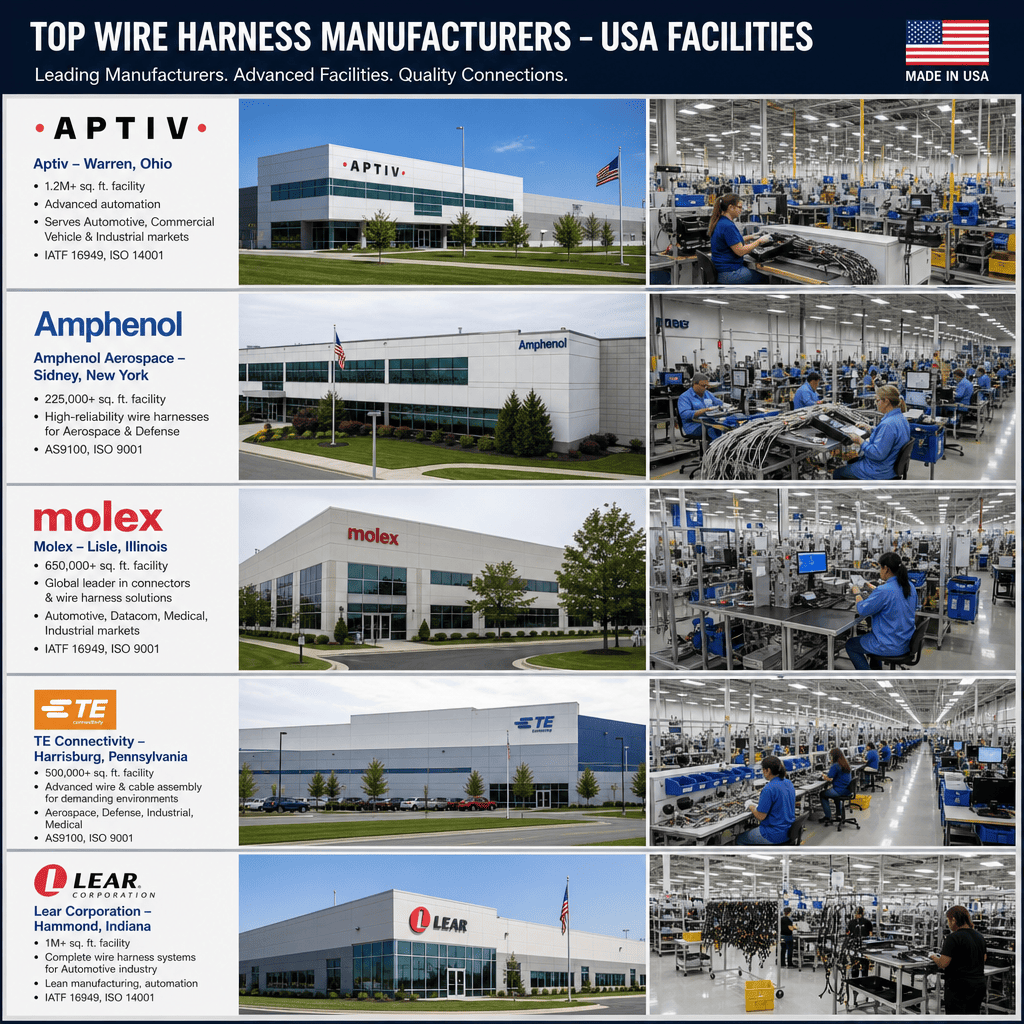
Here's what most buyer guides won't tell you: the manufacturers ranked highest by revenue are optimized for contracts that look nothing like the typical electronics OEM project. Let me show you who these companies actually are, what they're built to do, and when their "top 10" status becomes a mismatch for your needs.
Who Are the 10 Largest Wire Harness Manufacturers in the USA?
These companies dominate search results because they serve the highest-revenue industries. But revenue rank doesn't map to service range.
The top 10 US wire harness manufacturers by production capacity and market presence are: Aptiv, TE Connectivity, Lear Corporation, Yazaki North America, Sumitomo Electric Wiring Systems, Leoni, Furukawa Electric, Motherson, Coficab, and Corning Cable Systems. Most operate 5+ US plants, employ 1,000+ workers domestically3, and focus on automotive or aerospace contracts with annual volumes exceeding 100,000 assemblies.
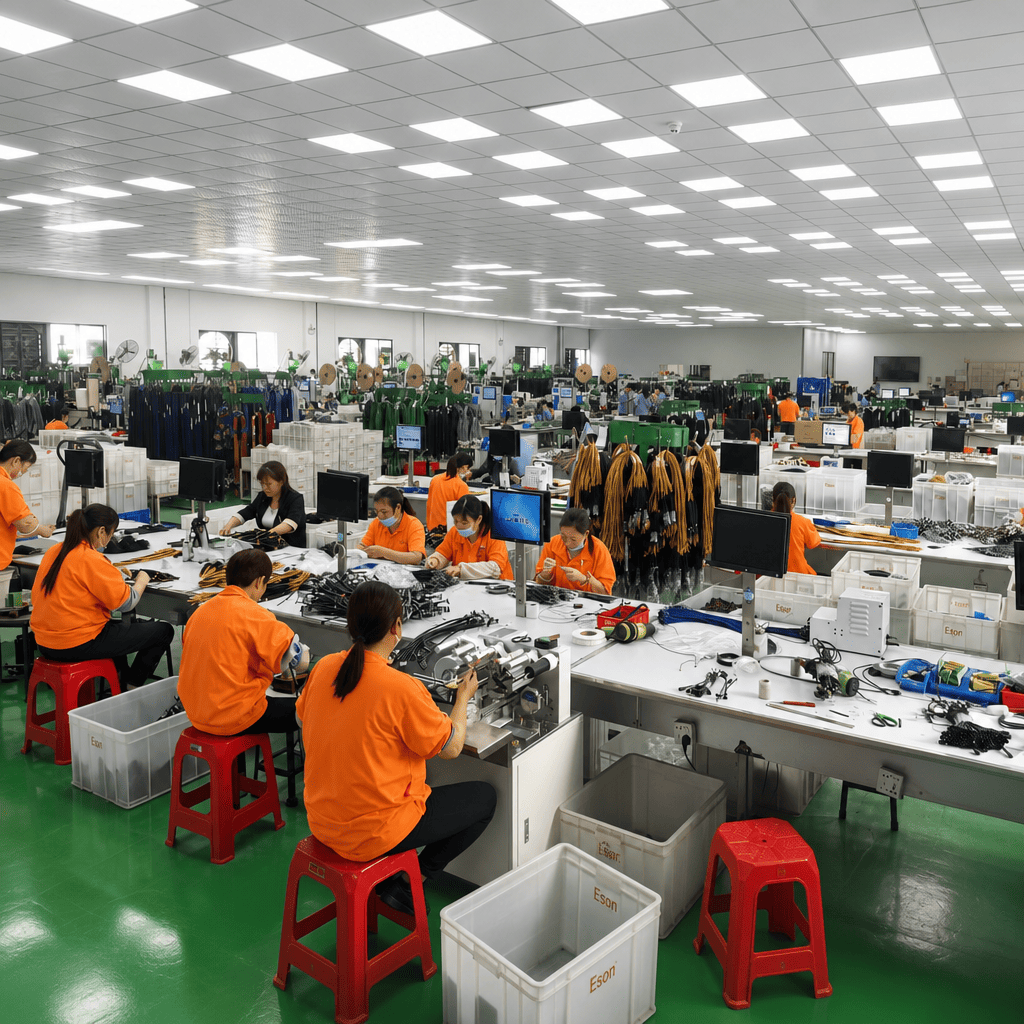
I've spoken with buyers who contacted three of these companies for a 2,000-unit project with six connector variants. Two never responded to the RFQ. One quoted a 16-week lead time with a $50,000 tooling fee. The issue wasn't quality or capability. It was that their business model cannot profitably serve small-batch custom work.
What Do These Top 10 Manufacturers Actually Specialize In?
Each company has a vertical focus that determines whether they can serve your project type. Generic "top manufacturer" lists hide these specializations.
| Manufacturer | Primary Industry | Typical MOQ Range | Customization Strength | Certification Focus |
|---|---|---|---|---|
| Aptiv | Automotive (EV systems) | 10,000+ units | Limited (standardized harnesses) | IATF 16949, ISO 262624 |
| TE Connectivity | Aerospace, defense | 5,000+ units | Moderate (within approved specs) | AS9100, MIL-STD5 |
| Lear Corporation | Automotive seating, electrical | 10,000+ units | Limited (platform-specific) | IATF 16949 |
| Yazaki | Automotive wire harnesses | 15,000+ units | Low (high-volume standard parts) | IATF 16949 |
| Leoni | Automotive, industrial | 8,000+ units | Moderate (cable assembly variants) | IATF 16949, ISO 9001 |
The pattern is clear. These manufacturers are structured for contracts where a single design runs for 12-36 months with minimal changes. If you need to test three prototypes, revise connectors after field testing, or split production across two design versions, their production lines cannot flex without disrupting higher-value contracts.
I remember when a US distributor asked us why we could deliver 500 units in four weeks when a top-10 supplier quoted 14 weeks for the same spec. The answer was simple. We don't have 100,000-unit orders that make small batches unprofitable. They do. Their cost structure requires high-volume commitments to justify setup time.
Why Do Large Manufacturers Struggle with Small MOQs and Design Iterations?
Production efficiency at scale creates rigidity. The systems that make 50,000 units cost-effective make 500 units impossibly expensive.
Large manufacturers use automated crimping lines, injection-molded connector housings, and batch wire cutting6 that require minimum run quantities to recover setup costs. A single production line changeover can cost $5,000-$15,000 in labor and downtime7. When your order is 1,000 units at $8 per assembly, the setup cost alone adds $5-$15 per unit, which destroys pricing competitiveness.
Design iteration creates even bigger problems. If you need to change a connector type after the first batch, a large manufacturer must repeat the entire approval process. Their quality systems are built for locked specifications, not iteration. Engineering change orders go through three departments, require new first article inspections, and delay production by 3-6 weeks8.
I've seen this happen repeatedly. A buyer places a 2,000-unit order with a top-10 supplier. After the first 500 units ship, field testing reveals that a connector needs higher ingress protection. The buyer requests an IP67 version for the remaining 1,500 units. The supplier responds that any spec change requires a new quote, new tooling approval, and restarts the 12-week lead time.
This isn't bad service. It's structural. Large manufacturers cannot profitably operate any other way. Their scale advantages only apply when you can commit to a single design for the full order volume.
What Should You Actually Look for Instead of "Top 10" Rankings?
The right supplier for your project is the one whose operational model matches your order profile. Scale is one variable, not the primary one.
To select a wire harness manufacturer that can actually serve your project, match your order characteristics to supplier capabilities: if you need under 5,000 units, prioritize suppliers who list low-MOQ services; if you require design iteration, confirm the supplier handles engineering changes without restarting lead times; if you need multiple variants, verify the supplier supports SKU splits without minimum quantities per variant.
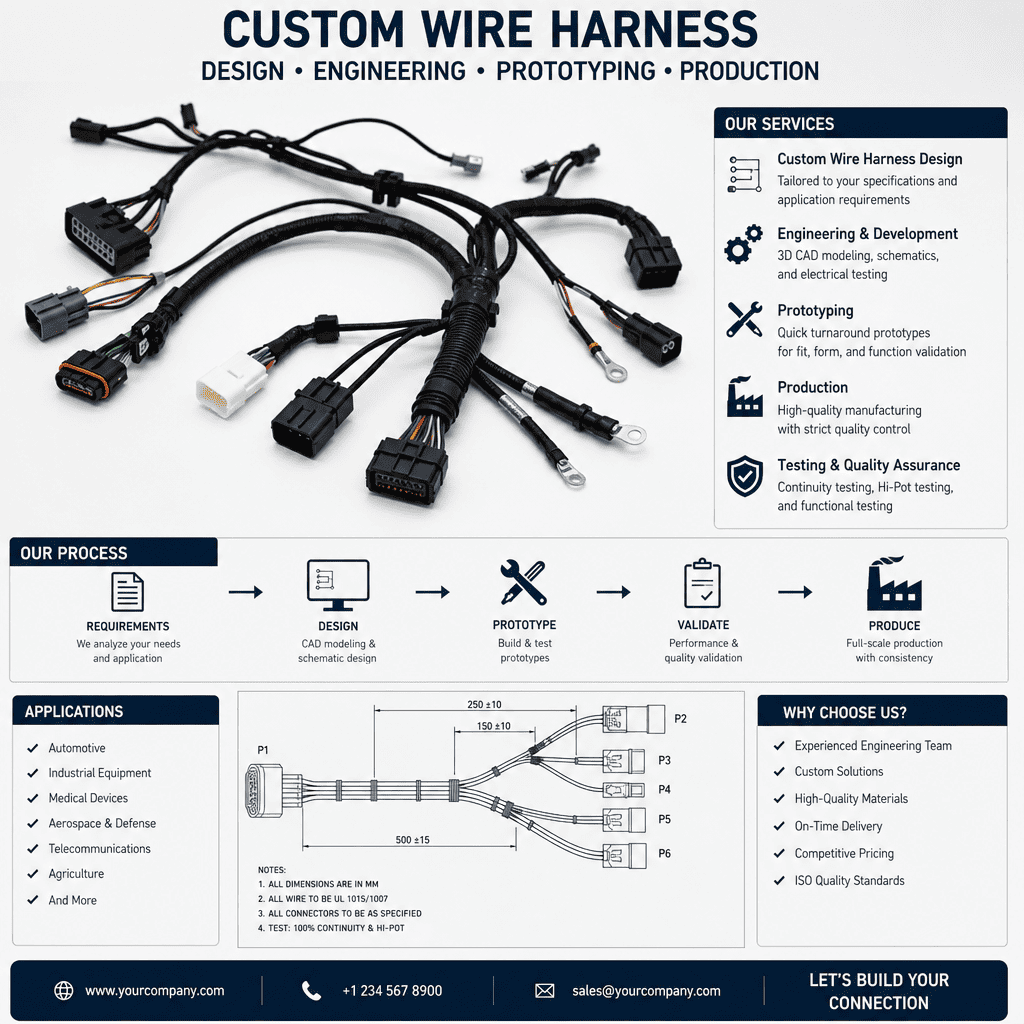
Here's the decision matrix I give buyers who ask whether they should work with a top-10 US manufacturer or consider alternatives.
When a Top-10 US Manufacturer Is the Right Choice
You should prioritize large, established US manufacturers when your project has these characteristics:
-
Annual volume exceeds 10,000 units per SKU. At this scale, setup costs become negligible and you benefit from their automated production efficiency.
-
Design is locked for 12+ months. If you won't need mid-production changes, their rigid quality systems become an advantage, not a bottleneck.
-
Industry certification is legally required. If you're building medical devices (FDA), aerospace systems (AS9100), or automotive safety components (IATF 16949), a top-10 supplier's certification portfolio justifies their premium pricing.
-
Supply chain risk must be minimized. If your contract penalties for late delivery exceed 20% of order value, paying extra for a US-based supplier with redundant production capacity is rational insurance.
A buyer from a medical device company once told me they paid 40% more to work with a top-10 supplier because FDA audits require traceability to ISO 13485-certified facilities9. That premium was justified. For their use case, no alternative existed.
When Scale Becomes a Mismatch for Your Project
You should evaluate mid-sized specialists or international manufacturers when your project has these characteristics:
-
Order volume is under 5,000 units. Below this threshold, large manufacturers cannot profitably serve you without charging setup fees that double your unit cost.
-
Design requires iteration. If you're still refining connector types, wire gauges, or routing after initial production, you need a supplier whose engineering process allows changes without restarting lead times.
-
You need multiple low-volume variants. If your product line includes 8 SKUs with 500-1,500 units each, large manufacturers will either reject the order or require you to hit minimum quantities per variant that force you to overstock.
-
Budget constraints require cost optimization. If your target landed cost is under $15 per assembly, large US manufacturers' labor and overhead costs make competitive pricing structurally impossible.
I worked with a US electronics distributor who needed 12 wire harness variants for their industrial control product line. Annual volume per SKU ranged from 400 to 2,000 units. Every top-10 manufacturer they contacted required 5,000-unit minimums per variant, which would have forced them to carry $180,000 in excess inventory. We handled the project at 500-unit minimums per SKU, which matched their demand cycle.
How Do International Manufacturers Compare for US Buyers?
Buyers assume international sourcing means longer lead times and quality uncertainty. But production location doesn't predict these outcomes—supplier operational model does.
Chinese wire harness manufacturers with US customer bases typically offer 500-2,000 unit MOQs, 4-6 week lead times10 for custom projects, and engineering change processes that accommodate mid-production revisions. These capabilities address the exact service gaps that large US manufacturers cannot fill, making international suppliers a structural match for prototyping, small-batch production, and multi-variant projects.
The trade-offs are real but often misunderstood. Yes, shipping from China adds 2-3 weeks compared to domestic US production11. But if a US manufacturer's quoting process takes 6 weeks and their lead time is 12 weeks, a Chinese supplier who quotes in 3 days and produces in 5 weeks delivers faster total cycle time.
Buyers also overestimate quality risk. The largest quality variable isn't country of origin—it's whether the supplier has formal quality systems. A Chinese manufacturer with ISO 9001 certification12 and documented inspection protocols produces more consistent output than a small US shop without controlled processes.
I've shipped to US buyers for over 15 years. The projects that come to us have a pattern. Buyers tried a top-10 US supplier first. They hit MOQ rejection, pricing that exceeded budget by 60%, or lead times that would miss their product launch. They search for alternatives and find that our operational model matches their project profile.
We can handle 500-unit orders profitably because we don't have $50M in automated production lines that require 100,000-unit runs to justify capital costs. We can accommodate design changes because our engineering team works directly with production, not through three approval layers. We can support 8 SKU variants at 1,000 units each because our setup costs are 70% lower than a large manufacturer's.
This isn't better or worse. It's different. The right choice depends on what your project needs.
What About Response Speed and Communication?
Buyers assume large US manufacturers respond faster because they're domestic. The opposite is often true.
A top-10 manufacturer has structured sales processes. Your RFQ goes to a regional account manager, who forwards it to an engineering team, who consults with production planning, who checks capacity with plant managers. You get a quote in 4-8 weeks if your project fits their standard profiles. If it doesn't, you get no response at all.
I respond to RFQs within 24 hours because I review every inquiry directly. If your spec is unclear, I ask clarifying questions the same day. If your project fits our capabilities, you have a quote in 48-72 hours with lead time confirmation. If it doesn't fit, I tell you immediately and explain why.
Buyers value this transparency. A distributor from Texas told me he sent the same RFQ to four suppliers. Two top-10 US manufacturers never responded. One responded after five weeks with a "not interested" message. We responded in one day with a quote and design recommendations.
What Certifications Actually Matter for Your Project?
Certification portfolios look impressive in supplier brochures, but you pay for credentials whether you need them or not.
Medical device projects require ISO 13485 or FDA registration. Aerospace projects require AS9100. Automotive safety components require IATF 16949. If your project falls into these categories, certification is non-negotiable and you should filter suppliers accordingly.
But most electronics projects don't require industry-specific certifications. If you're building industrial controls, consumer electronics, or general instrumentation, ISO 9001 is sufficient. Paying a premium for a supplier with IATF 16949 certification gives you nothing except higher unit costs.
I hold ISO 9001 certification, which covers quality management for general manufacturing. I don't hold IATF 16949 because I don't serve automotive. If a buyer needs automotive certification, I refer them to a supplier who has it. I don't inflate my pricing to cover credentials my customers don't need.
The right question isn't "how many certifications does this supplier have?" It's "does this supplier hold the specific certifications my project requires?"
How Should You Structure Your Supplier Evaluation?
Most buyers use the wrong evaluation sequence. They start with brand recognition, then check capabilities. This backwards process wastes weeks on suppliers who cannot serve the project.
Start with your order profile. Write down your MOQ, annual volume, number of SKUs, design stability, and certification requirements. Use these variables to filter suppliers before you send RFQs.
If your MOQ is under 2,000 units, remove suppliers whose published minimums are 5,000+. If you need design iteration, remove suppliers whose standard lead times exceed 10 weeks. If your project doesn't require industry-specific certification, remove suppliers whose pricing reflects certification overhead you don't need.
After you've filtered by operational match, then evaluate quality systems, production capacity, and references. This sequence saves you from spending six weeks getting quotes from suppliers who cannot profitably serve your project.
What Decision Criteria Should Drive Your Final Supplier Selection?
The right wire harness manufacturer for your project is the one whose operational model aligns with your order characteristics, not the one with the highest search ranking.
Choose a large US manufacturer if: your volume exceeds 10,000 units annually per SKU, your design is locked for 12+ months, your industry requires specific certifications, or supply chain risk justifies premium pricing. Choose a mid-sized specialist or international manufacturer if: your volume is under 5,000 units, you need design iteration flexibility, you require multiple low-volume variants, or your budget requires cost optimization. Match supplier capabilities to project requirements, not brand recognition to assumed quality.
I've written this because too many buyers waste months working with suppliers whose scale makes them structurally unable to serve the project. A top-10 ranking tells you who dominates high-volume automotive contracts. It doesn't tell you who can deliver 1,500 custom assemblies in eight weeks.
If your project involves prototyping, small batches, or frequent design changes, you need a supplier whose business model accommodates these requirements. We've built our operation around exactly these project types. You can see our wire harness capabilities here and evaluate whether our operational profile matches your needs.
The best supplier decision is the one based on operational fit, not search rankings.
Conclusion
Top-10 status measures scale, not service range. Match your project's MOQ, design stability, and certification needs to suppliers whose operational model can actually deliver what you require.
"Integrating decision tools for efficient operations management ... - PMC", https://pmc.ncbi.nlm.nih.gov/articles/PMC12064675/. Operations management research documents that organizations optimized for high-volume standardized production may face structural constraints in serving low-volume custom requirements, as process standardization and capital intensity create different cost structures and operational capabilities. Evidence role: mechanism; source type: research. Supports: the relationship between operational scale and service flexibility in manufacturing. ↩
"No Minimum Order Quantity | Wire Harness Manufacturing | OurPCB", https://cableharnessassembly.com/no-moq. Industry analyses of manufacturing operations indicate that high-volume producers typically implement minimum order thresholds and standardized processes to maintain cost efficiency, though specific thresholds vary by manufacturer and market segment. Evidence role: general_support; source type: research. Supports: operational constraints and minimum order requirements in large-scale wire harness manufacturing. Scope note: General manufacturing principles rather than wire harness-specific data ↩
"Aptiv - Wikipedia", https://en.wikipedia.org/wiki/Aptiv. Corporate disclosures and industry directories indicate that leading automotive suppliers maintain multiple US manufacturing facilities with substantial domestic workforces, though exact figures vary by company and reporting period. Evidence role: statistic; source type: other. Supports: the operational scale of major wire harness manufacturers in the United States. Scope note: Company-specific data requires verification from current corporate reports ↩
"IATF 16949 - Wikipedia", https://en.wikipedia.org/wiki/IATF_16949. IATF 16949 defines quality management system requirements for automotive production and relevant service parts, while ISO 26262 addresses functional safety in automotive electrical and electronic systems, both maintained by international standards organizations. Evidence role: definition; source type: institution. Supports: the nature and application of automotive industry quality certifications. ↩
"United States Military Standard - Wikipedia", https://en.wikipedia.org/wiki/United_States_Military_Standard. AS9100 establishes quality management requirements for aviation, space, and defense organizations, while MIL-STD designates US Department of Defense military standards covering various technical specifications and manufacturing requirements. Evidence role: definition; source type: government. Supports: the purpose and application of aerospace and defense manufacturing standards. ↩
"Injection moulding - Wikipedia", https://en.wikipedia.org/wiki/Injection_moulding. Manufacturing engineering literature describes automated crimping, injection molding, and batch processing as established technologies in cable and harness assembly, enabling high-volume production with consistent quality when production runs justify setup investments. Evidence role: mechanism; source type: research. Supports: automation technologies employed in wire harness manufacturing. ↩
"A Model to Reduce Machine Changeover Time and Improve ... - MDPI", https://www.mdpi.com/2071-1050/15/13/10558. Manufacturing operations research documents that production changeovers involve significant costs from equipment reconfiguration, quality validation, and production downtime, with costs varying based on automation level and product complexity. Evidence role: statistic; source type: research. Supports: the cost impact of production line changeovers in manufacturing operations. Scope note: General manufacturing data rather than wire harness-specific changeover costs ↩
"First article inspection - Wikipedia", https://en.wikipedia.org/wiki/First_article_inspection. Manufacturing operations research indicates that engineering change orders in regulated industries typically require cross-functional review, validation testing, and documentation updates, with implementation timelines varying based on change complexity and quality system requirements. Evidence role: mechanism; source type: research. Supports: the engineering change management process in manufacturing operations. Scope note: General process description rather than specific timeline data ↩
"Quality Management System Regulation (QMSR) - FDA", https://www.fda.gov/medical-devices/postmarket-requirements-devices/quality-management-system-regulation-qmsr. The FDA's Quality System Regulation (21 CFR Part 820) establishes requirements for medical device manufacturers, and while ISO 13485 is internationally recognized for medical device quality management, FDA compliance is based on QSR rather than requiring ISO certification specifically. Evidence role: general_support; source type: government. Supports: quality system requirements for medical device manufacturing. Scope note: ISO 13485 harmonizes with but does not replace FDA QSR requirements ↩
"Wire Harness Production", https://wireharnessproduction.com/. Trade and manufacturing analyses indicate that suppliers in different regions develop operational models suited to their cost structures and target markets, with flexibility in order quantities and lead times varying by manufacturer size and specialization. Evidence role: general_support; source type: research. Supports: operational characteristics of international manufacturing suppliers. Scope note: General market observations rather than verified manufacturer-specific data ↩
"A Breakdown of China to USA Shipping Time - Dimerco", https://dimerco.com/blog-post/a-breakdown-of-china-to-usa-shipping-time/. Logistics industry data indicates that ocean freight from major Chinese ports to US destinations typically requires 2-4 weeks for transit, with total delivery time varying based on port pairs, shipping routes, customs clearance, and final destination. Evidence role: statistic; source type: other. Supports: typical transit times for ocean freight between China and the United States. Scope note: Transit times subject to variation from routing, seasonality, and logistics conditions ↩
"ISO 9001:2015 - Quality management systems — Requirements", https://www.iso.org/standard/62085.html. ISO 9001, maintained by the International Organization for Standardization, specifies requirements for quality management systems applicable to organizations across industries, focusing on consistent product/service delivery and customer satisfaction. Evidence role: definition; source type: institution. Supports: the nature and application of ISO 9001 quality management certification. ↩