Custom Wiring Harness Manufacturing for OEM Equipment
At a Glanc
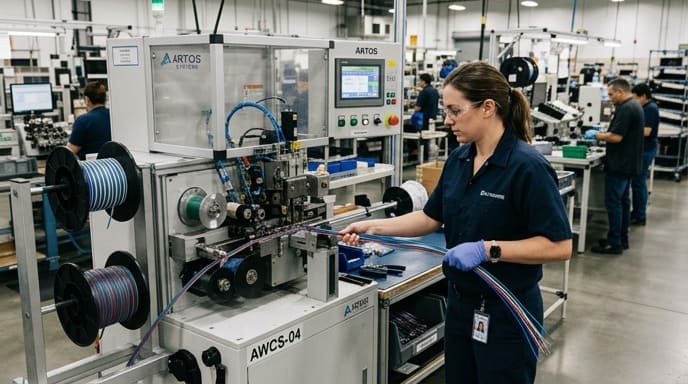
Wire processing is the complete sequence of cutting, stripping, crimping, terminal insertion, routing, and labeling that transforms a bill of materials into a production-ready wire harness. For OEM equipment, this is not simply gathering wires together — it is a system‑critical operation where every step directly influences connector compatibility, environmental sealing, and signal integrity under real‑world conditions.
What Is Wire Processing? The Foundation of Custom Harness Assembly
Procurement teams often treat a custom wiring harness as just a collection of cut wires. In reality, wire processing is a disciplined manufacturing workflow that begins with precise cutting to length, laser or mechanical stripping of insulation to an exact dimension, and crimping each terminal onto a conductor with a force profile matched to that specific wire gauge. Without this sequence, even a perfectly designed schematic cannot become a reliable assembly.
Wire gauge — commonly expressed in AWG — is the first design decision that ripples through every downstream process. A thicker gauge carries more current with less voltage drop, but it also demands larger connectors, bigger bend radii, and different stripping tooling. Selecting the wrong AWG early can lead to overheating, physical stress on terminals, or routing failures later. In a custom harness, each circuit may use a different gauge; the wire processing setup must handle those transitions without introducing handling damage or inconsistent strip lengths.
The operational backbone of a harness program is therefore the wire processing stage. A well‑run facility uses programmable cut‑strip‑crimp centers that can store hundreds of part numbers and switch between them with minimal changeover. However, the real value for an OEM buyer is not the machinery on its own — it is the process documentation that ties each reel of wire, each batch of terminals, and each crimp to a work order. That documentation provides the traceability needed when a harness must be validated against IPC/WHMA‑A‑620 acceptance criteria, which classify workmanship by measurable attributes rather than opinions.
Why Custom Wiring Harnesses Are More Than Wires and Connectors
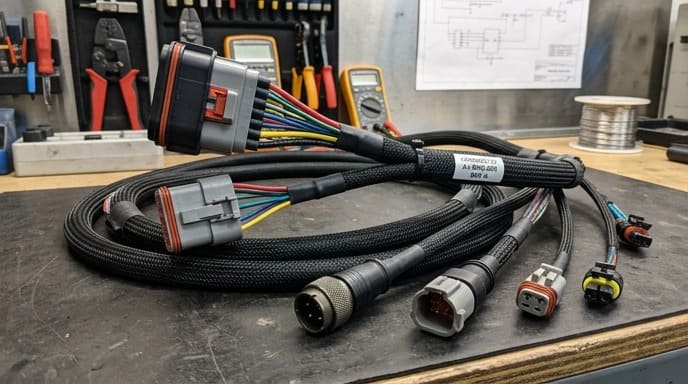
If a harness were simply wires and connectors, any assembly shop could produce one. The reality is that connector compatibility, pin count, and locking mechanisms turn a harness into a subsystem that must maintain electrical contact and mechanical integrity under vibration, thermal cycling, and exposure to fluids. A connector that fits perfectly on a bench but loosens after a few hundred hours of engine vibration is a warranty claim waiting to happen.
Environmental sealing is the next layer that separates commodity cables from engineered harnesses. Ingress Protection (IP) ratings are not achieved by adding a grommet after the fact. Boot seals, cavity plugs, and sealed connectors must be specified during the design review so that the harness routing, branch layout, and even the outer jacket material work together to keep moisture and dust out. For OEM equipment operating outdoors or in washdown environments, a single unsealed branch can lead to corrosion migrating up the wire strands into a control unit.
Industry guidance on acceptable workmanship comes from IPC/WHMA‑A‑620, the standard that defines criteria for crimp geometry, insulation displacement, strain relief, and overall assembly condition. It replaces subjective “looks good” evaluations with measurable targets. OEM buyers should not have to argue about quality; they should be able to reference this standard in a purchase specification and require that every harness meets the agreed class. Suppliers familiar with IPC/WHMA‑A‑620 can provide first‑article inspection reports that demonstrate compliance before production begins.
Material Trade-offs: PVC vs. TPE and Their Impact on Performance
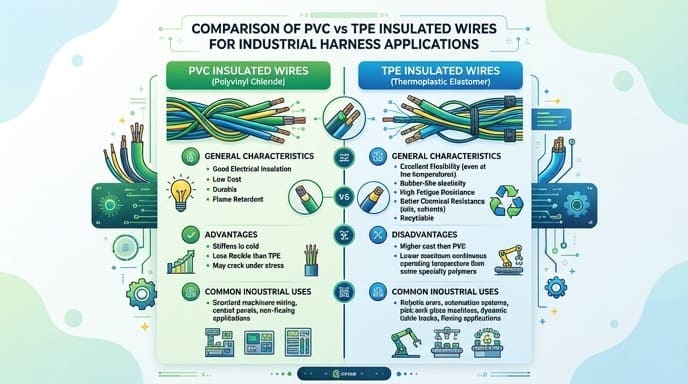
Choosing insulation material is rarely a simple cost decision. Two widely used compounds — PVC and thermoplastic elastomer (TPE) — behave very differently under thermal load, oil exposure, and repeated flexing. The table below summarizes key measurable parameters that should drive selection in an OEM harness program.
| Parameter | PVC (e.g., UL 1007[1], 1015) | TPE |
|---|---|---|
| Typical continuous temperature rating | 80°C (105°C for UL 1015) | 125°C and higher, depending on formulation |
| Flexibility at low temperature | Becomes stiff below -10°C; risk of cracking | Remains flexible well below -30°C |
| Resistance to oil and industrial fluids | Moderate; some compounds swell with prolonged exposure | Typically superior oil and chemical resistance |
| Abrasion resistance | Good for static routing; less suitable for dynamic flex | Excellent for applications involving continuous movement or rubbing |
| Flame rating (example UL styles) | UL 1007: VW-1; UL 1015: VW-1 | Can be compounded for VW-1 or higher ratings |
These materials are categorized under UL style designations that function as a verifiable shorthand: UL 1007 indicates a specific PVC compound with a 105°C continuous rating and VW-1 flame class, while UL 1015 covers a thicker wall construction rated for 105°C as well. When an OEM buyer sees a UL style number on a bill of materials, they can immediately reference the material’s properties without relying on a supplier’s marketing claims. For designs that must ship globally, RoHS compliance is a minimum expectation; both PVC and TPE can be formulated to meet RoHS requirements, but the OEM should always request a material declaration rather than assume.
A disciplined supplier will not simply offer a lower-cost insulation without first evaluating whether the compound can survive the thermal and mechanical environment. If an OEM application exposes the harness to hot engine oil, choosing a standard PVC insulation based on price alone will lead to premature failure and costly field replacements.
Industry Testing Standards That Validate Harness Reliability
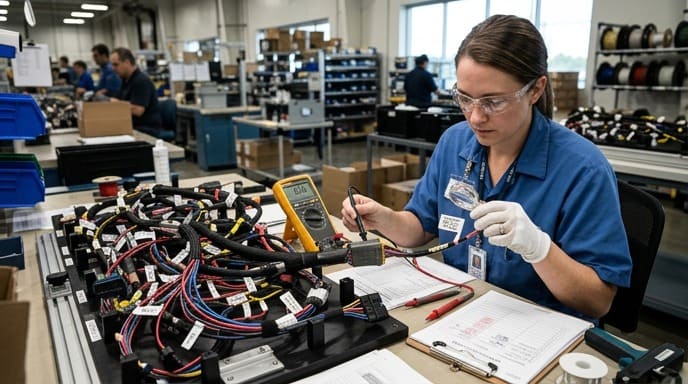
OEM procurement teams need a clear definition of what “tested” means. For custom harnesses, three electrical tests are essential before any unit leaves the factory:
- Continuity verification — ensures every wire path matches the wiring diagram, with no open circuits and no cross‑wiring between adjacent pins.
- Pull‑force testing — measures the mechanical retention of each crimped terminal. The acceptable force depends on wire gauge and terminal type, and IPC/WHMA‑A‑620 provides detailed tables for each combination.
- Hipot (dielectric voltage withstand) testing — applies a high voltage between circuits and the outer jacket to confirm that insulation can withstand potential spikes without breakdown.
IPC/WHMA‑A‑620 defines acceptance classes that map directly to product lifecycle expectations. Class 2 covers commercial and industrial equipment where extended service life is required but the operating environment is reasonably controlled. Class 3 applies to harsh vibration, temperature extremes, or safety‑critical functions — each crimp and routing decision is scrutinized to a higher standard, and the permissible defect rate is far lower. For OEM teams developing machinery that must run multi‑shift operations for years, specifying Class 3 from the start aligns the supplier’s quality system with the end‑use reality.
For automotive and off‑highway equipment, material specifications intersect with process standards through documents like SAE J1128. This standard defines the construction and performance requirements for low‑tension primary cable — the type of cross‑linked polyethylene or PVC insulated wire that runs through engine compartments, chassis, and body harnesses. By referencing SAE J1128 in a drawing, the OEM communicates not only the insulation type but also expectations for conductor stranding, strip resistance, and temperature rating. Together, IPC/WHMA‑A‑620 and SAE J1128 create a complete chain from material choice to final workmanship acceptance.
Critical Documentation Deliverables for OEM Procurement Teams
Quality cannot be assessed by looking at a finished harness. It must be demonstrated through documents that record what happened at each step of production. The minimum documentation package every OEM buyer should demand includes:
- Dimensional inspection report showing that branch lengths, breakouts, and connector positions match the drawing.
- Continuity and hipot test data for each individual harness or a representative sample, depending on lot size and testing agreement.
- Certificates of conformance and RoHS declarations, linking each material to its regulatory status.
- Material certifications for wire and terminals, including the UL style or manufacturer’s equivalent when relevant.
These documents are not optional extras. They are the evidence that a supplier has matched incoming materials to purchase specifications and that the finished assembly has passed agreed‑upon test limits. First‑article inspection (FAI) reports, built around the same acceptance criteria in IPC/WHMA‑A‑620, become especially valuable for new production runs or design changes. They establish a baseline that subsequent production samples can be measured against, making it easy for procurement managers to detect process drift before it leads to line‑down situations.
For more detail on how documentation ties into shipment readiness and final presentation, see quality inspection and export packaging practices that preserve harness integrity during transit.
Honest lead times for custom wiring harnesses never begin with an abstract “fast delivery” promise. The single largest variable is connector availability. Multi‑source connector families may ship in a few weeks, but customized or allocation‑constrained parts can extend procurement beyond 16 weeks. Even a well‑planned harness build can stall if a single 12‑pin sealed connector is on backorder.
Order complexity then multiplies the production timeline. Every breakout, every custom label, every glued or heat‑shrunk branch, every overmolded strain relief adds a sequential processing step. A harness with two breakouts and a simple PVC jacket may move through cutting and crimping in hours; a unit with a dozen branches, silicone jacket, convoluted tubing, and individually marked wire labels will spend days passing through multiple work centers. Reliable suppliers build this complexity into their scheduling algorithms rather than hiding it behind an overly optimistic date.
OEM buyers can influence lead times by providing a complete drawing, a bill of materials with approved alternates for long‑lead connectors, and a realistic target shipping window. This allows the production team to reserve capacity and order material early, rather than react to incomplete information. Transparent suppliers will flag connector risks immediately and offer mitigation options such as alternative sourcing — a critical support that helps keep OEM projects on track without compromising quality.
If the harness design also requires a separate custom cable assembly for sensor or power connections, coordinating lead times across both product categories becomes equally important, because each has its own material dependencies and testing steps.
From Drawing to Delivery: Structuring a Production-Ready Partnership
OEM procurement teams achieve scalable supply not by chasing the lowest quote, but by selecting a partner that treats wire processing as a quality‑managed system. The ideal onboarding sequence begins with a detailed drawing and specification review — an engineer reviewing pin numbering, connector orientation, and environmental seals while the procurement team confirms material availability and lead times. This review prevents most design‑related delays before a single wire is cut.
Next, the manufacturer coordinates connector matching, cable structure validation, and a pre‑production sample. This sample is the physical proof that the production process can meet IPC/WHMA‑A‑620 acceptance criteria, and it serves as the master reference for all future shipments. During full production, the manufacturing partner manages cutting, stripping, crimping, routing, labeling, and looming as a seamless sequence, with in‑line checks for continuity and appearance at each critical station. Final inspection compares each harness against the approved sample, the drawing, and the test data — not against vague expectations.
Export packaging then locks in all that value. Harnesses are routed into export cartons with internal protection to prevent connector damage, and each carton is labeled with part numbers, PO references, and quantity — matching the documentation package exactly. Suppliers such as EDOM Electronics support OEM buyers through exactly this kind of coordinated flow: drawing review, connector sourcing, sample confirmation, production follow‑up, in‑process inspection, and export‑ready packaging. When the shipment arrives at the buyer’s warehouse, the unpacked harness looks like the one that was approved, and the traceability records are complete.
Frequently Asked Questions
What is the difference between a wire harness and a cable assembly?
A wire harness groups multiple individual circuits that branch to different connection points according to a wiring schematic. A cable assembly typically has a single jacket and connects one interface to another. Both require disciplined wire processing, but harnesses demand more complex routing, labeling, and breakout management.
Which standard should I specify for automotive harness quality?
For automotive and off‑highway equipment, the core documents are SAE J1128 for low‑tension cable construction and IPC/WHMA‑A‑620 for harness workmanship acceptance. Referencing both in your drawing gives the manufacturer a clear technical baseline without redundant internal specifications.
How do I validate crimp quality without expensive equipment?
You don’t need your own lab. A competent harness manufacturer will provide crimp cross‑section photos or pull‑force test data against IPC/WHMA‑A‑620 thresholds. Request these as part of the first‑article inspection report; they prove that the crimp tooling and setup are correct for your specific wire and terminal combination.
Can a supplier really handle design review if I only have a sketch?
Yes, and this is where an experienced partner adds the most value. They can convert a rough sketch into a production‑ready drawing, recommend connector families with available stock, and flag sealing or routing problems before money is spent on tooling. Provide as much detail as possible — even a simple layout with pin counts and environmental requirements starts a productive conversation.
What packaging details protect harnesses during export shipping?
Harnesses should be individually coiled or laid flat with connector protectors in place. Export cartons need sufficient internal cushioning to prevent shifting and must be labeled with item numbers, quantities, and PO references that match the packing list. Sealed moisture‑barrier liners are advised for ocean freight.
Key Takeaways
- Wire processing is much more than bundling wires: it’s a controlled sequence of cutting, stripping, crimping, and routing that directly affects connector compatibility and system reliability.
- Material choices between PVC and TPE should be driven by temperature rating, oil resistance, and flexibility — not just unit cost — and UL style designations offer a verifiable basis for comparison.
- IPC/WHMA‑A‑620 provides objective acceptance criteria that OEM buyers should reference to remove subjectivity from quality inspection.
- Essential documentation — continuity reports, hipot data, RoHS declarations, and material certs — delivers traceability and turns quality claims into auditable evidence.
- Realistic lead time estimates depend on connector availability and harness complexity; providing a complete drawing and BOM with alternates early keeps production slots on schedule.
For OEM teams seeking a supplier that manages these details from drawing review through final export packaging, explore wire harness manufacturing services built for complex equipment needs.