Finding a supplier for custom LVDS cable assemblies feels like a sourcing problem. It is not. It is a capability verification problem — and most buyers find that out too late.
The safest way to find a custom LVDS cable assembly supplier is to identify manufacturers with in-house wiring, crimping, and controlled-impedance handling capability, then verify that capability through a structured sampling event — not through platform reputation or certifications alone.
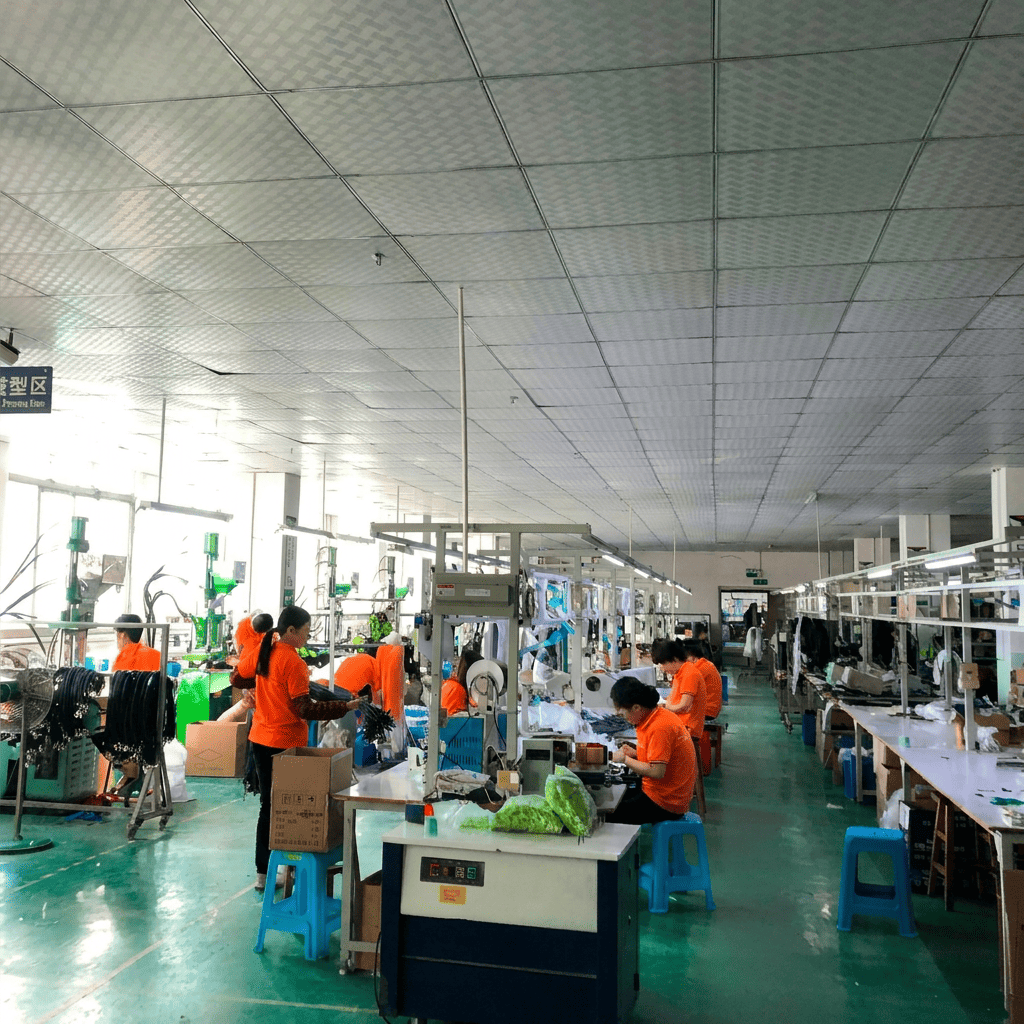
There is a gap between what most "LVDS cable suppliers" list and what an OEM engineer actually needs for a custom project. That gap causes rework, delays, and quiet production failures. This article breaks down where the gap comes from and how to close it before you send a purchase order.
Do You Actually Need a Custom LVDS Cable Assembly?
Most engineers searching for LVDS cable suppliers land on off-the-shelf listings first. That is a problem if what you need is not off-the-shelf.
A custom LVDS cable assembly differs from a standard cable in that it requires specific impedance control, a defined shielding structure, a precise connector pitch and orientation, and an AWG selection matched to your signal distance and current requirements — none of which off-the-shelf products are built to accommodate.
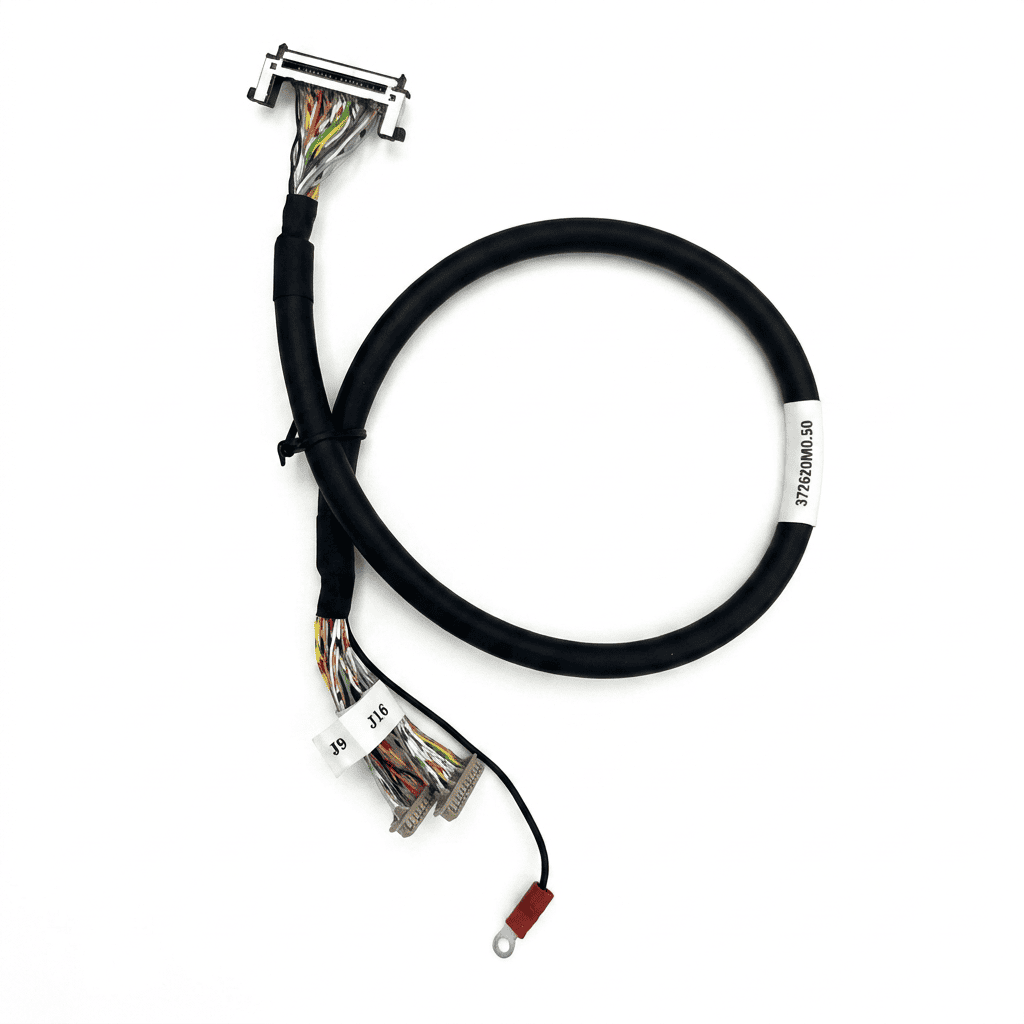
The word "custom" covers a wide range of actual requirements. Understanding where your project sits on that range helps you filter suppliers much faster.
What Does "Custom" Actually Mean for LVDS Cable Assemblies?
We receive RFQs at EDOM that say "custom LVDS cable" and mean very different things. Some engineers need a non-standard connector pitch. Others need a specific shielding type because their enclosure creates interference. Others have a controlled-impedance requirement from their display driver spec sheet1.
Here is a breakdown of what "custom" typically covers in the LVDS cable assembly context:
| Custom Requirement | What It Means in Practice | Why Off-the-Shelf Fails |
|---|---|---|
| Impedance control | The cable must maintain a defined differential impedance (commonly 100Ω) along its full length2 | Stock cables are not built to controlled-impedance specs |
| Connector pitch | Board-side or display-side connectors must match a specific FPC or ZIF footprint | Off-the-shelf assemblies use standard pitch only |
| Shielding type | Foil, braid, or combination shielding selected based on EMI environment3 | Stock cables use a single default shielding configuration |
| AWG selection | Wire gauge must match current load and signal integrity requirements for your cable run length4 | Off-the-shelf uses a fixed gauge regardless of application |
| Connector orientation | Right-angle, vertical, or reverse-locking connectors to match physical assembly constraints | Standard cables offer limited or no orientation options |
| Cable length and routing | Exact length with defined bend radius for tight enclosures | Catalog lengths do not match project-specific routing paths |
If your project requires two or more of these, you are not looking for a cable distributor. You are looking for a custom cable assembly manufacturer with engineering capability at the front end of the process.
At EDOM, we frequently see buyers come to us after spending weeks with a trader who confirmed dimensions and wire count but could not address impedance or shielding. That confirmation-without-capability pattern is very common in the market and it wastes the most valuable thing on a hardware project timeline: early sampling time.
What Technical Questions Should You Ask Before Requesting a Sample?
Most buyers ask for a sample too early. The sample request should come after you have confirmed that the supplier can actually meet your spec — not as a way to find out.
Before requesting a sample, you should ask the supplier directly about their impedance control capability, shielding construction options, crimp tooling range, and whether they can review your connector datasheet and confirm a mating solution. A supplier who answers these questions clearly — without deflecting to "we can do any custom" — is worth sampling.
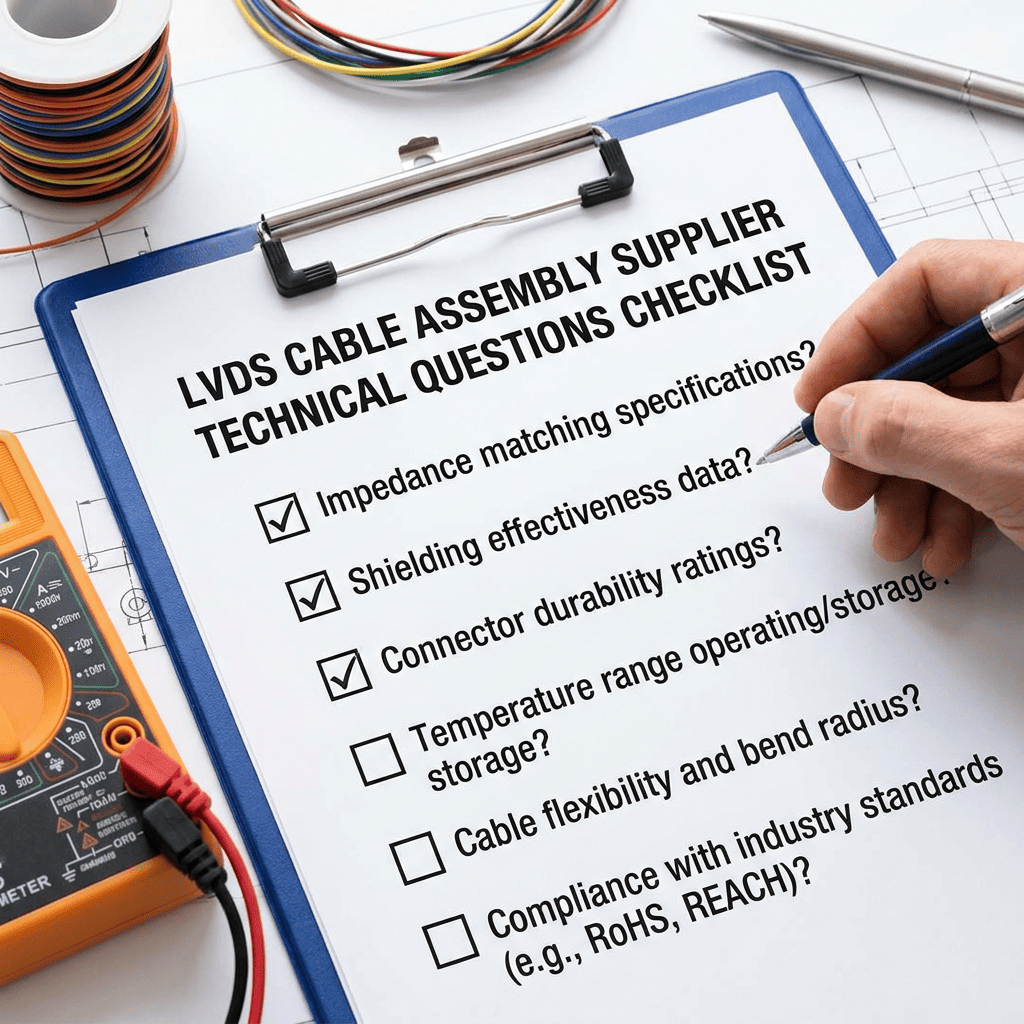
A capable supplier responds to technical questions with technical answers. That sounds obvious, but it is not the norm in the market.
A Pre-Sample Checklist for Custom LVDS Cable Assembly Suppliers
We use a structured intake process at EDOM when we receive a custom LVDS RFQ. The questions we ask buyers mirror the questions buyers should ask us. Here is that checklist from both sides:
| Question to Ask the Supplier | What a Capable Supplier Will Tell You | Red Flag Response |
|---|---|---|
| Can you handle controlled-impedance cable for differential signals? | Yes — and they will ask what impedance value your driver spec requires | "Yes, we can do any custom cable" (no follow-up question) |
| What shielding constructions can you build? | Foil only, braid only, or foil+braid — with guidance on which suits your EMI environment5 | "We use standard shielding" with no further clarification |
| Can you review my connector datasheet and confirm the crimp tooling? | They will request the datasheet and confirm the contact series and crimp die they use | "We support all connectors" with no request for your spec |
| What is your first-article turnaround for sampling? | A specific number of days based on component availability | "We are very fast" with no timeline |
| Do you have in-house testing for continuity and signal integrity? | They describe the specific tests they run and the equipment they use | "We test all products before shipment" with no specifics |
| What is your minimum order quantity for custom cable assemblies? | A number — and a clear statement of what changes at higher volumes | Deflection or refusal to answer until you place an order |
The checklist is not about catching suppliers in a lie. It is about distinguishing between a factory that has built LVDS assemblies before and a trading company that will outsource your job to a subcontractor they have not screened.
In our own RFQ intake, when a buyer provides a display driver spec with an impedance target, we ask which connector is on the display-side, what the cable run length is, and whether the assembly will operate in an electrically noisy enclosure. Those questions shape the shielding and AWG recommendation before sampling starts. If a supplier does not ask these questions, they are guessing — and you will discover that when the first article arrives.
Why Is Sampling the Most Reliable Capability Filter?
Certifications are not a capability filter. A factory can hold an ISO 9001 certificate and still have no engineering depth on controlled-impedance cable construction6. Buyers in the US, EU, and Australia already know this. The question is what actually tells you whether a supplier can execute on your spec.
Sampling is the most reliable filter because it forces the supplier to engage with your actual requirements in real production conditions. The accuracy of the first article, the questions they ask before building it, and the speed of their response to revision feedback all reveal capability that no document can confirm.
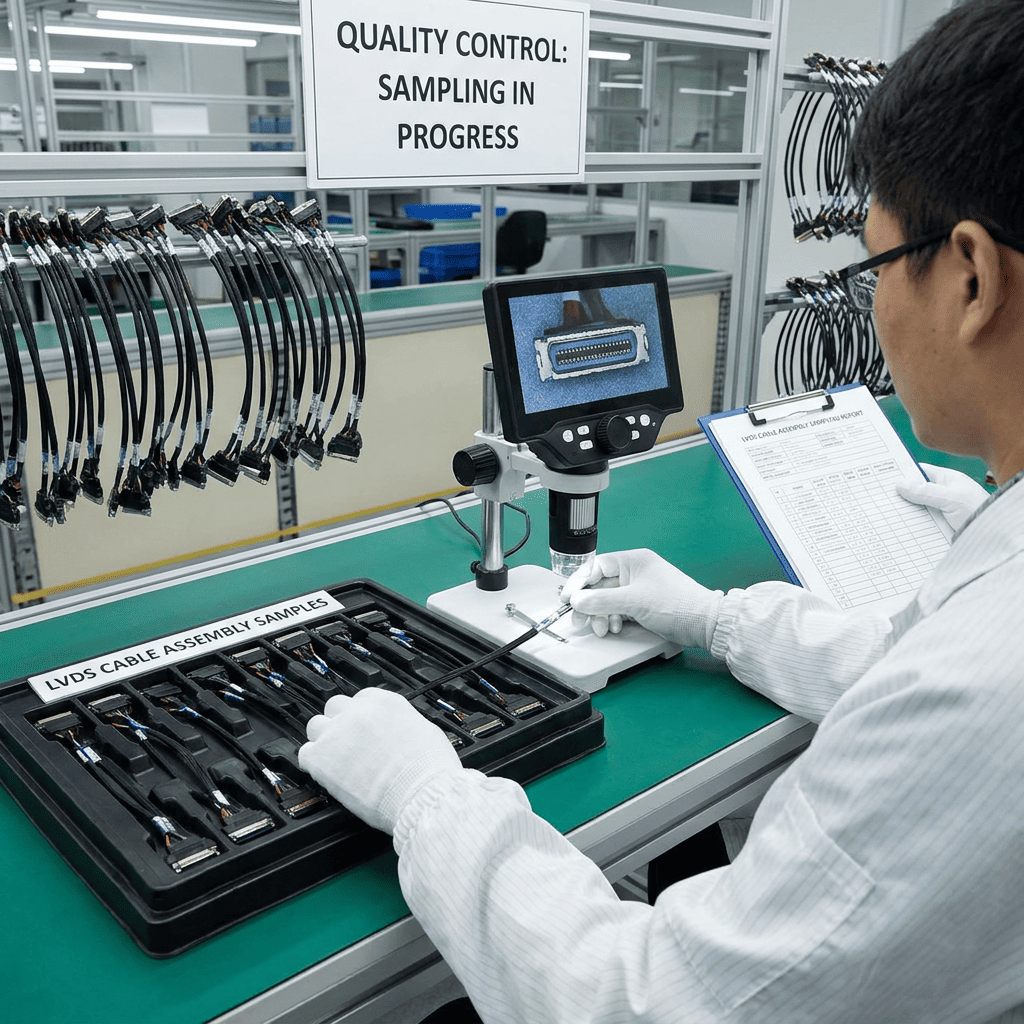
We treat every sampling event at EDOM as a two-way technical conversation, not a transaction. The buyer learns whether we can execute their spec. We learn whether the buyer's spec is complete enough to produce to. Both sides need that information before volume production starts.
How to Read a Supplier's Sampling Behavior
Here is what to watch for when you send a custom LVDS sample request to a supplier:
| Sampling Signal | What It Tells You | How to Use It |
|---|---|---|
| They ask clarifying questions before starting | They are building to your spec, not a guess | Positive signal — answer completely and note how precise their questions are |
| First article matches connector pitch and orientation exactly | They have the right tooling and read your spec correctly | Proceed to electrical verification |
| First article has correct wire count but wrong shielding | They can handle the mechanical build but may lack shielding process control | Ask specifically how they will correct it and what caused the deviation |
| They ship the sample with a dimensional inspection report | They have a first-article inspection process7 | Positive signal — review the report against your spec |
| Turnaround was faster or slower than quoted without notice | Their production communication is weak | Ask for a revised timeline with daily checkpoints on the next sample |
| They request a revision fee for a first-article error | They are not confident in their first-pass accuracy | Treat this as a negotiation signal and evaluate their error explanation carefully |
| They ask about your testing requirements before shipment | They want to confirm the sample meets your end-use criteria | Positive signal — share your test protocol if you have one |
We have found in our own sampling process that the buyers who provide the most complete specs — connector datasheet, impedance target, shielding preference, and cable routing photos — receive the most accurate first articles. The quality of a first article is partly a supplier capability signal and partly a buyer spec quality signal. Both matter.
If a supplier ships a first article with no inspection documentation, no deviation notes, and no request for feedback, that is not confidence. That is a sign that they are not treating the sample as a technical event. For a custom LVDS cable going into a display or embedded system8, that is a serious risk indicator.
Does the Sourcing Channel Matter — Alibaba, Trade Show, or Google?
Many buyers assume that finding a supplier through Google means the supplier is better than one found on Alibaba. Or that meeting a supplier at a trade show adds a trust layer that an online listing does not. These assumptions are mostly wrong.
The sourcing channel tells you almost nothing about a supplier's custom cable assembly capability9. What matters is whether the company is a factory with in-house wiring, crimping, and testing operations — or a trading company that places your order with a sub-manufacturer10. That distinction exists equally across all discovery channels.
The channel is just how you found them. Capability verification is still your job after that.
How to Verify Factory vs. Trader Across Sourcing Channels
Here is how the same verification questions apply regardless of where you found the supplier:
| Verification Question | Factory Signal | Trader Signal |
|---|---|---|
| Can I see your production floor, either in person or via video call? | They schedule a walkthrough with actual equipment visible | They show you a showroom or redirect to a certificate |
| Who handles engineering questions during the RFQ — a salesperson or an engineer? | An engineer joins the call or responds directly to technical questions | All communication goes through a salesperson who relays answers |
| What crimp tooling do you use for this connector series? | They name the applicator brand and confirm they have the die for your contact | They say they "have all tooling" without specifics |
| Where are your components sourced — connector housings, contacts, and cable? | They name specific component suppliers or brands | They say "we source from qualified suppliers" without detail |
| Can you provide a factory audit or production photos during sampling? | Yes, with photos from your actual job on the line | They provide stock photos or decline |
When I speak with a new potential customer at EDOM, the first thing I want them to do is ask us these questions. If a supplier is bothered by these questions, that tells you something. A factory with real production depth welcomes them because the answers are specific and confirmable.
Alibaba has factories. Google has traders. Trade shows have both. The platform is not the filter. The questions above are the filter.
What Should You Prioritize: Price, Speed, or Technical Fit?
For custom LVDS cable assemblies going into display systems or embedded hardware, the wrong priority ordering causes the most expensive mistakes.
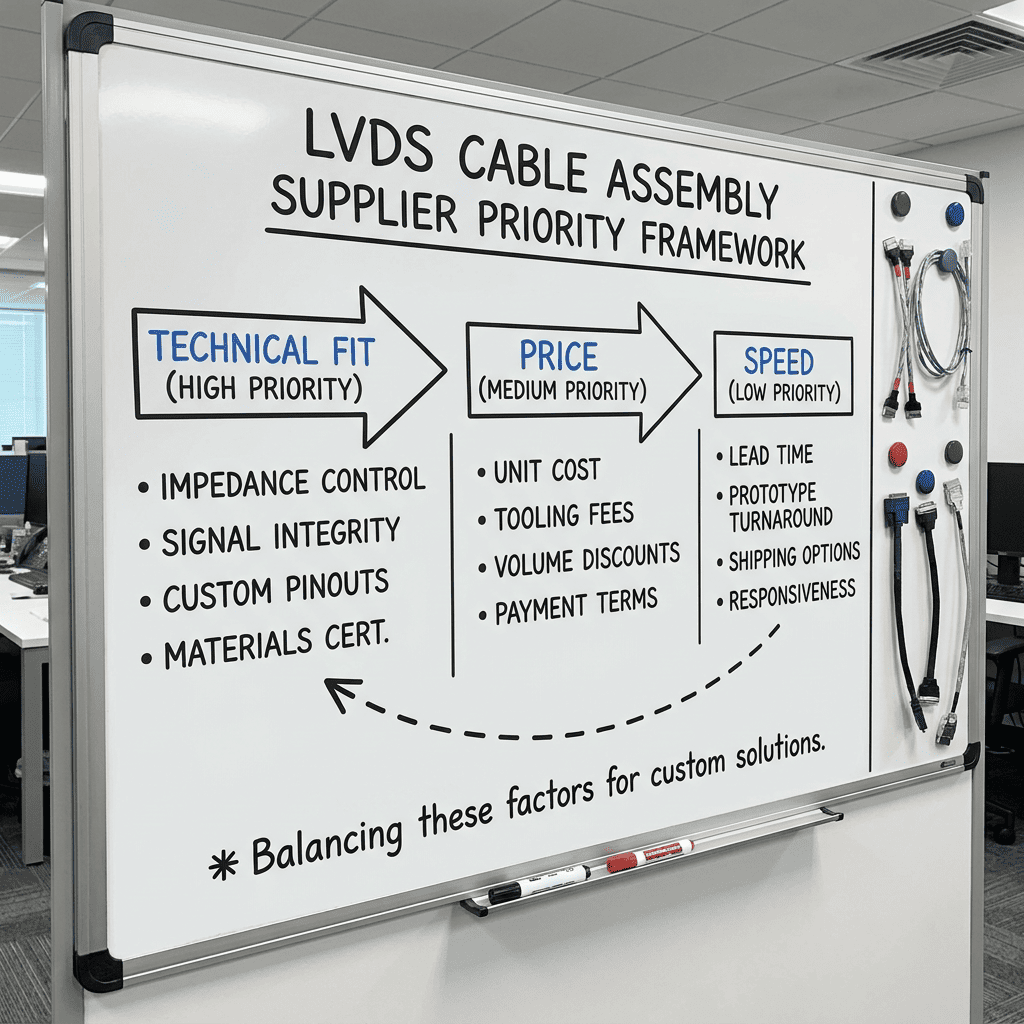
For a custom LVDS cable assembly, technical fit must come first, delivery timeline second, and unit price third. A lower unit price from a supplier who cannot maintain your impedance spec or shielding structure will cost more in rework and project delay than the price difference saved.
 )
)
This does not mean price is irrelevant. It means that evaluating price before confirming technical fit puts the decision in the wrong order.
A Priority Framework for Custom LVDS Cable Supplier Selection
Here is how I recommend ordering the evaluation for a custom LVDS cable assembly project:
| Priority Level | Evaluation Criteria | How to Confirm It |
|---|---|---|
| 1 — Technical fit | Can the supplier build to your impedance, shielding, and connector spec? | Pre-sample technical questions (see checklist above) |
| 2 — Sampling behavior | Does the first article match your spec? Do they ask the right questions? | Request a sample with a complete spec package |
| 3 — Production communication | Can they give you a reliable timeline and update you during production? | Ask for a milestone schedule on the sample and watch whether they keep it |
| 4 — Unit price at volume | Is the price competitive at your target annual volume? | Request pricing at your realistic annual quantity, not a one-time prototype quantity |
| 5 — MOQ and flexibility | Can they accommodate your volume ramp without large upfront commitments? | Ask specifically about MOQ at proto stage, low-volume production, and full production |
At EDOM, we work with OEM customers who are early in their product development cycle. Their volumes start low and increase as their product reaches market. We keep our MOQs accessible for that reason — because forcing a customer into a large first order before they have confirmed their design is a bad outcome for both sides.
The buyers who have the worst experiences with custom cable assembly suppliers are the ones who awarded the job based on price alone11, then discovered during sampling that the supplier's engineering team could not interpret their impedance spec. By the time that failure surfaces, the project is already behind.
Conclusion
Finding a qualified custom LVDS cable assembly supplier comes down to one thing: confirming capability before you sample, and confirming execution during the sample — not after production starts.
"[PDF] LVDS Owner's Manual - Non-secure http index page", https://web.pa.msu.edu/hep/d0/ftp/run2b/l1cal/hardware/component_information/national_lvds_owners_manual.pdf. LVDS driver and receiver datasheets typically specify a differential characteristic impedance requirement for the interconnecting cable, commonly 100Ω, to ensure that reflections at impedance discontinuities remain within acceptable limits for reliable data transmission. Evidence role: mechanism; source type: research. Supports: That display driver integrated circuits specify transmission line impedance requirements in their datasheets, which cable assemblies must match to ensure proper signal integrity. Scope note: Specific impedance values and tolerances vary by device manufacturer and application; the cited value represents a common industry convention rather than a universally mandated figure. ↩
"[PDF] LVDS Owner's Manual - Non-secure http index page", https://web.pa.msu.edu/hep/d0/ftp/run2b/l1cal/hardware/component_information/national_lvds_owners_manual.pdf. The TIA/EIA-644 standard for Low Voltage Differential Signaling specifies a nominal differential impedance of 100Ω for the transmission medium, which cable assembly designs must match to ensure signal integrity. Evidence role: definition; source type: institution. Supports: That 100Ω differential impedance is the standard target for LVDS transmission lines as defined in the relevant electrical signaling standard. Scope note: Specific display panel implementations may deviate from this nominal value; the standard defines the baseline, not every application variant. ↩
"[PDF] Measurement of shielding effectiveness of different cable ... - GovInfo", https://www.govinfo.gov/content/pkg/GOVPUB-C13-c89ff483e6cd6381d7cf6f7fbd7a3f66/pdf/GOVPUB-C13-c89ff483e6cd6381d7cf6f7fbd7a3f66.pdf. Technical literature on cable shielding distinguishes foil shields, which provide high coverage at high frequencies, from braid shields, which offer lower DC resistance and better mechanical flexibility, with combination constructions used where broadband attenuation is required across both low and high frequency interference sources. Evidence role: mechanism; source type: research. Supports: That foil, braid, and combination shielding constructions offer different EMI attenuation characteristics and are selected based on the frequency range and nature of the electromagnetic environment. Scope note: Optimal shielding selection depends on application-specific factors including frequency spectrum, enclosure geometry, and grounding scheme, which no single general reference fully addresses. ↩
"Differential Paired Cables And When To Use Them - Epec's Blog", https://blog.epectec.com/differential-paired-cables-and-when-to-use-them. In differential signal cable design, conductor gauge influences both the DC resistance relevant to current capacity and the per-unit-length attenuation of high-frequency signal components, with smaller gauges exhibiting higher resistance and greater signal loss over equivalent run lengths. Evidence role: mechanism; source type: research. Supports: That conductor gauge affects both resistive current-carrying capacity and signal attenuation characteristics over a given cable length in differential signaling applications. Scope note: The precise relationship between gauge, attenuation, and acceptable run length is application-dependent and must be evaluated against the specific signaling standard's loss budget. ↩
"Custom Shielded Cable Assemblies – EMI Protection for Any ...", https://www.epectec.com/cable-assemblies/shielded-cables.html. IEC and CISPR electromagnetic compatibility standards require that cable assemblies used in electronic equipment be designed with shielding appropriate to the electromagnetic environment, with shielding effectiveness requirements determined by the emission limits and immunity thresholds applicable to the product category and installation environment. Evidence role: mechanism; source type: institution. Supports: That electromagnetic compatibility standards and engineering guidelines require cable shielding to be selected based on the electromagnetic environment in which the assembly will operate, including both emissions and immunity considerations. Scope note: Specific shielding requirements vary substantially by product category, geographic regulatory jurisdiction, and installation class; no single standard prescribes a universal shielding construction for all LVDS cable applications. ↩
"[PDF] ISO 9001 Auditing Practices Group Guidance on: Scope and ...", https://committee.iso.org/files/live/sites/tc176/files/PDF%20APG%20New%20Disclaimer%2012-2023/ISO-TC%20176-TF_APG-Scope%20and%20app%20rev%2012-01-2023%20ed1.pdf. ISO 9001 specifies requirements for a quality management system and is concerned with an organization's ability to consistently provide products meeting customer and regulatory requirements, not with the presence of specific technical capabilities or engineering expertise in any particular manufacturing discipline. Evidence role: definition; source type: institution. Supports: That ISO 9001 certifies quality management system processes rather than specific technical or engineering competencies in a given manufacturing domain. Scope note: This is a general characterization of the standard's scope; whether a specific certified facility possesses a given technical capability requires independent verification beyond the certification itself. ↩
"First article inspection - Wikipedia", https://en.wikipedia.org/wiki/First_article_inspection. First Article Inspection, as defined in standards such as AS9102 for aerospace and analogous quality frameworks in electronics manufacturing, requires documented verification that a newly produced part or assembly conforms to all applicable design and specification requirements before volume production is authorized. Evidence role: definition; source type: institution. Supports: That first-article inspection is a formally defined quality process requiring dimensional and functional verification of a new part against its design specification prior to production release. Scope note: Formal FAI standards are most rigorously applied in aerospace and defense supply chains; their adoption in commercial cable assembly manufacturing varies by customer requirement and supplier quality system maturity. ↩
"Low-voltage differential signaling - Wikipedia", https://en.wikipedia.org/wiki/Low-voltage_differential_signaling. LVDS became a prevalent interface for connecting flat panel displays, particularly in laptop computers and industrial embedded systems, owing to its low power consumption, high data rate capability, and reduced electromagnetic emissions compared to single-ended alternatives. Evidence role: historical_context; source type: encyclopedia. Supports: That LVDS has been widely adopted as an interface standard in flat panel display connections and embedded computing applications. Scope note: Adoption patterns vary by market segment and era; newer display interface standards such as eDP and MIPI DSI have displaced LVDS in some consumer electronics categories. ↩
"Evaluating the drivers of B2B performance: An empirical analysis ...", https://pmc.ncbi.nlm.nih.gov/articles/PMC11244795/. Studies of B2B sourcing platforms indicate that listing presence and platform reputation metrics are weak proxies for actual manufacturing capability, and that buyers relying on platform signals without independent technical verification face elevated risk of supplier non-performance. Evidence role: general_support; source type: research. Supports: That the channel through which a supplier is identified does not reliably predict manufacturing capability, and that independent capability verification is necessary regardless of discovery method. Scope note: Published research on this topic tends to address general B2B e-commerce rather than specialized electronics cable assembly procurement specifically. ↩
"Trading vs Manufacturing, Which Business to Start in 2026", https://www.globalsources.com/knowledge/trading-vs-manufacturing-which-business-to-start-in-2024/. Supply chain research on electronics manufacturing intermediaries identifies that trading companies, which do not perform manufacturing themselves, can obscure the identity of the actual production facility from the buyer, limiting the buyer's ability to conduct direct capability audits and creating traceability gaps in quality management. Evidence role: general_support; source type: research. Supports: That intermediary trading companies in electronics supply chains introduce quality and traceability risks by subcontracting production to manufacturers the end buyer has not directly qualified. Scope note: Not all trading companies present equivalent risk; some maintain rigorous subcontractor qualification programs, and the risk level depends on the buyer's own verification practices. ↩
"[PDF] EFFECTIVE METHODOLOGIES FOR SUPPLIER SELECTION AND ...", https://etda.libraries.psu.edu/files/final_submissions/419. Research on supplier selection in electronics manufacturing indicates that price-dominant evaluation criteria, when applied without sufficient technical qualification, correlate with elevated rates of non-conformance and rework costs that frequently exceed the initial price savings achieved. Evidence role: general_support; source type: research. Supports: That procurement decisions based primarily on unit price without adequate technical qualification are associated with higher downstream quality failure and rework costs in electronics manufacturing. Scope note: Most published research addresses broader electronics or contract manufacturing contexts rather than cable assembly specifically; direct empirical data on LVDS cable procurement outcomes is not widely available in the literature. ↩