If you just received a drawing that says wire harness and you’re not sure what that means or what you need to prepare, this is the right place to start. A wiring harness is an organized bundle of wires and cables that routes power and signals throughout a vehicle, protecting conductors from vibration, heat, and moisture. For OEM buyers, understanding its components and the exact information suppliers need to quote accurately is the critical first step before engaging a manufacturer.
What Exactly Is a Wiring Harness?
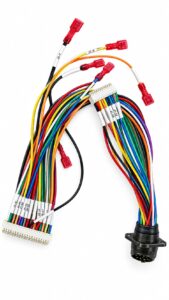
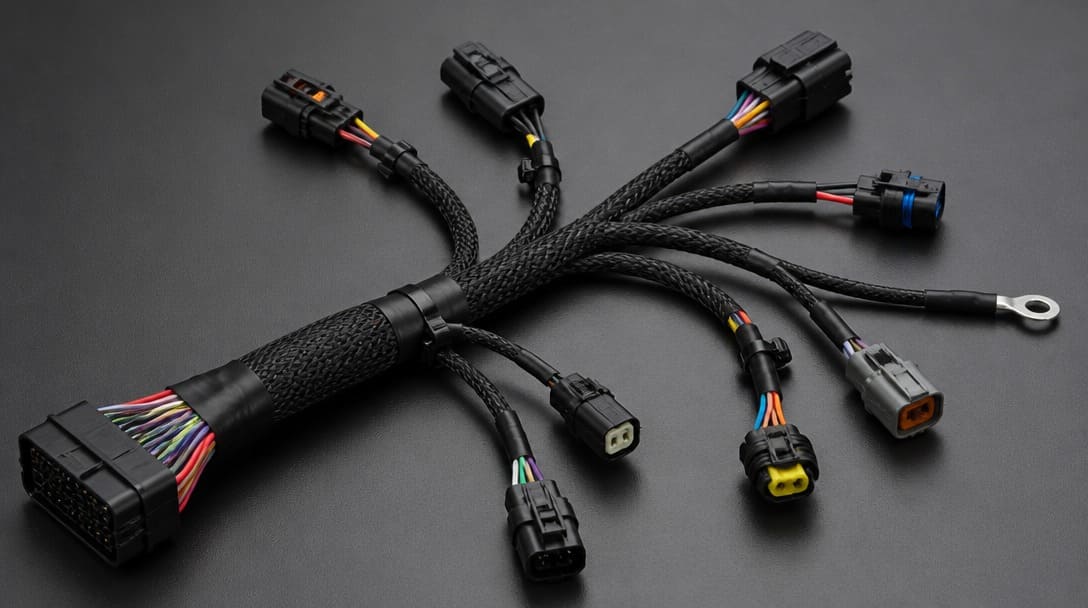
A wiring harness is a purpose-built assembly of conductors, terminals, connectors, and protective elements laid out to follow a defined path within a vehicle. It doesn’t just carry current — it manages the physical routing of multiple circuits, prevents chafing against sharp edges, and drastically reduces assembly-line errors during vehicle production.
The core components include:
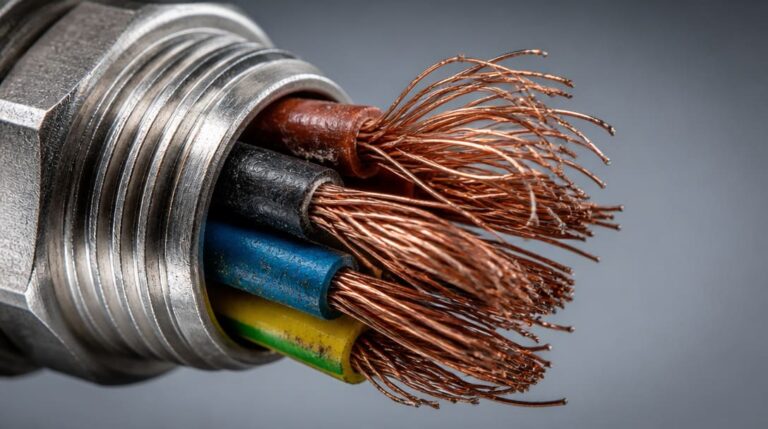
- Conductors — stranded copper wire specified in AWG (SAE J1128) or Metric cross-sections (mm² under ISO 6722-1), selected for current-carrying capacity, flexibility, and temperature ratings.
- Terminals — crimped metal contacts that connect each wire to a connector housing or grounding point, evaluated under USCAR-21 crimp performance standards.
- Connectors — plastic housings (with TPA/CPA locking mechanisms and optional IP67/IP69K seals) that mate with counterpart connectors, securing terminals and providing electrical insulation.
- Protective sleeving — conduit, braided loom, spiral wrap, or textile tape that shields wires from mechanical wear and environmental exposure.
- Labels — printed markers or heat‑shrink tubing that identify circuit numbers, aiding installation and future service diagnostics.
Unlike loose wiring added one strand at a time, a harness is built off‑vehicle on a fixture board. Every branch length, breakout point, and connector orientation is pre‑defined, so the entire assembly drops into the vehicle in minutes rather than hours.
Wiring Harness vs. Cable Assembly: Clearing the Most Common Confusion
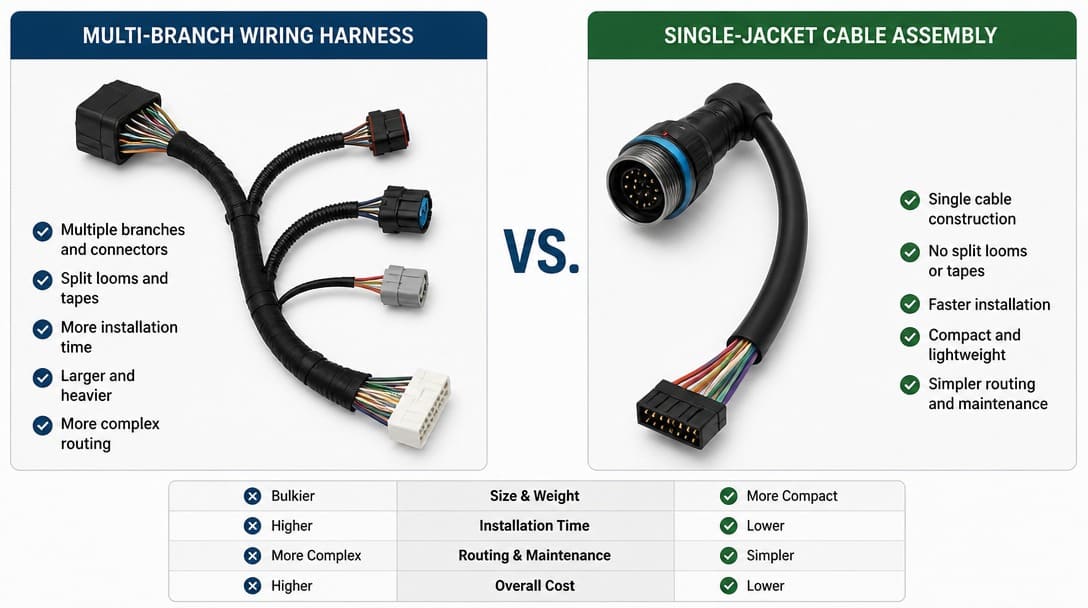
One of the most frequent missteps in early‑stage sourcing is using the terms “wiring harness” and “cable assembly” interchangeably. While they often coexist in the same vehicle, they serve different engineering purposes and are quoted against different manufacturing standards.
| Feature | Wiring Harness | Cable Assembly |
|---|---|---|
| Construction | Multiple discrete wires bundled together, each with its own insulation | One or more conductors housed inside a single overall jacket |
| Primary protection | External tape, conduit, or loom over a wire bundle | Outer jacket designed for environmental sealing and mechanical durability |
| Typical use | Inside vehicle cabin and protected chassis areas | Exposed areas such as engine compartments, underbody, and inter‑module links |
| Examples | Dashboard harness, door harness, HVAC control harness | Battery cable, ABS sensor lead, USB‑to‑OBD link |
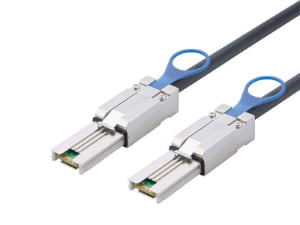
Why does this matter for procurement? A drawing labeled “cable assembly” that is actually a multi‑branch harness will receive an incorrect quote if the supplier assumes a simple jacketed cable. Conversely, a harness may contain several cable assemblies as sub‑components — a main trunk might use a jacketed cable for its heavy‑gauge power feed, while the rest of the branches are tape‑wrapped wires. For modular needs that demand a single jacketed product rather than a routed bundle, a custom cable assembly is often the correct category.
Ready to Specify Your Wiring Harness? Start Here
If you already have a drawing or BOM with a harness requirement and need to move toward a production‑ready quotation, gathering the right data points before you reach out will compress lead times dramatically. Suppliers such as EDOM Electronics support OEM buyers with requirement review, connector matching, sample coordination, production follow‑up, inspection, and export‑ready packaging for custom cable assemblies and wire harnesses. By understanding what information actually drives a quote, you turn a guessing game into a structured RFQ.
Why a Simple Drawing Isn’t Enough to Get a Quote
In our experience, the first inquiry from a new buyer almost always arrives without a quantity. Without that one number, we can’t give a meaningful price — material costs shift significantly between 50 units and 500. Wire and connector pricing are heavily tied to volume tiers, and a harness priced at prototype quantities can look nothing like a production‑run quote.
Wire specification adds another layer. The exact AWG gauge, stranding, and insulation material directly influence both cost and availability. A drawing that simply says “wire” doesn’t tell a manufactu… For comprehensive guidance, see our guide to harness wire.
Common Insulation Types at a Glance
| Insulation Type | Temperature Rating | Resistance Profile | Typical Application |
|---|---|---|---|
| PVC (GPT / TWP) | -40°C to +85°C / 105°C | General abrasion, moderate oil | Cabin interior, doors, dashboards |
| XLPE (GXL / TXL) | -40°C to +125°C / 150°C | Superior heat, cut-through & chemical | Engine bays, chassis, powertrain |
| Silicone | -60°C to +200°C | Extreme heat & extreme flexibility | Exhaust sensors, high-flex joints |
(Note: Never mix Tin and Gold contact pairings in the same connector assembly, as galvanic action can cause fretting corrosion under vehicle vibration.)
Connector plating is equally decisive. A tin‑plated terminal performs well in dry cabin environments at a lower cost, but gold plating may be required for low‑voltage sensors or high‑mating‑cycle applications. If plating isn’t specified, the supplier must either halt the quotation process or guess — and guessing creates risk for both parties. Color requirements follow a similar logic: stock colors such as black, red, or white are often immediately available, but a custom stripe or a non‑standard solid pigment can trigger minimum order quantities (MOQs) for the wire itself, which ties up working capital and extends lead times.
The 5 Data Points Every Harness Quote Depends On
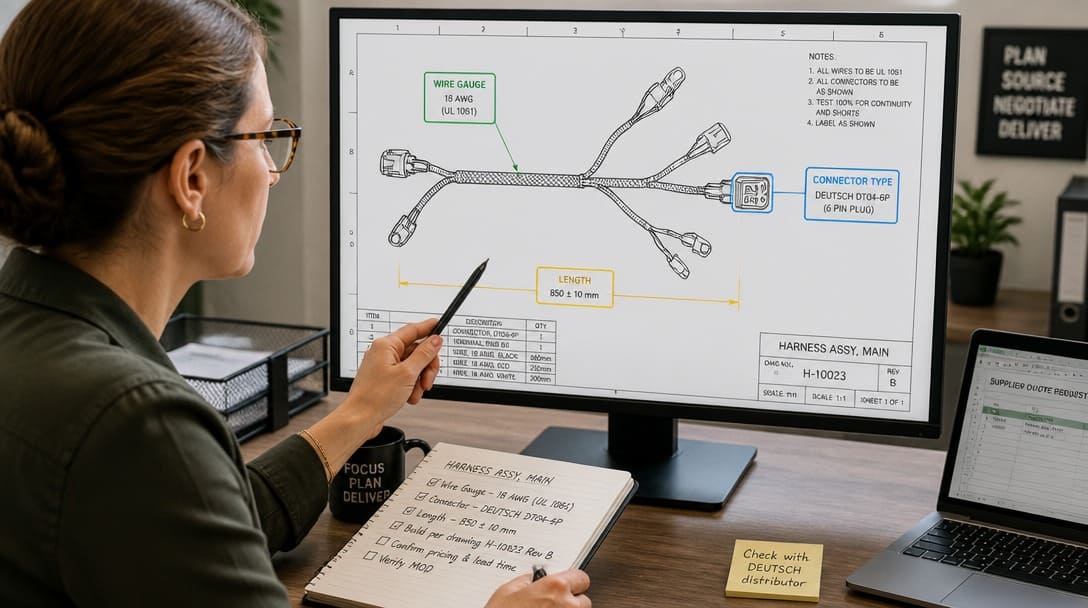
Before sending an RFQ, having these five items defined will give a supplier everything needed to return an accurate price, not a placeholder estimate.
- Target Quantities & Production Phases: Prototypes (e.g., 50 pcs) vs. annual production (EAU) directly influence tooling/applicator NRE costs.
- Detailed Wire Schedule: Exact gauge (AWG or mm²), conductor stranding, insulation type (e.g., TXL vs. PVC), and wire color coding.
- Connector Part Numbers & Approved Vendor List (AVL): Specific OEM part numbers (TE, Molex, Deutsch, etc.) and whether equivalent/alternative connectors are accepted to shorten lead times.
- Mechanical Layout & Branch Tolerances: Branch lengths, breakout positions, and allowable dimensional tolerances (e.g., ±5 mm).
- Quality & Testing Benchmarks: Compliance level, such as IPC/WHMA-A-620 Class 2 or Class 3, along with requirements for 100% electrical testing or micro-section analysis.
Inside the Wire Harness Manufacturing Process (Step‑by‑Step)
Understanding these manufacturing steps helps an OEM buyer appreciate why accurate specifications are critical before tooling is configured and materials are committed.
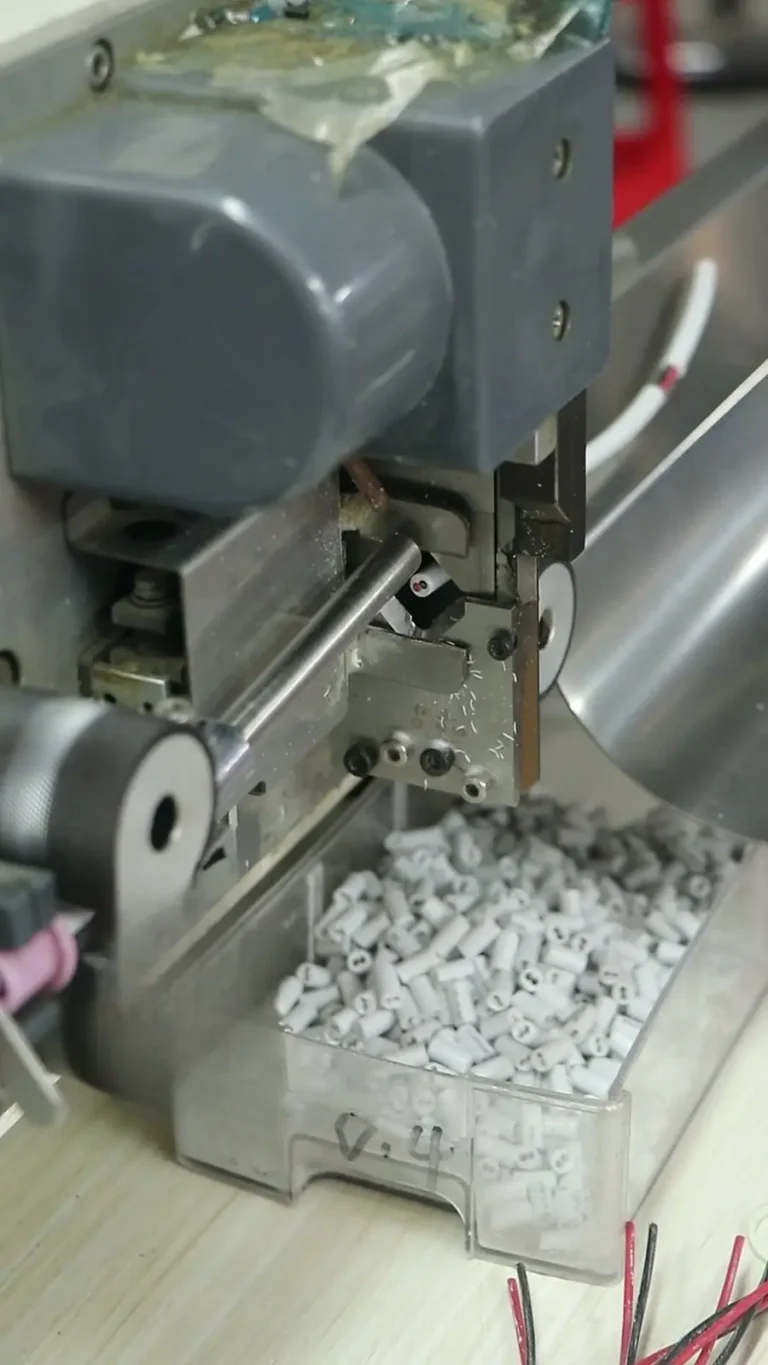
- Wire cutting and stripping — Automated machines cut and strip wire to the precise lengths defined on the build sheet or NA (non‑available) diagram. Even a few millimeters of error on a branch length can prevent a connector from reaching its mating point.
- Terminal crimping — Terminals are attached to wire ends using automated or semi-automated presses. Critical quality controls at this stage include measuring crimp height/pull-force limits, using Crimp Force Monitoring (CFM) on automated lines, and performing micro-section (cross-sectional) analysis to guarantee gas-tight crimps.
- Connector housing insertion — Terminals are seated into connector housings with an audible click. Operators verify proper locking and no backed‑out contacts.
- Routing and forming — Wires are laid onto a nail board or fixture board that replicates the exact harness geometry. Branches, breakouts, and splice locations are positioned according to the drawing.
- Protective sleeving — Conduit, braided loom, or tape wrapping is applied over the routed bundle. The choice of protection depends on the harness’s location in the vehicle and the abrasion risk.
- Labeling and marking — Circuit identifiers are added via heat‑shrink labels, self‑laminating tags, or ink‑jet printing. Traceability information links the finished harness back to its production batch.
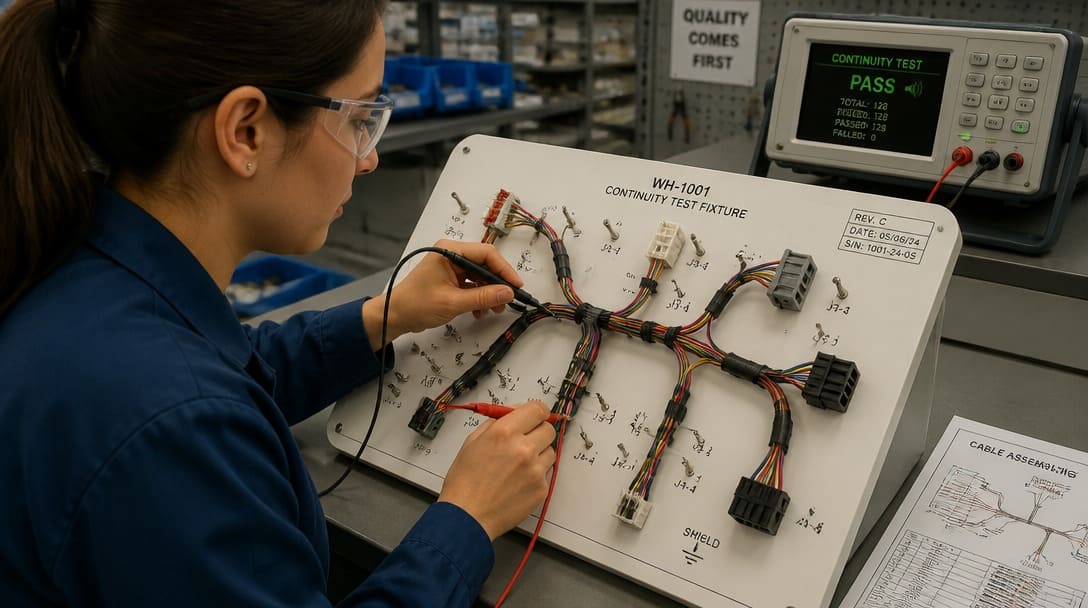
- Final inspection and export packaging — Continuity testing verifies every circuit path, and visual final checks confirm connector orientation, label readability, and absence of physical damage. The assembly is then packed for export according to the buyer’s logistics requirements. For a deeper look at the inspection protocols that protect product integrity during international shipment, see quality inspection and export packaging procedures.
Frequently Asked Questions
What quality standard should I specify for custom automotive wire harnesses?
For general industrial equipment, IPC/WHMA-A-620 Class 2 is standard. For automotive, heavy machinery, or mission-critical applications, specify IPC/WHMA-A-620 Class 3 and USCAR-21 crimp performance requirements, alongside an IATF 16949 certified manufacturing facility.
What is the main purpose of a wiring harness in a vehicle?
A wiring harness consolidates all the electrical circuits in a defined section of the vehicle into a single, protected assembly. It replaces dozens of loose wires, reducing installation time, preventing misrouting, and absorbing vibration so that conductors don’t rub through insulation.
Why do suppliers need the connector part number before quoting?
Connectors are not generic. The exact part number defines the housing dimensions, pin count, terminal series, and sealing type. Without it, a supplier cannot confirm mating compatibility or source the correct components, and any quote generated would be based on assumptions that rarely survive the first sample review.
How does IPC/WHMA‑A‑620 affect harness cost?
IPC/WHMA‑A‑620 defines three workmanship classes. A harness built to Class 3 — intended for high‑reliability applications — requires more rigorous inspection, additional documentation, and often tighter crimp tolerances compared to Class 1, leading to a measurable increase in labor hours and manufacturing cost.
Can a wire harness include RoHS‑compliant materials even if the vehicle is not sold in the EU?
Yes. Many OEMs standardize on RoHS‑compliant wires, terminals, and housings across all global production to simplify inventory management and avoid part duplication. Confirming RoHS status up‑front ensures that no non‑compliant materials slip into a batch intended for regions with strict regulations.
How can an OEM buyer speed up the quoting process for a new harness?
Providing a complete BOM with quantities, wire specifications, connector P/Ns, plating choices, color requirements, and test criteria in the first inquiry eliminates clarification loops. Suppliers can immediately turn to component sourcing and process planning instead of chasing missing variables. For buyers who want hands‑on support assembling this information, sourcing partners such as EDOM Electronics offer drawing review and connector matching before the RFQ ever reaches the production team.
From Inquiry to Production: Your Next Step as an OEM Buyer
A wiring harness is never a commodity item — it’s a tailored piece of the vehicle’s nervous system, sized and branched to fit a specific chassis. Moving from a rough drawing to a reliable production p… Understanding your specific requirements is key; refer to our guide on selecting the right harness.
For a deeper dive into the components, standards, and applications that shape harness design, read our complete guide: What Is a Wiring Harness? Key Components, Functions & Applications. When you’…
Key Takeaways
- A wiring harness is a structured, protected bundle of multiple circuits designed to route power and signals reliably inside a vehicle.
- It differs fundamentally from a cable assembly in construction, protection method, and application — confusing the two leads to incorrect quotes.
- Suppliers cannot provide an accurate price without quantity, wire gauge and insulation details, connector part numbers with plating, color requirements, and test criteria.
- Every missing data point at the RFQ stage lengthens the supplier’s feedback cycle, because each variable affects material cost, MOQ, and process selection.
- Standards such as SAE J1128 for wire, UL ratings for insulation, IPC/WHMA‑A‑620 for workmanship, and RoHS for material compliance are part of the specification language that drives a consistent, reliable harness program.