If you just received a drawing that says wire harness and you’re not sure what that means or what you need to prepare, this is the right place to start. For a fundamental understanding, see our article What Is a Wiring Harness?.
Direct answer: A wire harness is a bundled assembly of wires, terminals, connectors, and protective materials organized to route signals and power inside equipment. Before asking a supplier for a quote, you’ll need three critical pieces of information: production quantity, exact wire specifications, and connector part numbers with plating details.
What a Wire Harness Actually Is (and What It’s Made Of)
At its simplest, a wire harness is a structured grouping of individual electrical conductors that consolidates and protects circuits within a piece of equipment. Instead of running dozens of separate wires that would tangle and increase assembly errors, a harness bundles them together with terminals, connector housings, protective sleeving, and labels. It’s a sub‑assembly that makes installation safer, faster, and more repeatable.
Every harness consists of several key components: wires, connectors, terminals, and protective coverings. For a detailed breakdown of these elements and their roles, refer to our guide on what is a wire harness.
- Conductors. Copper wire strands sized according to the American Wire Gauge (AWG) system, with insulation rated to recognized safety standards such as UL. The insulation material—PVC, XLPE, or silicone—determines temperature range and chemical resistance.
- Terminals. Crimped or soldered contacts at the wire ends that mate with the connector housing. Terminal type, plating, and crimp quality are directly tied to reliability.
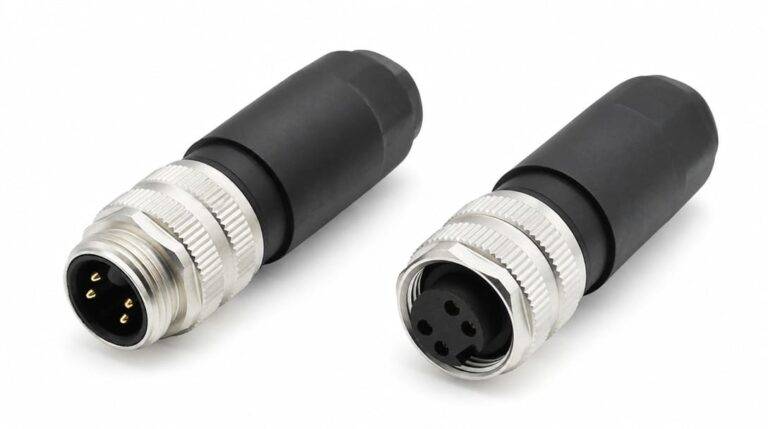
- Connector housings. Mating plastic shells that hold the terminals in a defined pinout, often from manufacturers like Molex, TE, JST, or Amphenol. Plating on the pins—tin, gold, or selective gold—is a critical selection parameter.
- Protective sleeving. Loom, braided sleeving, spiral wrap, or heat‑shrink tubing that shields the bundle from abrasion, heat, and moisture.
- Labels and markings. Heat‑shrink markers, cable ties with flag tags, or printed labels that identify each wire or branch for assembly and service.
Understanding these ingredients is the starting point for any OEM procurement discussion. Without a clear picture of what’s inside the harness, a supplier receives a request for “some wires tied together” rather than an engineered bill of materials.
Wire Harness vs. Cable Assembly: What’s the Difference?
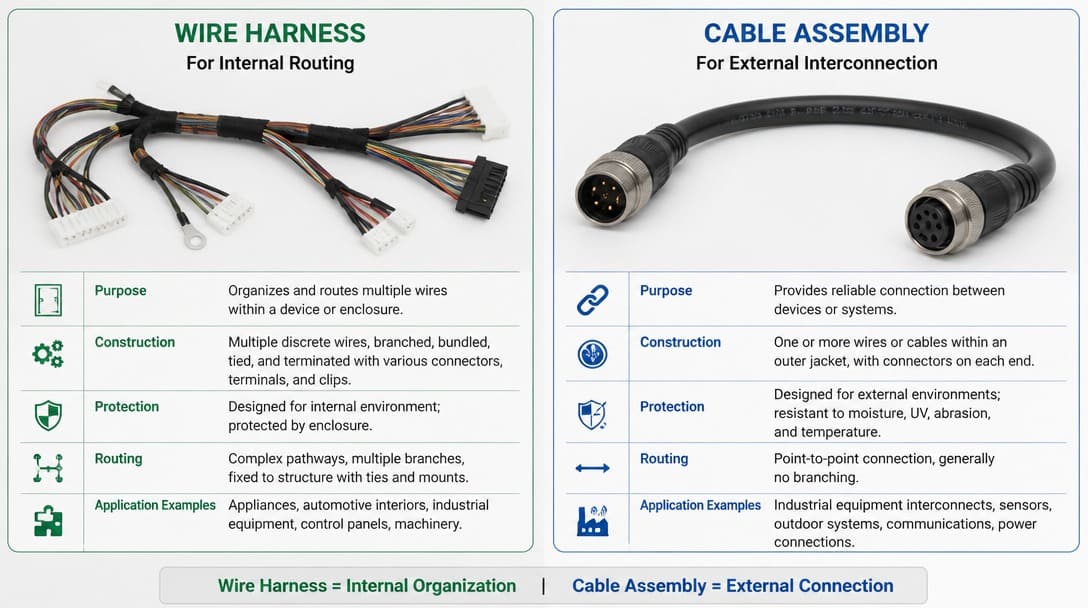
One of the most common misunderstandings among first‑time buyers is the distinction between a wire harness and a cable assembly. While both transmit power or signals, they serve fundamentally different roles, environments, and manufacturing processes.
A wire harness is designed for internal routing—inside an enclosure, appliance, vehicle chassis, or control cabinet. It organizes and protects conductors where external hazards are limited. A cable assembly, in contrast, is built for external interconnection between devices, often exposed to harsh conditions, so it typically includes molded overmolds and heavy‑duty jacketing.
| Parameter | Wire Harness | Cable Assembly |
|---|---|---|
| Typical Environment | Internal (inside a product or panel) | External (exposed to moisture, UV, abrasion) |
| Primary Function | Route and organize circuits | Interconnect separate equipment |
| Typical Protection | Sleeving, loom, tape, convoluted tubing | Overmold, heavy‑duty jacketing, strain relief |
| Common Standards | IPC/WHMA‑A‑620 (crimp & workmanship), SAE J1128[1] (automotive cable) | UL, IEC (component and assembly safety) |
| Main Cost Drivers | Connector count, wire complexity, custom coloring | Overmold tooling, specialty jacketing materials, environmental testing |
| Tooling & CapEx | Low CapEx — utilizes cost-effective wooden formboards, routing pegs, and simple testing fixtures | High CapEx — requires custom steel injection molds for overmolding, strain reliefs, and custom connectors |
💡 Pro Tip for Procurement: Avoiding Hidden Costs
When requesting a wire harness quote, look beyond the unit price and always clarify the tooling and fixture fees (Tooling Cost) upfront. For low-volume production, testing boards and crimp applicators can heavily distort your total cost.Additionally, if you are facing long lead times or high prices from mainstream component brands (like TE Connectivity or Molex), consider allowing your manufacturer to propose RoHS-compliant equivalent connectors. Doing so can often reduce your component costs by 20% to 40% and drastically improve lead times without sacrificing quality.
Most OEM projects begin with wire harnesses for internal wiring. Clarifying this scope early prevents a supplier from quoting unnecessary overmold tooling or a cable‑grade jacket when a lighter, lower‑cost harness is sufficient.
Ready to discuss your specific harness design? Contact our team with your requirements and we’ll help you clarify the details needed for an accurate quotation.
Why a Simple Quote Request Is Anything but Simple
If you’ve hesitated to send an inquiry because you’re unsure what information the supplier expects, you’re not alone. In our experience, the first inquiry from a new buyer almost always arrives without a quantity. Without that one number, we can’t give a meaningful price—material costs shift significantly between 50 units and 500. Quantity determines not only unit cost but whether certain components are even available, because many connectors have minimum order quantities and custom‑color wire spools demand specific volume commitments.
The ambiguity doesn’t stop there. Wire specification isn’t just “18 gauge.” It involves conductor stranding, insulation type (PVC, XLPE, silicone), temperature rating, and compliance standards such as UL and CSA. For a complete OEM purchasing guide, consult our article on harness wire specifications.
Connector plating is another silent variable. Gold plating is often required for reliable low‑voltage signal contacts, while tin is common for power connections in cost‑sensitive designs. If the plating requirement isn’t stated, a quote may default to the most economical option—which might not survive 1000 mating cycles or a humid environment.
Color requirements also matter. Standard black and red wires are typically in stock, but custom colors, stripes, or printed legends can mean minimum order quantities on the wire spool, added waste, and extended lead time. The same applies to sleeve marking and labeling formats.
These variables aren’t obstacles the supplier invents to be difficult—they are the very details that prevent downstream failures. When a harness is built without the correct plating or insulation rating, it can fail in service, leading to warranty claims, production line stoppages, and costly field retrofits. The more precise the buyer can be at the inquiry stage, the faster and more accurate the quotation.
The Information Suppliers Really Need to Give an Accurate Quote
To move from a vague request to a bankable quotation, compile the following before you contact a harness manufacturer:
- Production quantity. Even an approximate range (e.g., 100–200 units for pilot, then 500–1000 per quarter) lets the supplier provide tiered pricing and identify material availability.
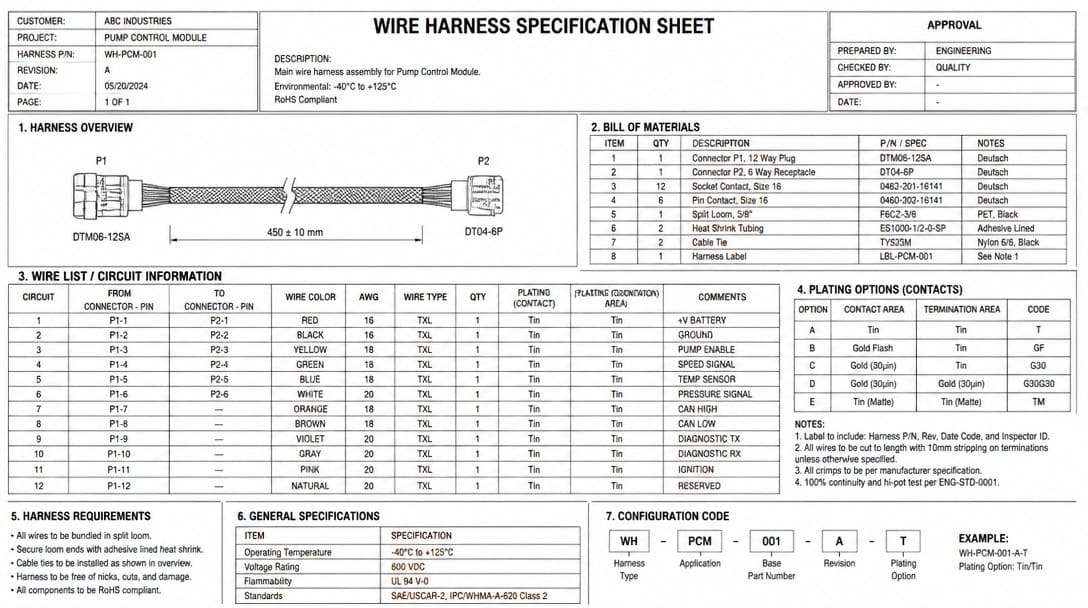
- Full wire construction. AWG size, conductor strand count, insulation material, voltage rating, and crucially, the maximum insulation outer diameter (OD)—as a wire with the correct gauge but wrong OD will fail to fit the connector seals.
- Connector details. Manufacturer part numbers for both the housing and terminal, plus the preferred plating (tin, gold, selective gold). When only a drawing is available, specify the mating connector family so the supplier can propose an equivalent.
- Overall harness dimensions and routing. Provide a dimensioned layout showing branch lengths, breakout positions, and any clearances. Include length tolerances (e.g., ±10 mm on main trunk).
- Testing requirements. Is continuity testing enough, or is hipot (dielectric withstand) required? What visual acceptance standard applies—IPC/WHMA‑A‑620 Class 1, 2, or 3?
- Quality Approval Level (PPAP/FAI). Indicate if you require a standard First Article Inspection (FAI) report with crimp micro-section analysis (per EIA-364-08) or a full PPAP Level 3 submission. This determines the engineering documentation overhead and tooling verification scale.
- Packaging and labeling needs. Inform the supplier how the finished harness should be packed for export: individual polybags, carton labels with barcodes, moisture barrier requirements. This detail affects final cost and is often overlooked. For a thorough overview of what export‑ready packaging entails, refer to this inspection and packaging guide.
This checklist turns an ad‑hoc email into a professional RFQ. Suppliers who receive complete information can usually return a quotation within a few working days rather than engaging in a multi‑round clarification exercise.
How a Wire Harness Gets Made — A Quick Overview
Understanding the manufacturing sequence helps you see where your input fits and why late changes can be expensive. The production process follows these typical steps:
- Cutting and stripping. Automated cut‑and‑strip machines process wire to length, removing insulation from each end according to the specification.
- Crimping terminals. Terminals are attached using calibrated crimp tools. Crimp quality is verified through pull‑force tests and visual inspection under magnification, following criteria defined in IPC/WHMA‑A‑620.At EDOM Electronics, we utilize automatic crimping machines with integrated crimp force monitoring (CFM) to detect and reject microscopic defects in real-time.
- Connector assembly. Terminated wires are inserted into the connector housings in the exact pinout sequence called out by the drawing. A seating check confirms proper latch engagement.
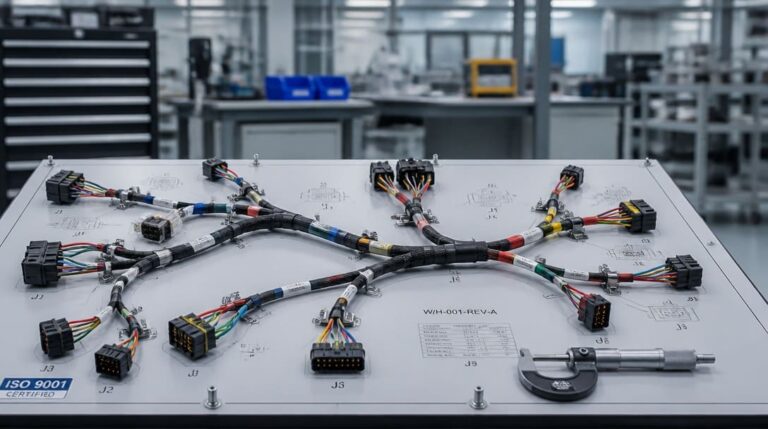
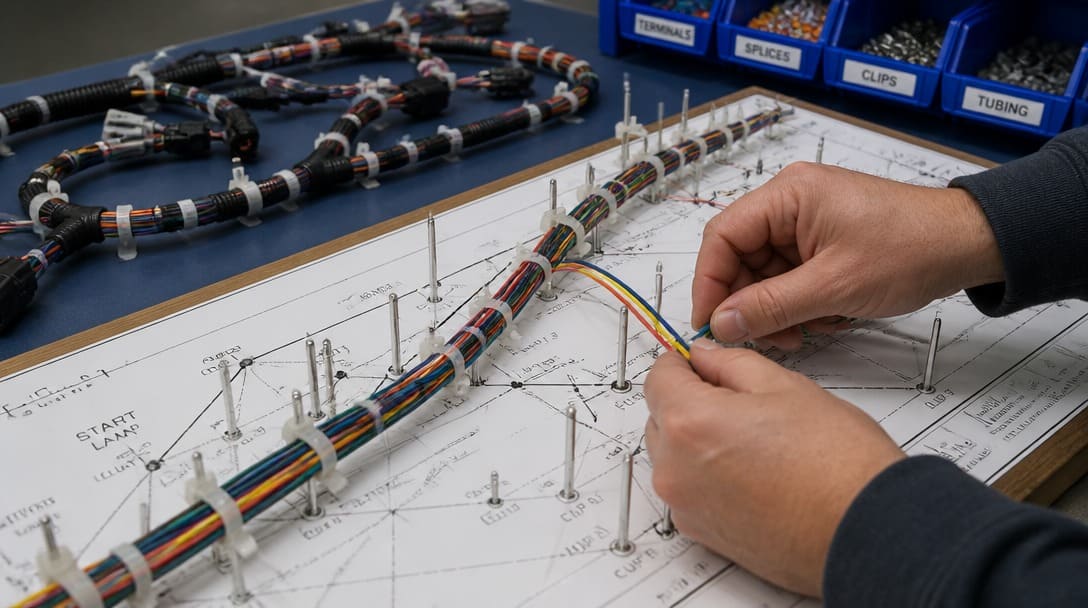
- Routing and looming. Wires are laid out on a form board, bundled into the defined routing path, and covered with protective sleeving, braid, or tape. Tie‑wraps or tubing secure the bundle at designated intervals.
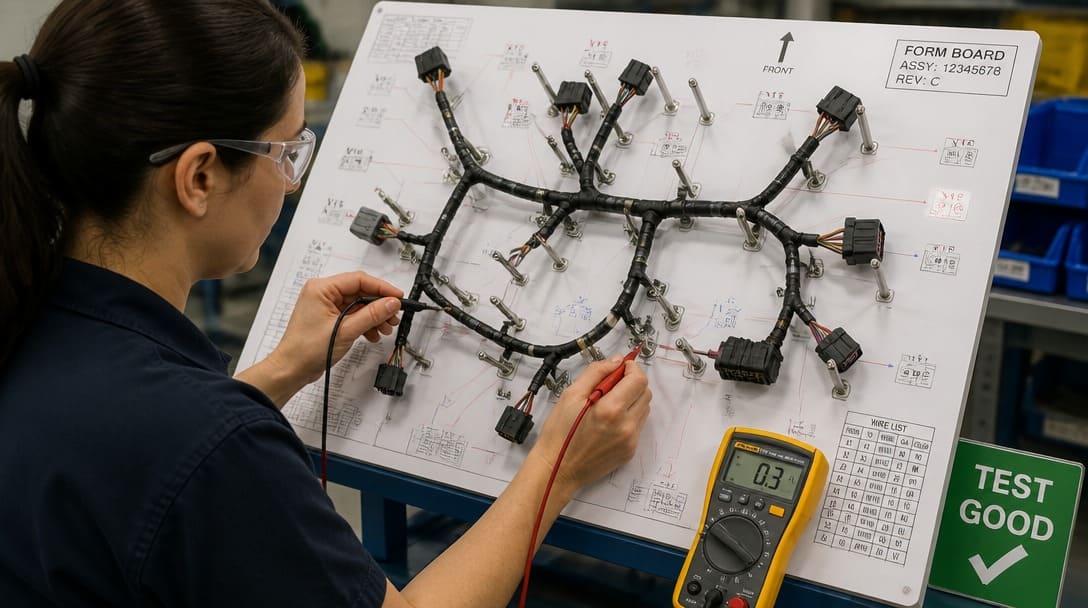
- Testing. Continuity and, where required, hipot testing are performed on every circuit. A final appearance inspection checks workmanship against the relevant IPC/WHMA‑A‑620 class level.We perform 100% electrical continuity testing on custom fixtures to guarantee zero-defect delivery
- Labeling and packaging. Heat‑shrink labels or marker ties are applied, and the completed harness is packed in polybags, labeled cartons, or moisture‑protected packaging for export.
Each step has a setup time, which is why a production quantity is vital—small batches amortize that time differently than large runs. For a deeper exploration of lead‑time factors, tooling, and quality gate management, see the detailed wire harness manufacturing guide.
What Standards Apply to Wire Harnesses (and Why Should You Care)
Buyers who speak the language of applicable standards gain credibility with suppliers and ensure the finished harness meets market requirements. The key standards include:
- IPC/WHMA‑A‑620. The global benchmark for acceptance criteria of cable and wire harness assemblies. It defines three workmanship classes (1‑general electronic products, 2‑dedicated service, 3‑high performance) and is referenced in most OEM quality agreements.
- SAE J1128. A standard for low‑tension primary cable used in surface vehicles, covering conductor and insulation performance. It is frequently encountered in automotive and off‑highway harness projects.
- UL. Underwriters Laboratories standards, such as UL 758 for appliance wiring material, establish safety benchmarks for wire and components. Using UL‑listed materials can simplify end‑product certification in North America.
- AWG (American Wire Gauge): The standard system for measuring conductor cross-section. A mismatch in AWG can lead to dangerous overheating or excessive voltage drop over long runs. Specifying the exact gauge, strand count, and copper purity is critical to ensuring your system delivers sufficient current without power loss.
- RoHS. The Restriction of Hazardous Substances directive prohibits lead, mercury, cadmium, and other substances in electrical and electronic equipment. Most global OEMs require RoHS‑compliant materials. Requesting a RoHS compliance statement at the RFQ stage prevents non‑conformance surprises later.
When your harness specification references these standards, the supplier knows exactly which quality and compliance benchmarks to meet, reducing the risk of misinterpretation.
Next Steps: Preparing Your First Wire Harness Inquiry
With a clear understanding of what a wire harness is, how it differs from a cable assembly, and what information drives an accurate quotation, you are ready to compile your inquiry package.
- Gather all available documentation: design drawings, bills of material, sample images, and any target specifications you’ve received.
- Use the checklist above to record production quantity, wire details, connector part numbers with plating, and testing requirements.
- Contact a supplier with your prepared information. Expect a dialog: even the most complete RFQ often leads to a few clarifying questions about tolerances, alternative connectors, or packaging that were not explicitly addressed. This is a sign of a thorough manufacturer, not an obstacle.
- Once the design review is complete and a quotation accepted, request a pre‑production sample run. This step verifies fit, form, and function before you commit to full‑scale production.
Suppliers such as EDOM Electronics support OEM buyers with requirement review, connector matching, sample coordination, production follow‑up, inspection, and export‑ready packaging for custom wire harnesses and cable assemblies. Working with a partner that handles these details reduces the coordination burden on your procurement team.
For deeper technical detail on manufacturing lead times, tooling considerations, and in‑process quality control, visit the full guide at wire harness manufacturing.
Frequently Asked Questions
What if I don’t have a complete technical drawing or BOM yet?
Don’t worry—that is very common in the early stages of OEM procurement. EDOM Electronics offers reverse engineering and co-design services. If you can provide a physical sample, a rough hand-drawn sketch, or even just the pinout requirements and equipment cabinet dimensions, our engineering team can help you build the official manufacturing drawings and Bill of Materials (BOM) from scratch.
What is the minimum order quantity for a custom wire harness?
Minimum order quantities vary widely depending on the connector types, custom wire colors, and tooling required. Some suppliers can accommodate pilot runs of 50–100 pieces, while others may require 500 or more to cover material spool minimums. Always provide your target quantity upfront so the supplier can check component availability.
What does IPC/WHMA‑A‑620 Class 2 mean?
Class 2 in IPC/WHMA‑A‑620 is the “dedicated service” category where the product is expected to have a longer life cycle and where uninterrupted service is desired but not absolutely critical. It specifies more stringent workmanship criteria for crimping, soldering, and routing than Class 1 (general products) but is less demanding than Class 3 (high‑reliability applications). The class you select influences inspection severity and production cost.
Can we request a prototype/sample before full production?
Absolutely. In fact, we highly recommend it. For custom OEM harness designs, EDOM Electronics usually provides a First Article Inspection (FAI) sample for form, fit, and function testing in your actual equipment cabinet before releasing the design for mass production.
How long does it take to receive a quotation?
When you provide complete information—quantity, wire specs, connector part numbers, plating, and required standards—a supplier can typically return a quotation within 3–5 working days. Incomplete information triggers back‑and‑forth clarification that can extend the timeline by a week or more.
Does the color of the wire affect cost?
Yes. Standard colors such as black, red, white, and green are usually priced at base material cost. Custom colors, stripes, or printed legends often require manufacturing a specialty spool, which carries minimum order quantities and higher per‑meter cost. If color coding is not essential for your application, sticking to standard colors lowers cost and lead time.
How do I know if I need RoHS‑compliant materials?
If your product is sold in the European Union or supplied to a global OEM, RoHS compliance is typically mandatory. Even if not legally required, many industrial buyers specify RoHS by policy. When in doubt, requesting a RoHS compliance statement from your harness supplier ensures all components meet the restrictions on hazardous substances.
Key Takeaways
- A wire harness is an internal wiring sub‑assembly that organizes, protects, and simplifies the installation of electrical circuits inside equipment—not to be confused with an external cable assembly.
- Production quantity, exact wire construction, connector plating, and color requirements are the four most frequently missing pieces of information that delay an accurate quote.
- Leading with a complete specification package (drawings, BOM, quantities, plating preferences, testing standards) positions you as a knowledgeable buyer and accelerates the RFQ cycle.
- International standards such as IPC/WHMA‑A‑620, SAE J1128, UL, AWG, and RoHS provide a common language for quality and compliance expectations.
- Engaging a supplier that offers drawing review, connector matching, sample runs, and export‑ready packaging streamlines the entire procurement process from design to shipment.
To support your next project, learn more about custom cable assembly solutions.