What Is Harness Wire, and Why Should B2B Buyers Care?
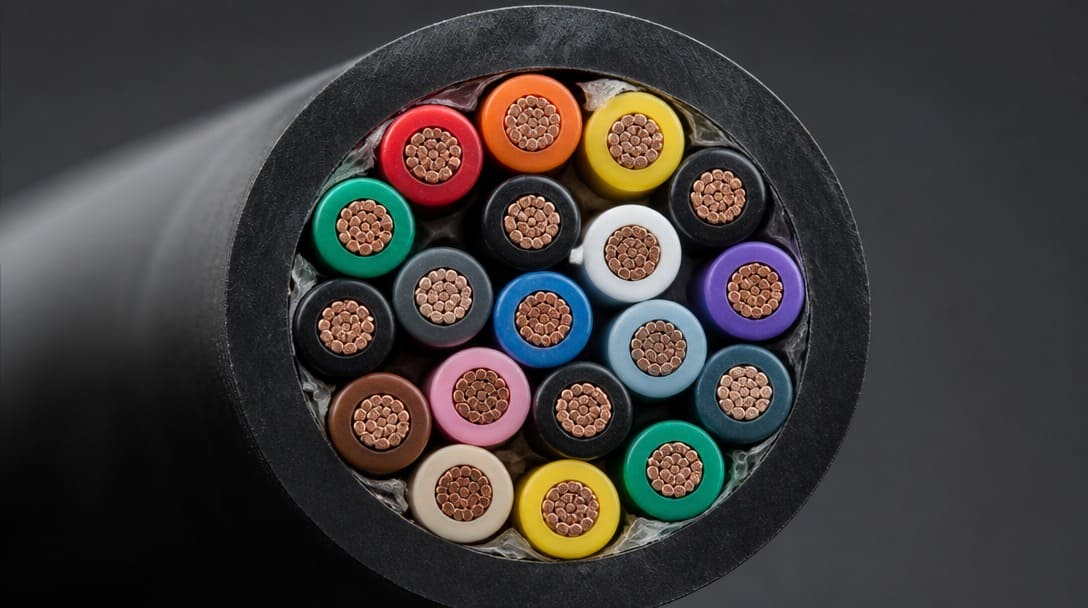
Harness wire refers to the individual conductors — the actual copper or tinned copper strands — that are cut, stripped, terminated, and bundled together inside a wiring harness. In any piece of industrial equipment, a commercial vehicle, or an appliance, these conductors carry power and signals from one module to another. The wire itself is the core element that determines current capacity, voltage isolation, temperature resistance, and overall durability of the finished harness assembly.
For OEM buyers, procurement managers, and engineering teams, harness wire is far more than a commodity. A poorly specified conductor can lead to overheating, intermittent connections, or premature insulation failure in the field. Conversely, a well-documented wire specification — tied to industry standards and verified through sample approval — forms the foundation of a stable, repeatable supply chain. Understanding what harness wire is and how to specify it correctly is a strategic advantage, not just a technical detail.
Components of a Wire Harness: Where Harness Wire Fits
A wire harness is more than a bundle of wires. It typically includes terminals, connectors, protective sleeving (such as braided loom or corrugated tube), cable ties, and identification labels. Each component plays a role, but the harness wire itself anchors the entire design. The wire’s conductor material, cross-sectional area (expressed in AWG or mm²), insulation type, and voltage/temperature ratings determine what the harness can safely carry and where it can be installed.
During production, the wire’s properties directly dictate the crimping process: conductor stranding affects terminal deformation, insulation thickness influences stripping accuracy, and the jacket material must withstand the heat of the surrounding environment. Routing and bundling decisions also flow from the selected wire — thicker, less flexible conductors require larger bend radii and may dictate the use of protective conduits. While a finished harness might incorporate dozens of parts, the wire is the one constant through every leg of the assembly. For more complex signal or power arrangements, a custom cable assembly approach may integrate multi-conductor cables and overmolded connectors, but the underlying wire specification discipline remains identical.
Key Standards Governing Harness Wire: IPC/WHMA-A-620, SAE J1128[1], and UL
Global buyers rely on a small set of standards to align expectations with suppliers. The three most frequently referenced in wire harness procurement are IPC/WHMA-A-620, SAE J1128, and UL standards such as UL 1007 and UL 1015. Each addresses a different layer of quality and safety.
IPC/WHMA-A-620 is the international acceptance standard for cable and wire harness assemblies. It defines workmanship criteria for crimps, soldering, routing, staking, and overall assembly quality. Critically, it establishes three classes of product: Class 1 for general electronics, Class 2 for dedicated service, and Class 3 for high-performance or harsh-environment applications. When an OEM contract references IPC/WHMA-A-620, it sets a uniform inspection language that both buyer and supplier can use.
SAE J1128 is a standard that specifies low-voltage primary cable for surface vehicle electrical systems. It outlines conductor stranding, insulation thickness, physical properties, and temperature ratings for wires used in automotive, marine, and off-road equipment. Compliance assures that the wire can withstand under-hood temperatures and mechanical stress typical of vehicle environments.
UL (Underwriters Laboratories) standards, including UL 1007 (300V, 80°C) and UL 1015 (600V, 105°C), certify wire for electrical safety and fire resistance in North American equipment. Many insurance policies and local electrical codes demand UL listing for internal wiring, making it a prerequisite for OEMs exporting to the United States or Canada.
The following table highlights how these standards differ in scope and what they address for harness wire selection:
| Standard | Primary Focus | What It Covers for Harness Wire | Typical Applications |
|---|---|---|---|
| IPC/WHMA-A-620 | Workmanship and assembly acceptance | Crimp quality, wire dress, strain relief, terminal insertion; applies after wire selection | Any industry using wire harnesses — industrial, medical, aerospace |
| SAE J1128 | Low-voltage primary cable for vehicles | Conductor stranding, insulation physicals, temperature ratings for the wire itself | Automotive, marine, construction equipment |
| UL 1007 / UL 1015 | Appliance and equipment wiring safety | Insulation voltage/temperature rating, flame resistance, material marking | Industrial control panels, appliances, electronic equipment |
In practice, an OEM harness might simultaneously call for UL-listed wire, require SAE J1128 temperature performance, and be inspected to IPC/WHMA-A-620 Class 2. Harmonizing these references early in the specification process prevents misunderstandings on the production floor.
Material Compliance for Global Markets: RoHS, REACH, and Insulation Choices
Two chemical regulations dominate international trade in harness wire: RoHS (Restriction of Hazardous Substances) and REACH (Registration, Evaluation, Authorisation of Chemicals). RoHS, mandated in the EU and adopted by many other regions, restricts lead, mercury, cadmium, hexavalent chromium, and certain phthalates in electrical products. Any wire harness exported to Europe or used in CE-marked equipment must be RoHS-compliant, meaning the conductor plating, insulation compound, and even colour pigments must not contain proscribed substances above threshold limits. REACH goes further by requiring registration of chemical substances used in manufacturing and addressing substances of very high concern (SVHCs). For EU importers, ensuring that wire insulation materials and conductor coatings are REACH-registered is a critical piece of due diligence.
Insulation material selection directly affects both compliance and performance. Common options include:
- PVC — cost-effective, flexible, widely available in RoHS-compliant grades; suitable for general indoor use but limited to lower temperature ranges.
- Cross-linked polyethylene (XLPE) — higher temperature resistance and better abrasion properties, often specified where harnesses are exposed to engine heat or outdoor environments; RoHS/REACH-compatible formulations are standard.
- Silicone — excellent flexibility across a wide temperature range (−50°C to +200°C), ideal for high-flex or extreme-temperature applications; compliant versions exist, though documentation should be verified.
When a shipment crosses a border, authorities may ask for a Declaration of Conformity or material test report. Export-ready carton labeling that clearly states RoHS and REACH compliance status prevents customs delays and reassures downstream distributors. Buyers should request compliance certificates with each production batch.
How to Select the Right Harness Wire for Your Application
Choosing harness wire should start with a methodical review of electrical, mechanical, and environmental requirements. The process can be broken into four distinct steps:
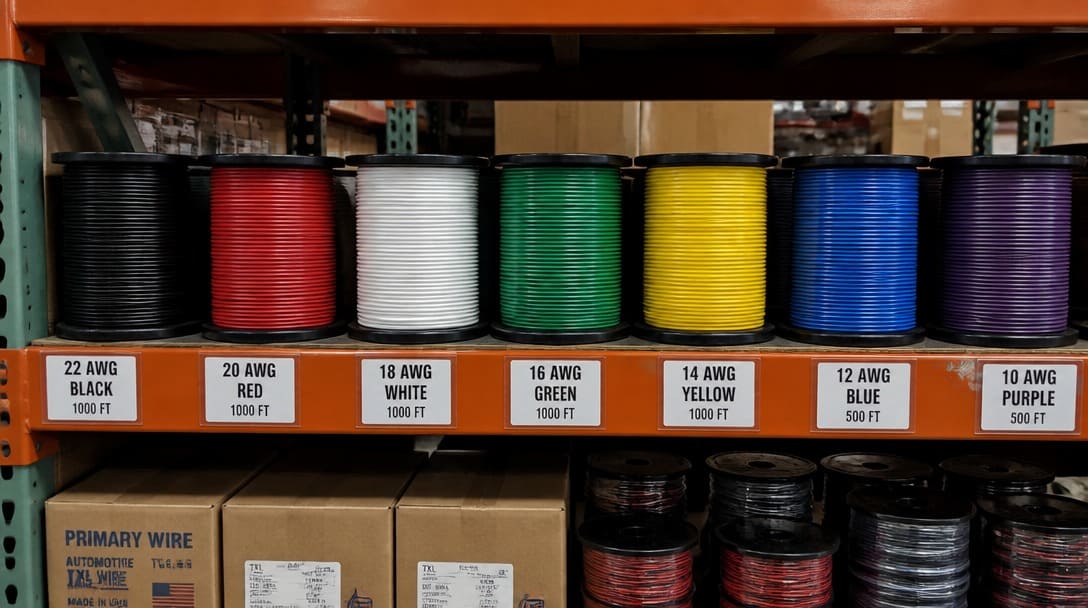
- Determine electrical needs. Establish the maximum continuous current, peak current, and operating voltage. These values drive the minimum conductor size (AWG or mm²) and insulation voltage rating. For example, a 10 A circuit in a 12 V DC system might require 16 AWG wire, but the exact gauge depends on allowable voltage drop over the wire run length.
- Assess mechanical demands. How many flexing cycles will the harness endure? Is the installation subject to vibration, sharp edges, or pinch points? These factors dictate insulation wall thickness and material hardness. SAE J1128 provides guidance on abrasion and pinch resistance for automotive wire, while UL standards address general mechanical strength.
- Evaluate environmental exposure. Consider temperature extremes, moisture, oil, fuel, and chemical splashes. A wire rated for 105°C continuous (UL 1015) may be sufficient for an indoor enclosure, but a harness routed near an engine block may demand XLPE insulation rated for 125°C or higher. Silicone jackets offer extreme low-temperature flexibility, which is critical for cold-climate equipment.
- Request material samples and datasheets. Before finalizing the bill of materials, ask the supplier for a wire sample and the manufacturer’s specification sheet. Compare conductor stranding, insulation diameter, and markings with the datasheet. One batch control check is to measure insulation resistance and conductor resistance on the sample to confirm it meets expected values under actual load conditions.
In multinational programs, involving the assembly partner early can streamline material selection. A supplier experienced in drawing review and connector matching can flag incompatible insulation types or suggest alternative wire specifications that reduce lead time without sacrificing compliance.
Quality Assurance: Inspection, Testing, and IPC/WHMA-A-620 Workmanship Classes
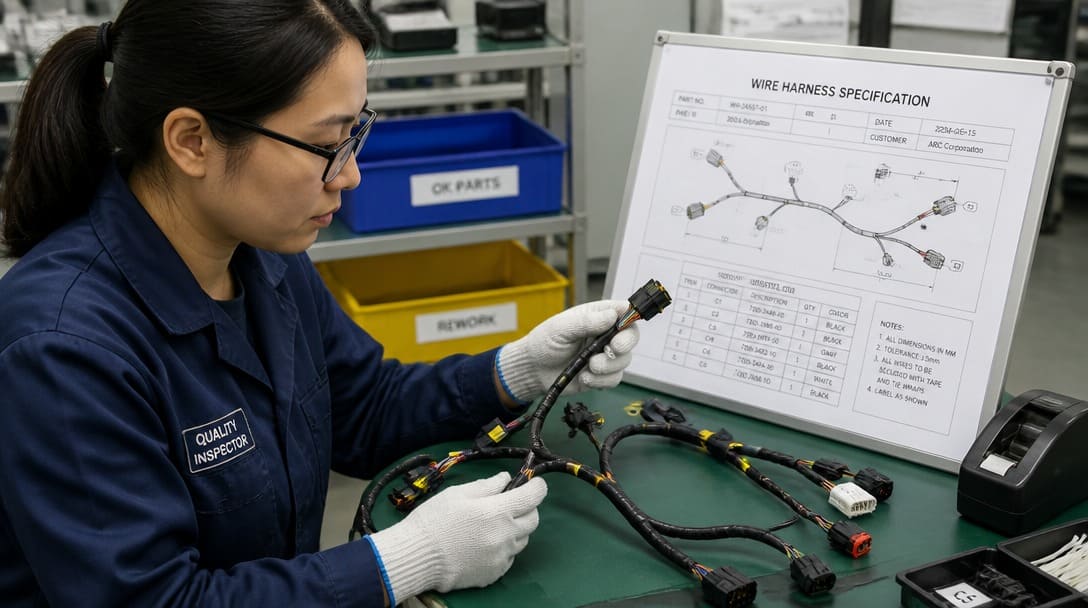
IPC/WHMA-A-620 provides a ready-made framework for quality assurance that both buyers and manufacturers can adopt. The standard’s three classes set graduated acceptance criteria. Class 1 permits cosmetic imperfections and is seldom used in durable goods. Class 2, the most common for industrial and commercial OEM applications, balances reliability with cost. Class 3 demands tighter tolerances, smaller allowable defects, and more documentation, suited for aerospace, medical, and critical systems. Agreeing on a class at the contract stage eliminates subjective judgment during final inspection.
In production, a structured inspection plan for harness wire assemblies should include:
- Incoming material checks: Verify wire gauge, stranding, insulation diameter, and manufacturer markings against the datasheet for each spool received.
- Crimp height and pull-force testing: At setup and at periodic intervals, measure crimp compression and terminal retention force to ensure consistent electrical and mechanical connections.
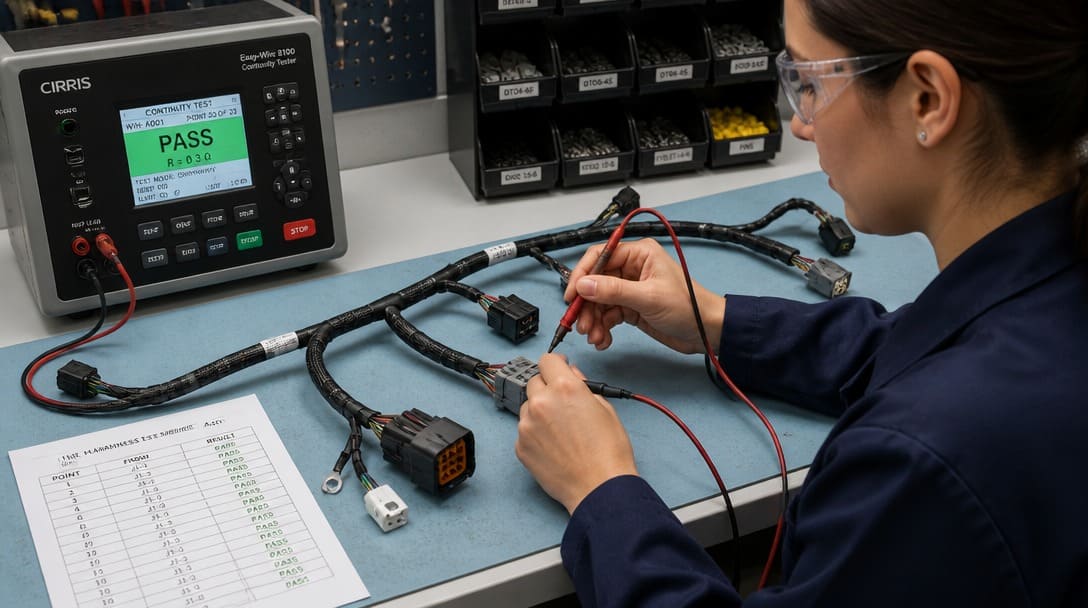
- Continuity and insulation resistance testing: Every completed harness should undergo automated point-to-point continuity checks and, for critical circuits, high-voltage insulation resistance tests.
- Visual appearance inspection: Examine routing, sleeving installation, label placement, and overall cleanliness against the IPC/WHMA-A-620 criteria for the agreed class.
- Final shipment verification: Confirm labeling accuracy, barcode readability, and export packaging robustness. This step is where a supplier’s quality inspection and export packaging process connects directly to distributor receiving operations.
Reputable assembly suppliers integrate these checks into a documented production workflow. In many cases, an OEM can request a formal First Article Inspection Report (FAIR) that includes measurement data and photographs to validate the process before full production begins.
Sourcing Harness Wire Assemblies for OEM and Distribution Programs
Finding a wire harness supplier that can consistently deliver compliant product to multiple global destinations involves more than comparing unit prices. Buyers benefit from evaluating a partner’s process against the full production lifecycle:
- Drawing review and specification alignment. The supplier should scrutinize the wire specification, connector part numbers, and routing drawings at quote stage and raise red flags about obsolete parts or conflicting standards before samples are built.
- Sample coordination. A short sample run, built to IPC/WHMA-A-620 criteria, lets the engineering team validate fit, form, and function on the actual equipment. Any crimping or routing issues surface early.
- Production follow-up. The supplier must maintain revision control, track material lot numbers, and communicate any proposed changes before they reach the production line. For recurring OEM programs, part number assignment and long-term wire availability planning avoid unplanned requalification.
- Export-ready packaging. Harnesses destined for different markets often require distinct labeling, barcodes, and pallet configurations. A supplier competent in export packaging reduces receiving-side handling costs and minimises transit damage.
Suppliers such as EDOM Electronics have built their service model around this structured approach, supporting OEM buyers with requirement review, connector matching, sample coordination, production follow-up, and export packaging for custom cable assemblies and wire harnesses. While many factories can provide a quote, the difference shows in how proactively a partner engages with specifications, compliance documentation, and logistics before the first shipment leaves the dock.
For buyers looking to deepen their understanding of the complete production cycle, learn more about dedicated wire harness OEM services that incorporate IPC/WHMA-A-620 inspection standards and end-to-end shipment preparation.
Frequently Asked Questions
What is the difference between harness wire and a cable assembly?
Harness wire refers to the individual conductors inside a wiring harness, while a cable assembly usually consists of a multi-conductor cable terminated with connectors and often protected by an overmold. A harness may incorporate many separate wires routed and bundled together, whereas a cable assembly handles signal or power transmission in a single jacketed bundle. Both share the same underlying need for proper wire specification, crimping, and inspection.
Do I need to specify IPC/WHMA-A-620 for my harness order?
Specifying IPC/WHMA-A-620 is recommended for any OEM or industrial buyer who needs measurable, repeatable assembly quality. Without it, inspection standards become subjective. Citing a class — typically Class 2 for most general industrial equipment — gives the supplier clear acceptance criteria and protects the buyer in case of non-conformance.
Can a single harness wire meet both UL and SAE J1128 requirements?
Yes, certain wire types are dual-rated. For example, some XLPE automotive primary wire can be certified to both SAE J1128 for physical properties and UL for electrical safety. However, the manufacturer must provide the appropriate markings and test reports. Buyers should verify the complete rating combination, as not all SAE wire automatically carries a UL listing.
How can I confirm that imported harness wire is RoHS and REACH compliant?
Request a copy of the supplier’s test reports or declarations of conformity from the wire manufacturer. These should reference specific material certifications, not just a generic statement. For REACH, confirm that SVHC declarations are up to date with the latest candidate list. During incoming material inspection, check that the insulation jacket carries the necessary RoHS markings.
What is a realistic lead time for a custom wire harness pilot run?
Lead times depend on wire and connector availability, harness complexity, and supplier capacity. A simple harness using standard components may be prototyped relatively quickly, but specialized materials or tooled connectors add time. Engaging the supplier early, with a complete drawing and BOM, helps avoid delays caused by component shortages or specification gaps.
Key Takeaways
- Harness wire is the fundamental element that governs electrical performance, mechanical resilience, and compliance. Selecting it carefully is a supply chain discipline, not an afterthought.
- Standards like IPC/WHMA-A-620, SAE J1128, and UL serve different but complementary purposes — combining them in one specification protects both assembly workmanship and wire-level safety.
- RoHS and REACH compliance affect material choice and documentation flow; labelling at the carton level prevents customs friction and safeguards distributor readiness.
- Quality assurance built around IPC/WHMA-A-620 workmanship classes, supported by in-process crimp testing and final continuity checks, turns inspection into a predictable gate rather than a negotiation.
- Successful sourcing requires a partner that manages drawing review, sample coordination, revision control, and export packaging — not just unit price analysis.