How Manufacturers Ensure Consistent Cable Assembly Quality?
When a single intermittent connection can idle a production line or trigger a field recall, consistency in cable assemblies is not a production metric — it is a supply chain survival requirement. Procurement managers and OEM engineers know that one batch of harnesses with out-of-tolerance crimps or mismatched connector inserts can generate costs far beyond the unit price. This guide breaks down the practical, measurable steps that separate a reliable cable assembly supply from a lottery of late-surfacing defects. If you need a refresher on core definitions and standard classification, start with our foundational guide on what is a cable assembly.
At a Glance
Consistent cable assembly quality is achieved by combining brand-certified connectors and materials, production processes aligned with the IPC/WHMA-A-620[1] standard, a testing regimen matched to the application’s electrical and environmental risk, and rigorous supply chain controls that lock in the approved sample across every batch. When these elements are specified and verified, assemblies perform repeatably, assembly line stoppages drop, and warranty exposure is contained.
How to Ensure Consistent Cable Assembly Quality in OEM Supply Chains
Step 1: Define Quality Parameters in Engineering Terms, Not Just Drawings
Before specifying connectors or calling out a wire gauge, the sourcing team must translate the application’s operational stress into testable requirements. A harness for an indoor control cabinet faces different threats than one routed across a vibrating engine frame. Work with product engineers to document:
- Maximum allowable voltage drop per circuit under full operating current
- Minimum insulation resistance after exposure to specified humidity and temperature cycles
- Mechanical retention force targets for each connector interface
- Flex life expectations and minimum bend radius for moving sections
Without these parameters, a supplier can deliver assemblies that pass a simple continuity test yet fail years later due to fretting corrosion or cold flow — failures that bypass even diligent end-of-line checks. Setting these criteria upfront converts vague “high quality” into measurable acceptance conditions.
Step 2: Lock Down Connector Selection and Material Certifications
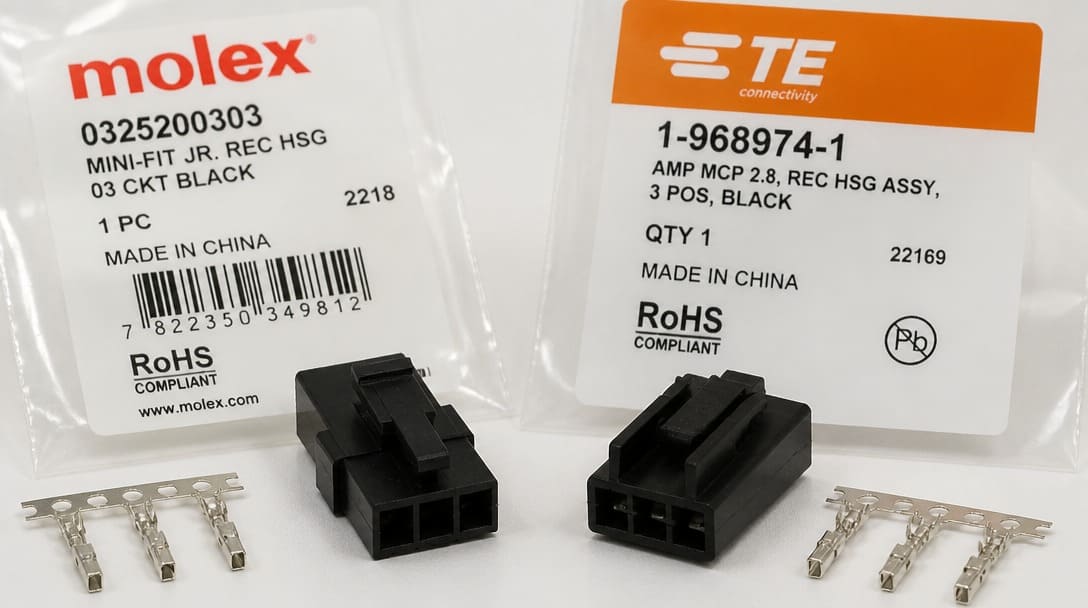
Connector consistency starts at the bill of materials. Specify genuine connectors from established families — Molex, TE Connectivity, JST, and Amphenol maintain tight manufacturing tolerances that keep insertion loss and contact resistance stable across production lots. Using a single approved source for each connector part number prevents the mixed-batch insertion force and micro-arc problems that arise when a lower-cost substitute sneaks in during a production shortage.
Material certifications provide the second layer of consistency. Specify UL-listed wire and RoHS[2]-compliant jacketing, and require certificates of conformance with each shipment. UL listing assures that the wire’s insulation will not degrade unexpectedly under rated voltage and temperature, while RoHS compliance is now a baseline expectation for global market access. When cable assemblies must withstand outdoor exposure or chemical washdown, move beyond generic PVC and specify materials with published chemical resistance and UV stability data.
Step 3: Control the Production Process to IPC/WHMA-A-620 Standards
Consistent output demands a controlled process, and the cable and wire harness industry’s recognized benchmark is IPC/WHMA-A-620. This standard defines acceptance criteria for crimping, soldering, routing, and mechanical support across three classes — Class 1 for general electronics, Class 2 for dedicated service, and Class 3 for high-reliability applications. Requiring IPC/WHMA-A-620 training and periodic re-certification of operators brings reproducibility to what is otherwise a manual assembly environment.
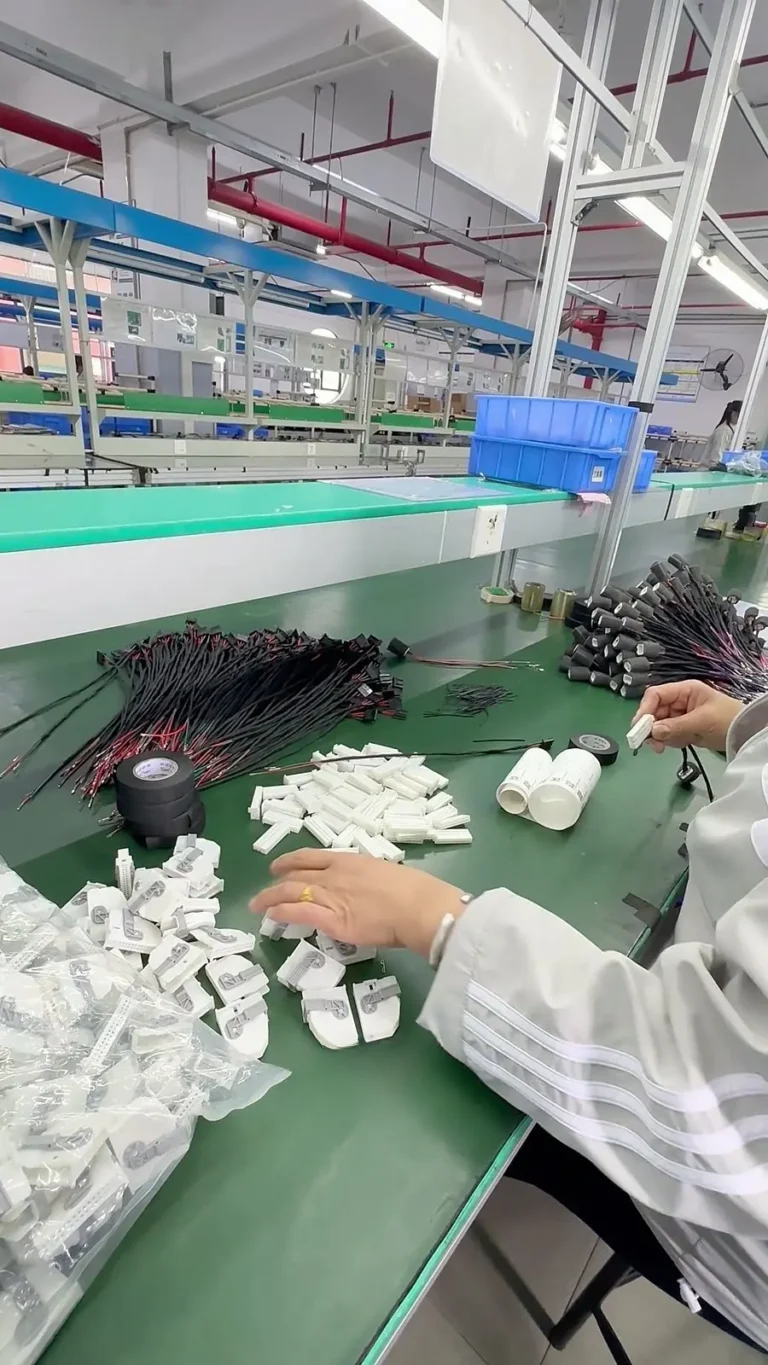
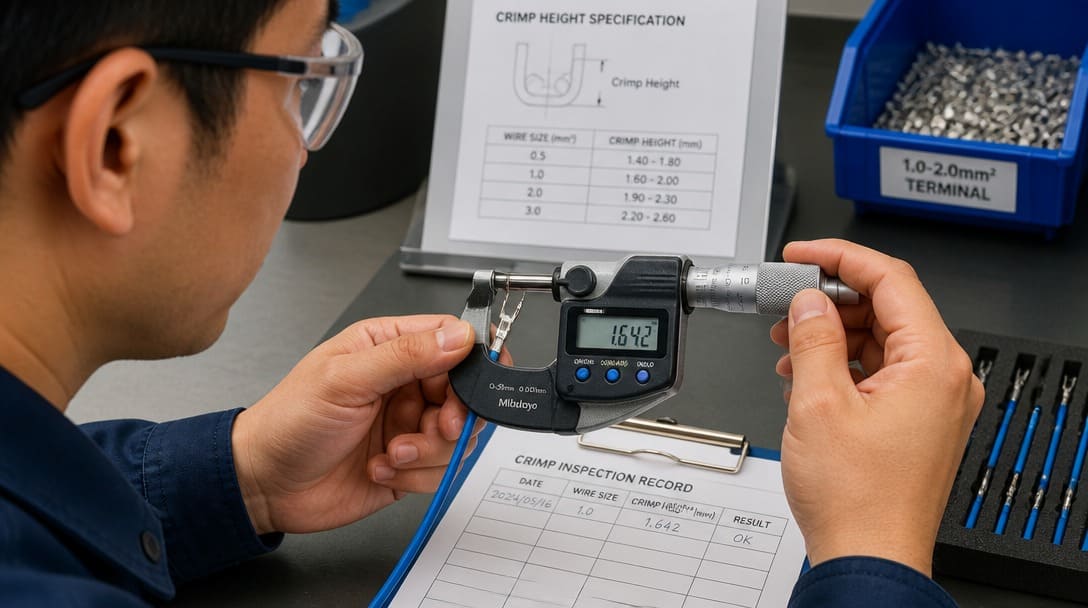
On the production floor, consistency is driven by process checks rather than hoping that final inspection will catch everything. Crimp force monitoring captures an out-of-spec terminal before it enters a housing. Periodic micrograph cross-sections of crimp joints verify strand deformation and gas-tight connection quality. Controlled routing and lacing, along with loom materials selected for the installation environment, prevent chafing that causes delayed opens. Investing in inline workmanship checks — supported by wire harness manufacturing workflows built around the IPC standard — reduces the burden on end-of-line testing and catches variability at its source.
Step 4: Specify a Testing Regime Matched to Application Risk
No single test profile fits all cable assemblies. The sourcing engineer’s task is to align the test plan with the consequence of a field failure. A comparison of inspection depth versus typical escape rates can be mapped as follows:
| Test Method | Defects Detected | Typical Application Context |
|---|---|---|
| Continuity only | Opens and shorts | Low-complexity internal wiring where intermittent connections are not safety-critical |
| Continuity + hipot (dielectric withstand) | Insulation breakdown, creepage faults | Mains-connected or safety-isolated circuits requiring regulatory compliance |
| Automated harness tester (full net list, resistance measurement) | Intermittent opens, high-resistance joints, miswires, missing diodes/resistors | Multi-branch OEM harnesses with cost of rework exceeding test investment |
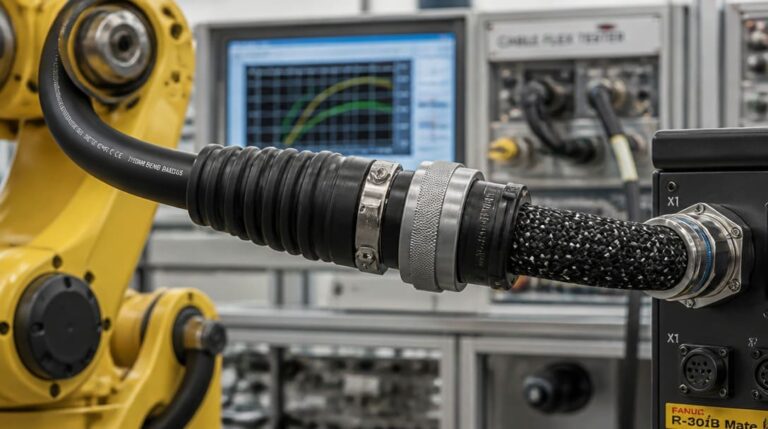
| Thermal cycling or vibration profiling | Latent material aging, fretting corrosion, connector back-out | Engine compartment, heavy equipment, outdoor sensor arrays |
For an OEM buyer, the economic decision is simple: the per-unit cost of a more thorough test is compared against the probability of a defect escaping to the assembly line or the field, multiplied by the disruption cost. In applications where a single harness failure stops a production station valued at hundreds of dollars per minute, 100% automated testing is the rational baseline. Adding environmental stress screening — a limited thermal cycle or vibration exposure — becomes cost-effective when early-life infant mortality in the field would trigger a recall investigation.To properly specify the hardware required for this regime, from basic continuity to hipot, consult our comprehensive guide on What Is a Cable Tester: Function and Quality Inspection Uses.
Step 5: Manage Supply Chain Consistency Across Production Batches
Even when all components and processes are defined, batch-to-batch consistency depends on a rigorous handover system that makes the first approved article the blueprint for every subsequent delivery. The process begins with a detailed drawing and specification review that captures not just wire lengths and connector part numbers, but also dimensional tolerances, labeling content, and acceptable surface finish. A first-article inspection against this review creates a physical and documented golden sample.
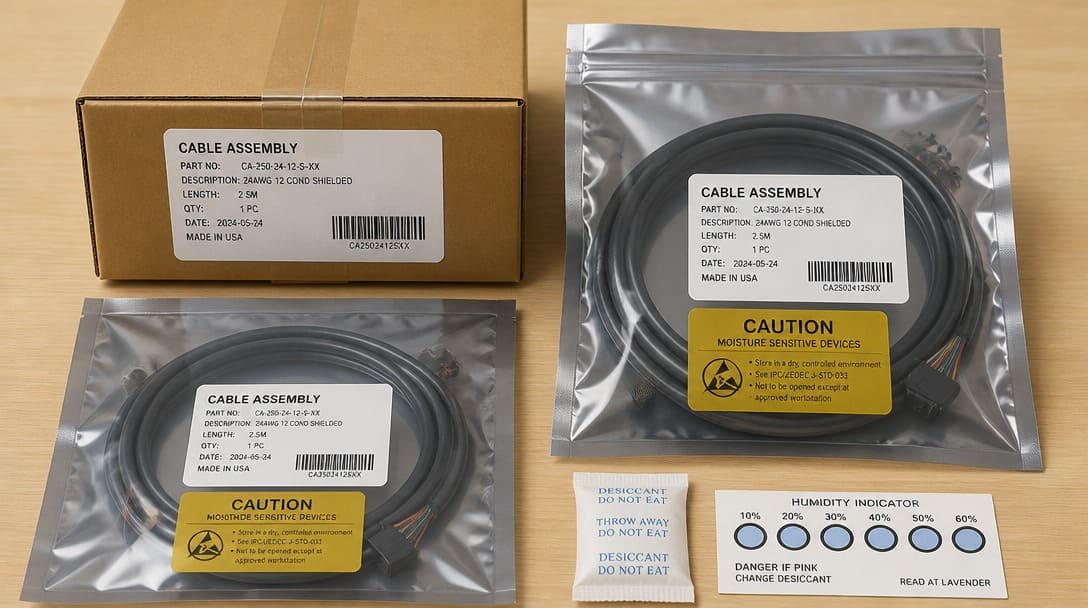
Retaining a master sample at the supplier and a duplicate at the buyer’s incoming inspection becomes the reference for all later lots. For international OEM supply, export packaging is an extension of workmanship: moisture-resistant wrapping, antistatic protection where needed, and labeling that integrates the buyer’s receiving codes eliminate inbound handling damage and ambiguity. Suppliers who provide quality inspection and export packaging as part of a standard commercial arrangement remove a common source of batch variation that appears only after the shipment crosses a border.
In practice, experienced sourcing partners such as EDOM Electronics support OEM buyers through drawing and specification review, connector matching against approved brand families, production follow-up against the retained golden sample, and documented final inspection — all wrapped into export-ready packaging that protects assemblies during transit. This coordination role is what turns a one-time acceptable pilot batch into a predictable, multi-year supply of cable assemblies.
Step 6: Validate Long-Term Consistency Through Field Performance
Quality plans prove themselves when field failure rates drop. Consider a heavy equipment OEM that deployed an outdoor sensor array using TE Connectivity sealed connector systems, UL2464[3] cable, and RoHS-compliant jacketing across multiple machine models. Initial batches assembled without a defined workmanship standard exhibited a 3.1% field failure rate over two years, traced mainly to moisture ingress at connector seals and intermittent continuity caused by inadequate strain relief.
The OEM’s engineering team introduced a structured quality plan: all harnesses were to be built to IPC/WHMA-A-620 Class 3 workmanship requirements, with full crimp inspection records and 100% hipot testing following automated continuity checks. Over the next production cycle, the field failure rate dropped to 0.2% — a level that not only eliminated assembly line rework but also removed the warranty reserve the OEM had previously allocated to harness replacements. This real-world contrast demonstrates that discipline in connector selection, process standard adherence, and layered testing directly translates into production uptime and brand protection.
Key Takeaways
- Cable assembly consistency is a specification problem: define maximum voltage drop, retention force, and environmental exposure limits before issuing a purchase order.
- Genuine connectors from Molex, TE Connectivity, JST, or Amphenol, combined with UL-listed wire and RoHS material documentation, provide a repeatable performance baseline.
- IPC/WHMA-A-620 process controls and inline workmanship checks, including crimp force monitoring and micrograph verification, prevent variation from reaching final test.
- Choose a testing regime based on failure consequence: automated net-list testing is the minimum for production-line-critical harnesses; add environmental screening where infant mortality is unacceptable.
- Batch-to-batch consistency requires a retained golden sample, structured drawing review, and packaging that protects assemblies until they reach the buyer’s dock.
Frequently Asked Questions
How can a smaller OEM buyer get the same quality consistency as high-volume manufacturers?
Smaller order quantities do not have to sacrifice process rigor. The same IPC/WHMA-A-620 workmanship standards apply regardless of batch size. What changes is the commercial model: buyers can work with suppliers who support prototype-to-production transitions, including small-batch sample confirmation, retained master samples, and repeatable packaging. Suppliers such as EDOM Electronics provide drawing review, connector matching, and first-article inspection that standardize output whether the order is fifty pieces or five thousand.
Is 100% hipot testing necessary for every cable assembly?
Not necessarily. The need for hipot (dielectric withstand) testing depends on the circuit’s safety classification and operating voltage. For mains-connected assemblies or where insulation failure poses a shock or fire hazard, hipot testing is a regulatory requirement and also a sensible consistency gate. For low-voltage signal cables in class-2 circuits, automated continuity and resistance measurement often provides adequate defect coverage.
What is the most common reason for batch-to-batch variation in cable assemblies?
Unnoticed changes in connector sources or wire compound are the most frequent culprits. When a supplier substitutes an authorized distributor part with an uncertified equivalent, even if the part number appears identical, insertion force, plating thickness, or material flame rating can change. Maintaining a controlled bill of materials and requiring certificates of conformance with each shipment prevents this silent drift.
How does IPC/WHMA-A-620 define acceptable crimp quality?
The standard specifies visual and dimensional acceptance criteria, including acceptable compression ratios, absence of cracked insulation wings, and proper bellmouth formation. It also defines requirements for cross-section analysis to verify that all conductor strands are fully deformed into a gas-tight junction. Trained inspectors can identify crimp problems before the terminal exits the production cell, which is why many OEM buyers ask for evidence of operator training to IPC/WHMA-A-620.
Can export packaging really affect cable assembly quality?
Absolutely. Moisture, vibration, and crushing during transit can deform connectors, embrittle insulation, or displace labels. Export packaging designed for the shipping distance and logistics chain — using sealed moisture-barrier bags, antistatic materials, and protective edge boards — preserves the assembly’s condition from the factory floor to incoming inspection. Inconsistent packaging is a common hidden cause of rejects that appear only after unpacking.
Designing a consistency plan that starts with connector specification and ends with field validation is the only reliable way to move cable assembly quality from a hopeful expectation to a supply chain routine. For OEM procurement teams, the difference between a disruptive run of failures and a predictable, years-long supply is rarely about price per unit — it is about whether the upstream processes are designed to deliver the same assembly every time. Explore custom cable assembly solutions that embed this consistency discipline from drawing review to export-ready shipment.