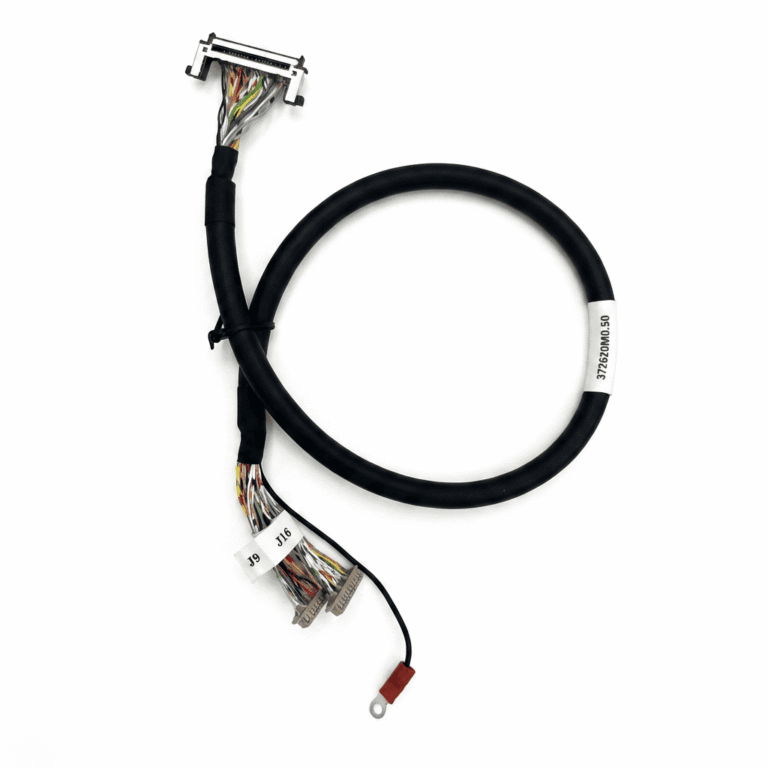
Why Aerospace Wire Harness Manufacturing Demands Precision and Compliance
Aerospace platforms operate in unforgiving environments where vibration, temperature extremes, and electromagnetic interference converge. A single wire harness failure in an avionics bay, satellite power distribution unit, or flight control actuator can cascade into mission-critical consequences. Unlike general industrial assemblies, aerospace wire harnesses must withstand decades of thermal cycling, resist chemical degradation from hydraulic fluids and de-icing compounds, and maintain signal integrity across pressurized and unpressurized zones. This operational reality means procurement teams cannot evaluate aerospace wire harness manufacturers using the same criteria applied to commercial or automotive suppliers. The margin between acceptable and catastrophic narrows considerably at altitude, making process discipline, material traceability, and documented compliance the true benchmarks of a qualified manufacturing partner.
Key Aerospace Wire Harness Assembly Standards: IPC/WHMA-A-620 and SAE J1128
Two standards form the backbone of aerospace wire harness quality assurance. Understanding their scope and application helps buyers separate manufacturers with genuine aerospace capability from those with only general assembly experience.
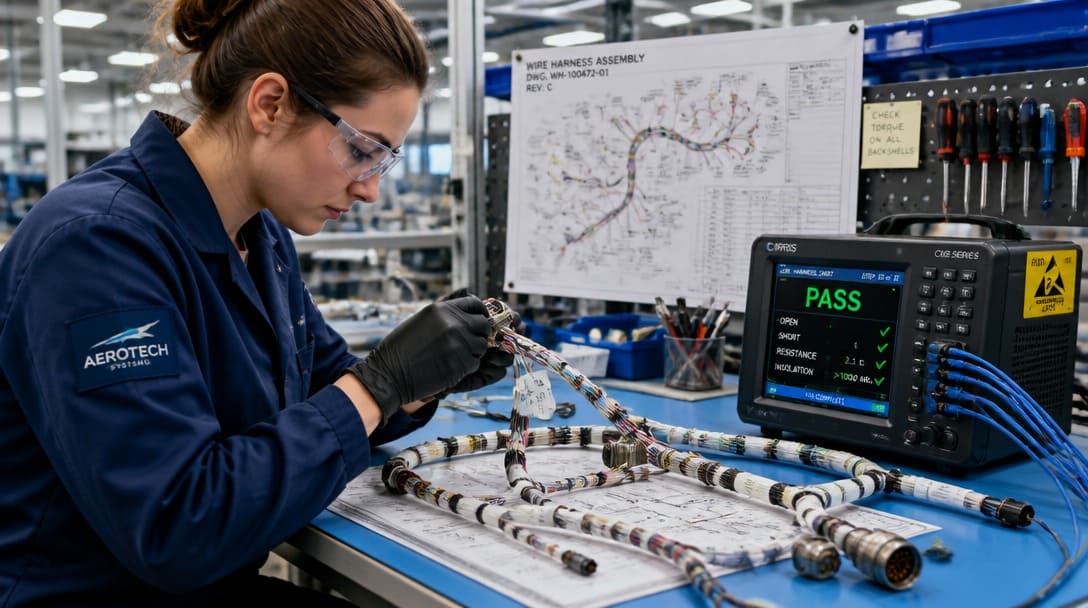
IPC/WHMA-A-620 is the globally recognized standard governing the acceptability of cable and wire harness assemblies.[1] For aerospace applications, the standard’s Class 3 requirements apply — these mandate the most stringent criteria for crimp height and pull force verification, solder joint inspection under magnification, conductor strand damage limits, and insulation clearance measurements. A manufacturer seriously engaged in aerospace harness production maintains IPC/WHMA-A-620 trained and certified operators, with training records available for buyer review during the qualification process. The standard defines exacting pass/fail criteria for every termination type, from open-barrel crimps to soldered cups, and specifies the measurement equipment required for objective inspection.
SAE J1128 addresses the cable itself. This specification defines the construction and performance requirements for low-tension primary cable used in aerospace ground vehicle and airborne applications. It covers conductor stranding patterns, insulation wall thickness, temperature rating, abrasion resistance, and dielectric strength. When a manufacturer sources wire that meets SAE J1128[2], the buyer gains assurance that the raw cable can endure the mechanical and electrical stresses encountered in service. Procurement teams shortlisting aerospace wire harness manufacturers should request not only the assembly standard certifications but also the material certifications for the wire and cable stock used in production.
Material compliance in aerospace extends far beyond basic functionality. Three regulatory frameworks intersect with every harness design, and the procurement team’s ability to verify compliance directly affects market access and legal exposure.
UL certification validates that wire and cable materials meet specific fire resistance and safety benchmarks. In aerospace, where flame propagation through a wiring bundle can be catastrophic, UL-rated materials with appropriate flame-retardant properties are often specified. Buyers should confirm that the manufacturer’s wire stock carries UL listing marks traceable to the specific spool or lot number used in their harness build.
RoHS (Restriction of Hazardous Substances) and REACH (Registration, Evaluation, Authorisation, and Restriction of Chemicals) are European Union directives with global reach. Any aerospace harness destined for an aircraft registered in an EU member state, or integrated into equipment sold into European markets, triggers these compliance obligations. RoHS[3] restricts lead, mercury, cadmium, hexavalent chromium, and specific flame retardants in electrical and electronic equipment. REACH[4] goes further, requiring that substances of very high concern (SVHCs) are registered and disclosed throughout the supply chain. A manufacturer that maintains RoHS-compliant material declarations and REACH substance data sheets for every connector, wire insulation compound, heat-shrink tubing, and label material used in an assembly provides the transparency needed for importer due diligence.
The practical impact of material compliance on aerospace harness design manifests in connector plating choices — where lead-free solder tails and RoHS-compliant contact finishes are now standard — and in cable jacket compounds that balance flame resistance with environmental compliance without adding excessive weight.
Inside the Production Floor: Processes That Ensure Aerospace-Grade Quality
Walking through a production run reveals whether a manufacturer’s aerospace claims translate to disciplined execution. The difference between a generalist custom cable assembly shop and one producing aerospace-grade harnesses often appears in four areas.
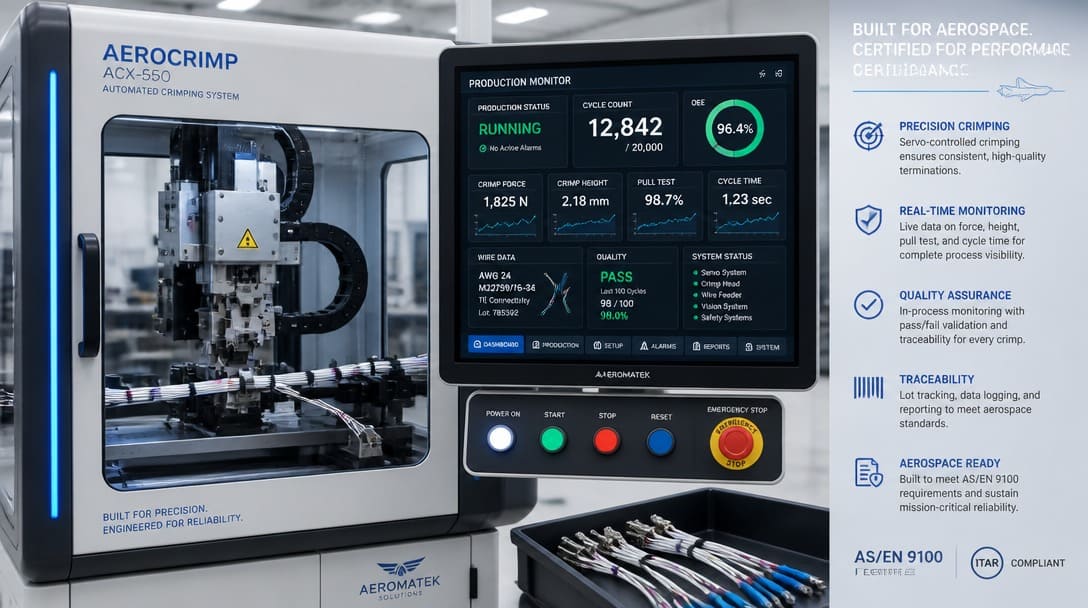
Precision cutting and stripping at aerospace tolerances demands equipment capable of holding strip length variations within fractions of a millimeter. Semi-automated and automated cutting machines with programmable parameters reduce operator variability, and pull-test sampling at defined intervals verifies that strip quality remains consistent throughout the batch. For aerospace harnesses using ETFE, PTFE, or polyimide-insulated wire — common in high-temperature zones — blade condition and strip speed settings become critical to avoiding conductor nicks that standard PVC processing would never expose.
Crimp quality verification shifts from statistical sampling to near-comprehensive inspection for aerospace Class 3 assemblies. Crimp height, width, and pull-force measurements are recorded, not merely spot-checked. The crimp tooling itself undergoes periodic calibration against certified standards, and the manufacturer maintains a tooling log that links each crimp to a specific tool, operator, and time window.
Continuity testing and hipot (dielectric withstand) testing serve as mandatory checkpoints, not optional add-ons. Every circuit in an aerospace harness undergoes continuity verification against the wiring diagram or net list. Hipot testing applies voltages well above operating levels — often 1,500 VDC or higher depending on the specification — to detect insulation weaknesses, creepage paths, or contamination that visual inspection cannot reveal.
For buyers managing aerospace projects that start with smaller quantities or prototype builds, working with a supplier that applies these same process controls to low-volume runs prevents the quality gaps that can appear when manufacturers treat small orders as low-priority. Suppliers such as EDOM Electronics support OEM buyers with requirement review, connector matching, sample coordination, production follow-up, inspection, and export-ready packaging — applying consistent process discipline regardless of order size.
Global Sourcing Analysis: Comparing Aerospace Wire Harness Manufacturers by Region
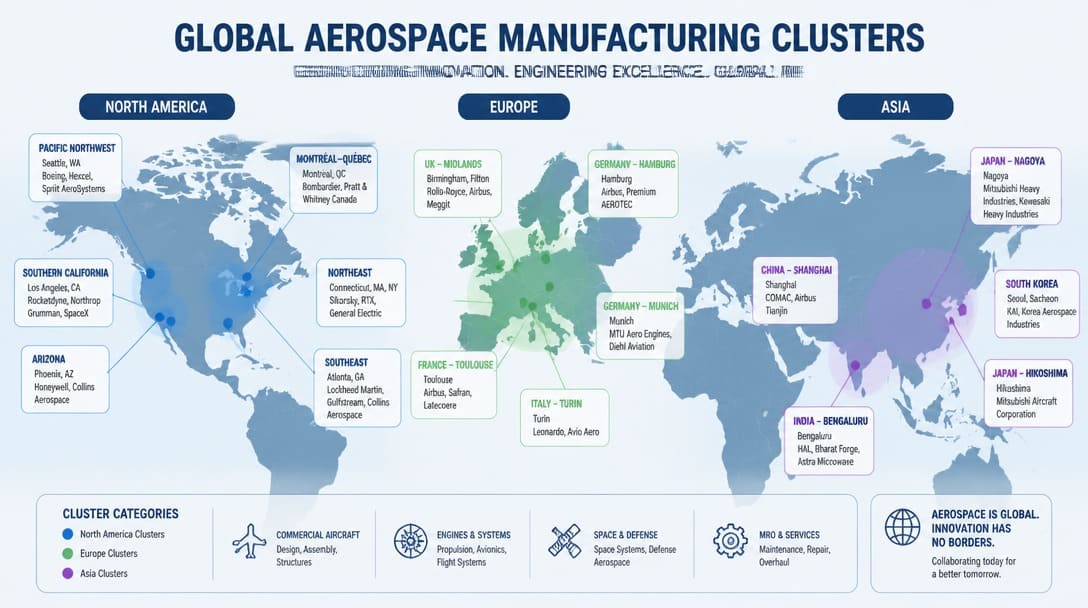
Aerospace harness sourcing decisions increasingly span multiple continents, with each region offering distinct advantages and trade-offs. The following comparison provides a structured framework for evaluating suppliers across key sourcing criteria.
| Evaluation Criterion | North America | Europe | Asia |
|---|---|---|---|
| Certification depth | Strong IPC/WHMA-A-620 and AS9100 presence; mature audit infrastructure | Robust EN/AS standards; strong EASA-aligned documentation culture | Growing IPC adoption; certification depth varies significantly by supplier tier |
| Testing capability | In-house hipot, continuity, and environmental chambers widely available | Advanced test labs; strong integration with notified bodies | Testing capability concentrated in top-tier exporters; third-party lab access for mid-tier suppliers |
| IP and export control handling | ITAR and EAR compliance infrastructure well established | Strong dual-use export control frameworks; data protection via GDPR | Varies; requires explicit contractual IP protection and NDA enforcement protocols |
| Communication and project management | English-native; dedicated program managers at qualified suppliers | Multilingual; strong technical documentation in English | English proficiency varies; structured communication protocols recommended with technical translators for complex specifications |
| Lead time and MOQ flexibility | Moderate lead times; MOQs often higher for specialized materials | Comparable to North America; strong prototype support | Competitive lead times; greater MOQ flexibility for pilot and small-batch orders |
| Cost positioning | Higher labor and overhead; competitive for high-complexity, low-volume aerospace work | Similar to North America; precision engineering commands premium | Cost advantages on labor-intensive assembly; total landed cost analysis essential |
Geopolitical considerations increasingly shape sourcing strategies. Buyers weighing Asian suppliers against North American or European partners should evaluate not only unit price but also continuity risk, export license complexity, and the ease of conducting on-site audits. A manufacturer with established export experience — demonstrated through a history of accurate commercial invoices, compliant packing lists, and familiarity with destination-country customs requirements — reduces friction that first-time exporters introduce.
How to Vet an Aerospace Wire Harness Manufacturer: A Step-by-Step Guide
Qualifying an aerospace wire harness manufacturer requires moving beyond capability presentations to documented evidence. The following sequence mirrors what experienced sourcing teams execute before awarding a first purchase order.
- Request certification documentation upfront. Ask for current IPC/WHMA-A-620 operator training records — not just a company-level certificate. Verify that the training covers Class 3 criteria specifically. Request SAE J1128 compliance certificates for the wire types the manufacturer proposes for the project. Obtain UL file numbers and verify them against UL’s online database. These documents should be date-stamped and traceable to the individuals and materials involved.
- Conduct a structured audit — virtual or on-site. An audit agenda should prioritize the production floor over the conference room. Observe whether crimp tooling calibration stickers are current, whether operators reference work instructions at their stations, and whether in-process inspection data is recorded in real time rather than filled in retrospectively. Testing equipment — continuity testers, hipot testers, tensile testers — should show current calibration certificates with traceability to an accredited calibration laboratory.
- Evaluate a sample run before scaling. Commission a small pre-production batch using the exact materials, tooling, and operators that would produce the full order. Inspect the samples against the IPC/WHMA-A-620 Class 3 criteria. Measure crimp heights, review test reports, and examine labeling, sleeving, and connector orientation. A manufacturer that delivers conforming samples with complete documentation on the first attempt demonstrates the process control needed for production consistency.
- Assess communication responsiveness and problem-solving. During the sample phase, note how the manufacturer handles questions about specifications, proposed substitutions, or drawing ambiguities. A supplier that raises technical queries before cutting wire — rather than making assumptions — protects the buyer from discovering non-conformances during incoming inspection.
When engaging suppliers for aerospace-adjacent projects — such as ground support equipment harnesses or test bench cabling that does not require full aerospace certification — buyers can still apply this vetting framework proportionally. Working with a supplier that already maintains documented quality processes, even if the specific project does not demand Class 3 criteria, builds a foundation for future aerospace work.
The Hidden Factor: Export Packaging and Logistics for Aerospace Wire Harnesses
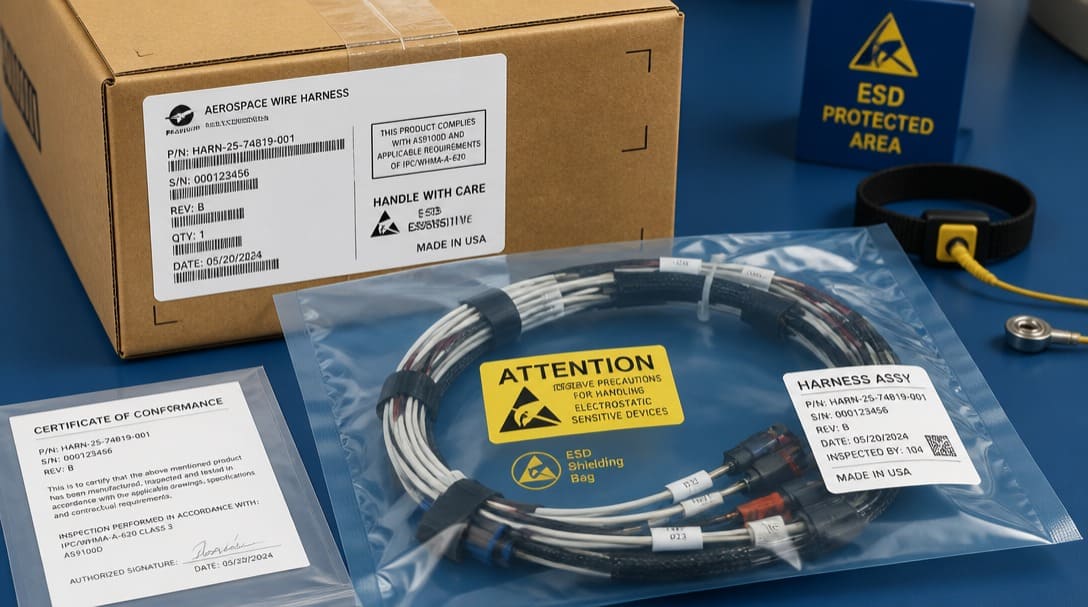
Packaging decisions made at the factory floor directly affect what the receiving inspection team finds upon delivery. Aerospace wire harnesses are especially vulnerable to damage during international transit — connectors can deform under stacked carton weight, moisture ingress can corrode unsealed contacts, and electrostatic discharge can degrade sensitive components integrated into the assembly.
Export-grade packaging for aerospace harnesses should include ESD-protective materials for any assembly containing exposed connector contacts or integrated electronic modules. Moisture barrier bags with desiccant packs and humidity indicator cards protect against condensation during air freight temperature transitions. Individual harnesses benefit from being secured to rigid backing boards or suspended in partitioned cartons that prevent connector-to-connector contact and wire bundle compression. Carton labeling that includes part numbers, revision levels, quantity, and ESD sensitivity warnings supports efficient warehouse receiving and reduces the handling errors that occur when labels are handwritten or ambiguous.
Suppliers that integrate quality inspection and export packaging into a single workflow reduce the risk of a harness passing final test only to arrive damaged. The packaging specification should be treated as a production document with the same revision control as the assembly drawing. For distributors and overseas traders managing inventory turnover, packaging that supports shelf-life tracking and quick warehouse identification adds operational value beyond the harness itself.
Building a Long-Term Aerospace Supply Chain Partnership
The most successful aerospace procurement relationships evolve beyond transactional RFQ cycles. When a manufacturer invests time in understanding the buyer’s platform — the operating environment, the maintenance intervals, the weight budgets — the collaboration yields benefits that spread across multiple programs.
Design-for-manufacturability feedback from the production floor can identify connector selections that complicate automated crimping, branch-out geometries that create routing pinch points, or label materials incompatible with the specified overmolding compound. These insights are difficult for a design team to extract from drawings alone. A manufacturing partner that reviews the bill of materials and assembly drawing before quoting — flagging lead time risks on sole-sourced connectors or suggesting form-fit-function alternates with better availability — reduces program delays that no amount of purchasing leverage can reverse after production starts.
Obsolescence management further rewards long-term thinking. Connector series, wire insulation compounds, and marking system consumables do not remain available indefinitely. A supplier that monitors component lifecycles and proactively communicates end-of-life notices allows the buyer to execute last-time buys or qualify alternates before the production line stops. The same supplier that produced the initial prototype harnesses can support repair and overhaul requirements years later because it retains the tooling, test fixtures, and build records from the original production run.
Explore wire harness manufacturing and OEM support services to understand how production-capable suppliers structure their engineering and quality support for programs ranging from pilot builds to ongoing production volumes.
Frequently Asked Questions
What is the difference between IPC/WHMA-A-620 Class 2 and Class 3 for aerospace wire harnesses?
Class 2 defines acceptability criteria for general industrial and commercial applications where continued performance is important but minor cosmetic imperfections are tolerable. Class 3 applies to aerospace and other applications where uninterrupted performance is critical and the end-use environment precludes easy repair or replacement. Class 3 imposes tighter limits on conductor strand damage (typically no broken or nicked strands allowed versus a limited percentage under Class 2), narrower acceptable ranges for crimp height and pull force, stricter soldering acceptance criteria, and more rigorous documentation requirements. For flight-critical systems, only Class 3 provides the required confidence level.
How can a buyer verify SAE J1128 compliance when the manufacturer is overseas?
Request the wire manufacturer’s certificate of conformance that explicitly references SAE J1128, including the specific part number, lot number, and date of manufacture. Cross-reference this with the wire marking printed on the cable jacket, which should include the SAE specification number and temperature rating. For high-value programs, commission independent third-party testing of wire samples — measuring insulation wall thickness, conductor resistance, and dielectric withstand voltage — against the values specified in SAE J1128. Reputable wire manufacturers provide these test reports as standard documentation.
Are RoHS and REACH compliance mandatory for aerospace wire harnesses exported globally?
Legally, RoHS and REACH compliance is mandatory for products entering the EU market and several other jurisdictions with equivalent legislation. Even outside mandated markets, many global aerospace OEMs include RoHS and REACH compliance as contractual requirements in their procurement specifications to simplify their own regulatory obligations and to support corporate sustainability commitments. A manufacturer that cannot provide full material disclosure data for every substance in the harness — including wire insulation, connector bodies, contact platings, labels, and sleeving — creates a compliance gap that the importer must resolve before customs clearance.
What should procurement teams look for during a virtual factory audit?
Focus the virtual audit on verifiable evidence rather than narrated presentations. Request the auditor to show crimp tooling calibration labels close-up, walk the camera past workstation documentation so you can read dates and revision numbers, and demonstrate a live continuity test on a completed harness. Ask to see the segregated area for non-conforming material and inquire about the disposition process for rejected assemblies. Observe whether the production floor is organized for traceability — are wire spools labeled with lot numbers? Are work orders accompanied by the correct revision of the assembly drawing? These details reveal more about daily discipline than polished conference room presentations.
When does it make sense to work with a supplier that handles both prototypes and production volumes?
For aerospace programs that follow a build-to-print model, continuity between prototype and production phases eliminates the learning curve that occurs when transferring tooling, test fixtures, and build knowledge between separate suppliers. A manufacturer that produces the first-article harnesses, refines the process during pilot builds, and then scales to production volumes retains the institutional knowledge of what worked, what required adjustment, and what tolerances proved critical. This continuity is especially valuable when the program involves custom connector orientations, complex branching geometries, or specialized testing protocols that are difficult to document completely in a transfer package.
Key Takeaways
- Certification documentation must be operator-level and current. Company-wide certificates are insufficient; verify that individual operators hold IPC/WHMA-A-620 Class 3 training records and that wire stock carries traceable SAE J1128 and UL certifications.
- Process control differentiates aerospace-capable manufacturers from generalists. Look for documented crimp verification, in-process continuity and hipot testing on every circuit, and calibration programs with accredited traceability — not just end-of-line sampling.
- Material compliance spans safety and environmental regulations. UL-rated wire and cable, RoHS-compliant connector finishes, and REACH substance declarations are interconnected requirements that affect both product integrity and global market access.
- Export packaging is a quality function, not an afterthought. ESD protection, moisture barriers, and carton labeling directly impact whether the harness arrives in the same condition it left the factory floor.
- Vet through samples, not presentations. A pre-production sample run inspected against Class 3 criteria reveals more about a manufacturer’s capability than any capability presentation ever will.