In the realm of electronics manufacturing, wire harnesses are indispensable. They serve as the critical linkages that connect various components, ensuring the accurate and efficient transmission of power and signals. At EDOM Electronics, we recognize the significance of these components and have committed ourselves to the production of high-quality wire harnesses and cable assemblies. A key element of a wire harness is the connector. In this comprehensive guide, we will explore the different types of wire harness connectors, their applications, and how they contribute to the overall performance of your electronic devices.
The Role of Wire Harness Connectors
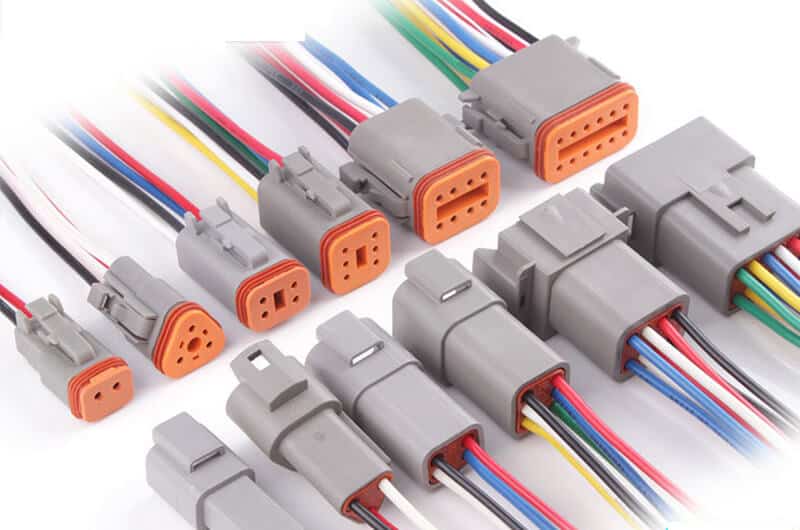
Automotive waterproof wiring harness
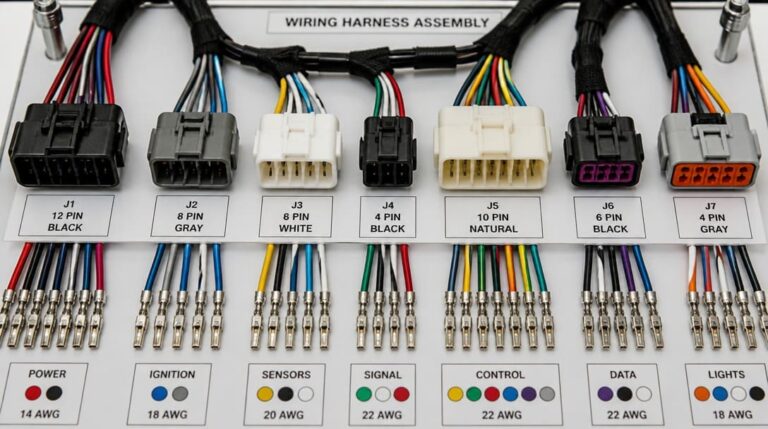
Wire harness connectors are the unsung heroes in the world of electronics. They are the points of contact that ensure the seamless transmission of power and signals between different components. These connectors come in various types, each designed for specific applications and environments. Understanding these types is crucial for any manufacturer or distributor who requires wire harnesses and cable assemblies for their products.
Types of Wire Harness Connectors
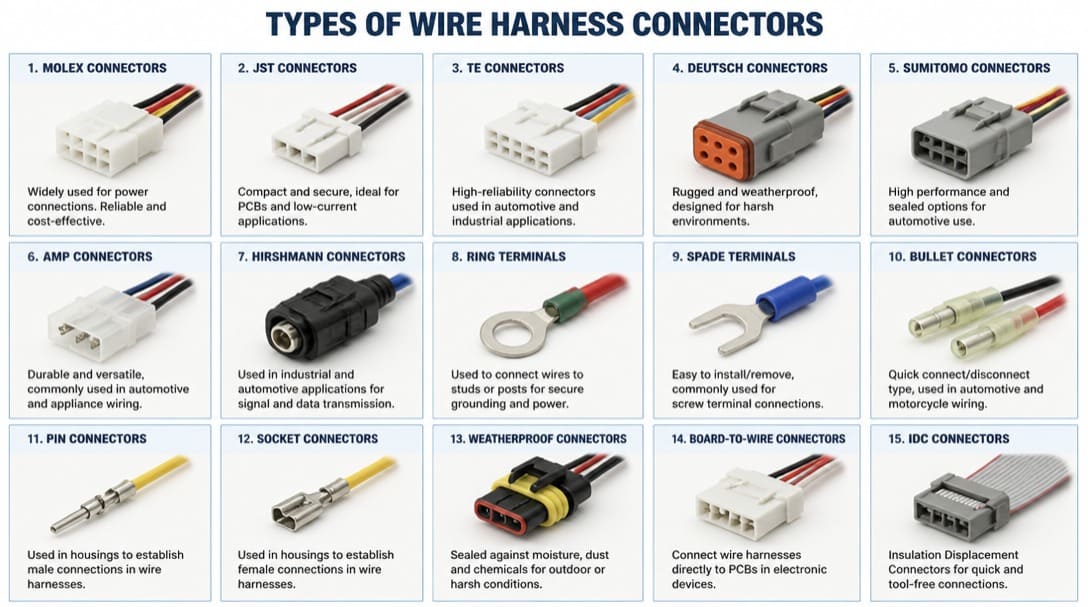
Wire harness connectors are primarily used to transmit electrical signals from the wire harness to the power source. They consist of different plugs and jacks, with the design being based on the function, space constraints, and performance required.
To choose the right solution for your design, it is best to understand the three primary physical connection configurations, followed by their specific functional types:
1. Physical Connection Configurations
- Wire-to-Wire (WTW) Connectors: Used to connect two wire-terminated cables together. They are commonly used in automotive wiring harnesses and appliances where sub-assembly components are physically separated.
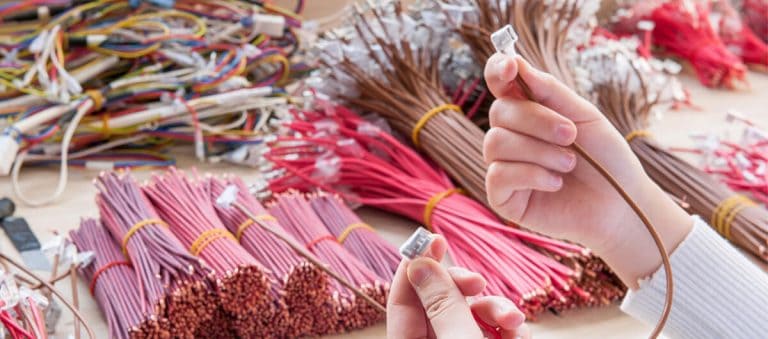
- Wire-to-Board (WTB) Connectors: These connect a wired assembly directly to a printed circuit board (PCB). Highly common examples include the Molex Micro-Fit series or JST XH / PH series equivalents.
- Board-to-Board (BTB) Connectors: Used to link different circuit boards within a device without using loose wires. They are designed to maintain a secure connection even in high-vibration environments, making them ideal for industrial and aerospace applications.
2. Functional Connector Types
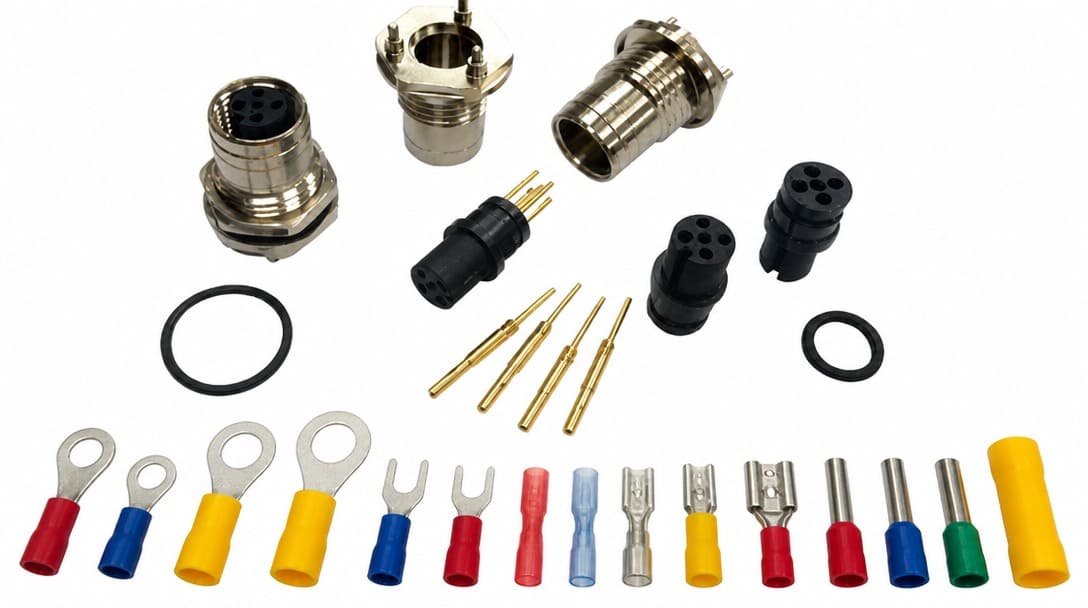
- Terminal Connectors: Terminal connectors are simple and versatile, making them a popular choice for many applications. They consist of a male end (the terminal) and a female end (the housing). The terminal is crimped onto the wire and inserted into the housing to establish a connection.
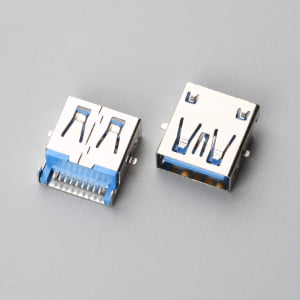
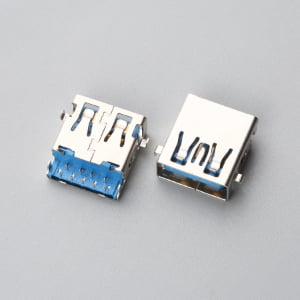
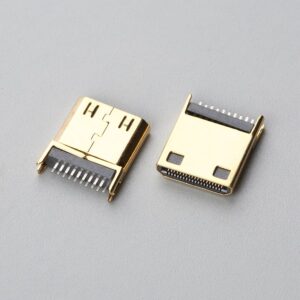
- Input/Output (I/O) Connectors: I/O connectors are used to connect external devices to a system. They come in various standardized forms, including USB, HDMI, RJ45 Ethernet, and D-Sub connectors. These connectors are designed to handle high-speed data, power, and signal transmission.
- Power Connectors: Power connectors are engineered to transmit electrical currents from a power source to a device. They are designed to handle high currents and voltages safely, preventing thermal issues in power supply units.
- RF (Radio Frequency) Connectors: RF connectors (such as SMA, MCX, or Fakra) are used in applications involving high-frequency signals. They maintain the precise impedance of the transmission line, preventing signal loss and electromagnetic interference (EMI).
Wire Harness Terminals
Terminals are used in wire harnesses to terminate the conductor at a particular point, secure the connection, and protect it. They are generally made of metal or alloy, but depending on the application requirement, they may also be composed of silicon or carbon. Terminals come in various shapes, sizes, and designs, including hooks, rings, bullets, and spades. The design of terminals is crucial for producing a product with continuity, integrity, and safety.
Key Parameters for Choosing the Right Connector
Selecting the ideal connector for your custom wire harness requires evaluating several technical parameters. When you work with an OEM/ODM partner like EDOM Electronics, our engineering team evaluates the following critical metrics:
- Electrical Requirements:
- Current Rating (Amps): Must support the maximum current without overheating.
- Voltage Rating (Volts): Defines the dielectric breakdown limit between adjacent terminals.
- Mechanical & Structural Constraints:
- Pitch (Spacing): The distance from center-to-center of adjacent contacts. Compact devices require smaller pitches (e.g., 1.0mm or 1.25mm), while high-power systems require larger pitches to prevent arcing.
- Mating Cycles: How many times the connector can be plugged and unplugged before contact resistance degrades.
- Environmental Protection (IP Rating):
- If your wiring harness is exposed to moisture, dust, or chemicals (such as an automotive waterproof harness), you must choose sealed connectors with an appropriate IP rating (e.g., IP67 or IP68).
- Sourcing & Equivalents (Cross-Referencing):
- To lower BOM costs and reduce lead times, EDOM offers high-quality equivalent/replacement connectors for industry-standard brands like Molex, JST, TE Connectivity, Hirose, and Amphenol.
Frequently Asked Questions (FAQ)
Q1: What is the difference between Wire-to-Board and Board-to-Board connectors?
Answer: Wire-to-Board (WTB) connectors connect a cable assembly/wire harness directly to a PCB, allowing signal and power routing. Board-to-Board (BTB) connectors connect two PCBs directly without using intermediate wires, which is ideal for compact and multi-layered electronic devices.
Q2: Can EDOM Electronics provide custom wire harnesses with Molex or JST equivalent connectors?
Answer: Yes. We support standard brand components (Molex, TE Connectivity, JST, Hirose) as well as certified, cost-effective equivalent connectors. Using equivalents can significantly reduce sourcing lead times and costs while maintaining the same technical specifications.
Q3: Why is pitch size important when selecting a wire harness connector?
Answer: Pitch determines the density of the connection. Smaller pitches (like 1.0mm) save board space but handle lower currents, while larger pitches (like 3.96mm or 4.2mm) are physically robust and can carry higher voltages and currents safely.
Q4: What makes a wiring harness connector waterproof?
Answer: Waterproof wire harness connectors use silicone rubber seals, O-rings, and specialized backshells to block water and dust ingress. These are heavily used in automotive, outdoor marine, and industrial environments to achieve IP67 or IP68 ratings.
Conclusion
Wire harness connectors are a small but vital part of any electronic device. By understanding the different types of connectors and their applications, you can make informed decisions when designing and manufacturing your products. At EDOM Electronics, we are committed to providing high-quality wire harnesses and cable assemblies that meet the highest standards of quality. We understand that delivery date and quality are the most critical factors for our clients, and we prioritize these aspects in all our operations.