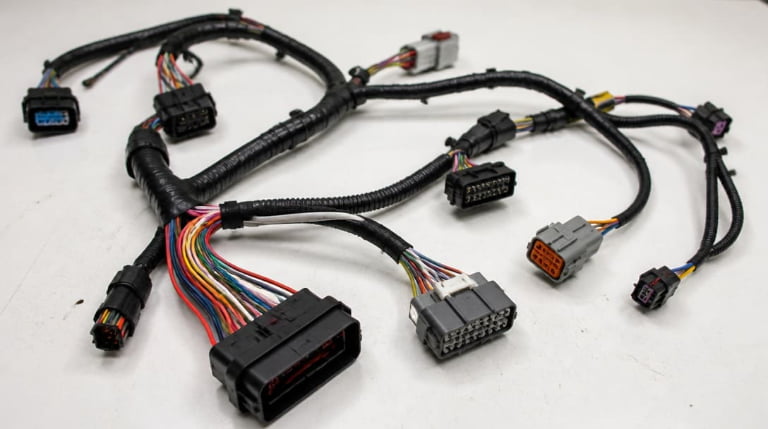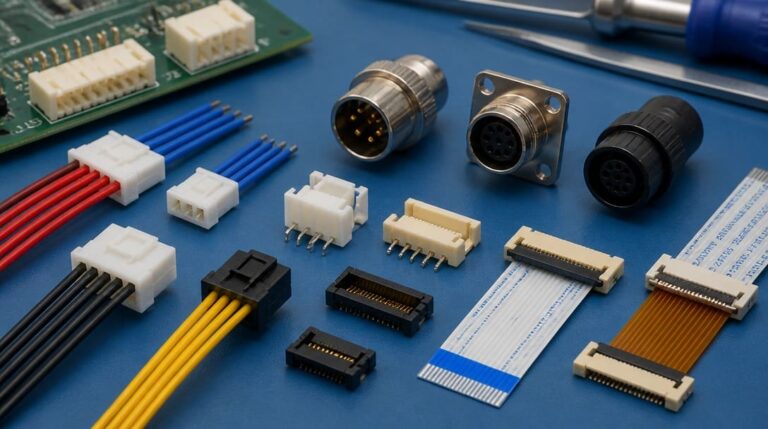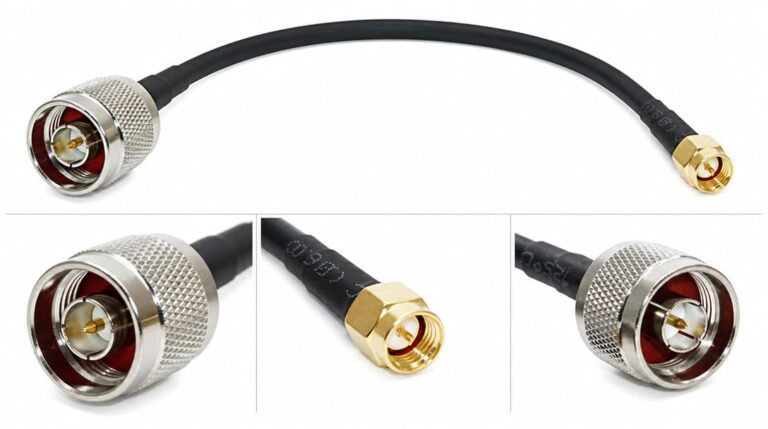
Dielectric withstand voltage hipot test duration for cable assemblies is the dwell time—a specified hold period at full test voltage applied across insulation with defined ramp and leakage current limits—used to verify insulation integrity under sustained electrical stress before a production lot is accepted.
Do Either of These Situations Sound Familiar?
A just-received supplier QC report for a new wire harness shipment shows a 1-second hipot test pass. The purchase specification, however, calls for a 60-second dielectric withstand voltage test at the same test voltage. Incoming inspection now has a live acceptance decision, not an academic debate about insulation testing.
In another facility, an engineer is drafting incoming acceptance criteria for cable assemblies. The draft simply says “hipot passed.” But when asked which parameters must appear on the report—dwell time, test voltage, ramp time, leakage current, cable length—the answer has not yet been defined. The pass/fail stamp has no acceptance boundary.
Do either of these situations sound familiar? If yes, the next step is not another tutorial on what hipot testing is. It is an accept/reject decision path based on the specific test parameters that make a pass meaningful.
Why “Hipot Passed” Has No Meaning Without Dwell Time
Dielectric withstand voltage is the insulation stress test that applies a high potential across conductors or between conductors and shield/ground for a specified dwell time. Dwell time is the hold period at full test voltage after the controlled rise is complete. Ramp time is that controlled rise from zero to test voltage, and leakage current is the small current conducted through the insulation or along contamination or moisture paths during the test.
A short dwell can allow the cable’s capacitance charging current to dominate the measured current. As capacitance charges, the current falls quickly; a tester can show a normal reading while a pinhole, thin spot, contamination path, or damaged connector surface has not been stressed long enough to break down. The result is a pass at one second against a purchase specification that intentionally required 60 seconds of sustained voltage stress.
That is why “hipot passed” has no standalone meaning. A pass/fail statement is only interpretable when the dwell, test voltage, ramp condition, leakage current limit, and cable length or capacitance are specified together—and when the printed values match the drawing, purchase order, or safety standard that applies to that cable assembly.
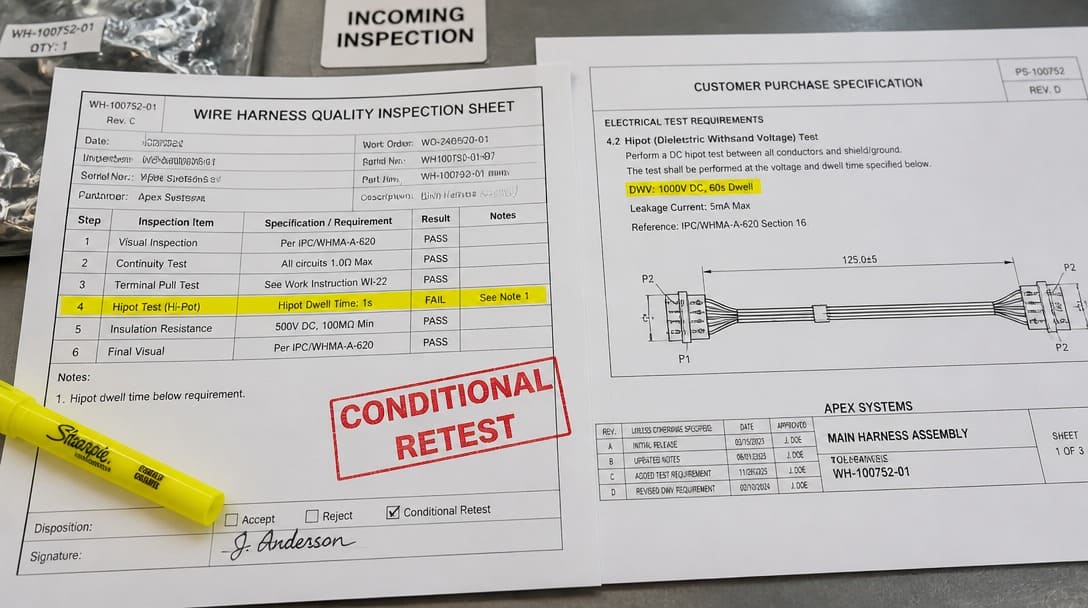
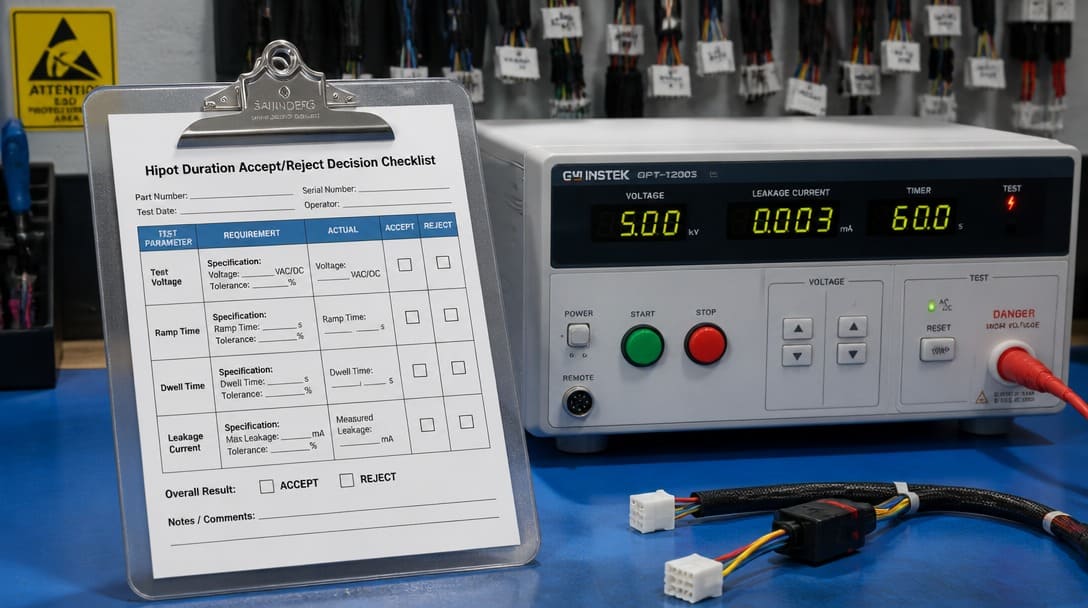
Go/No-Go Comparison: Hipot Duration Accept/Reject Decision Checklist
The following decision table can be applied directly to a supplier report. It classifies a hipot duration deviation as accept, reject, or conditional with retest—not as a general performance score.
| Purchase-Spec Dwell | Reported Dwell | Voltage | Ramp | Leakage Current | Cable Length / Capacitance | Decision | Immediate Disposition Action |
|---|---|---|---|---|---|---|---|
| 60 s | 1 s | Same | Same | Same | Same | Reject | Issue SCAR / CAR; quarantine lot; mandate 100% retest at 60 s dwell. |
| 60 s | 60 s | Same | Same | Higher limit / Missing | Same | Conditional | Hold lot; require raw test data logs proving actual leakage did not exceed purchase limit. |
| 30 s | 30 s | Lower than spec | Same | Same | Same | Reject | Reject immediately; reduced voltage does not validate specified dielectric clearance. |
| 10 s | 10 s | Same | Unspecified / Fast (<1 s) | Same | Same | Conditional | Review ramp curve; verify no false-pass masking from sudden voltage overshoot. |
| 60 s | 60 s | Same | Same | Same | Same | Accept | Release to production; archive calibration cert and serial-matched test logs. |
| “Passed” only | Missing | Missing | Missing | Missing | Missing | Reject Documentation | Reject shipping docs; treat lot as untested until full parameter certificate is provided. |
If the reported dwell is shorter, the correct disposition is usually reject or conditional with retest at the purchase-spec dwell. A conditional retest is permitted only when the same voltage, ramp, and leakage current criteria are used, and the retest report is documented. For a broader view of where hipot fits in incoming inspection, see what a cable tester is and where it fits in incoming inspection.
Pairing Duration with Voltage, Ramp, Leakage Current, and Cable Capacitance
Test voltage and dwell time must be evaluated as a pair. A longer dwell at reduced voltage is not equivalent to the specified test. Insulation that withstands 500 V DC for 60 seconds has not demonstrated the same dielectric withstand voltage performance as insulation tested at 1,000 V DC for 60 seconds. The stress profile is different, and the acceptance evidence is different.
Ramp time matters because too fast a rise can cause false trips or miss slow-creepage failures, while too slow a ramp changes the effective stress profile. A manufacturer that reports a pass without stating the ramp condition has not given the full condition under which the pass occurred.
Leakage current acceptance is also not a fixed number unless cable length and capacitance are considered. Longer cable assemblies have higher capacitance, so the initial charging current is higher. A tight leakage threshold applied to a long cable without length correction can produce a false reject; a loose threshold applied to a short cable can produce a false pass. Before accepting any hipot result, verify that the reported voltage, ramp, dwell, and leakage limit all match the purchase specification or the referenced IEC/UL/IPC test condition—especially for custom cable assembly drawings where lengths, shielding, and connector configurations vary.
What IPC/WHMA-A-620 and IEC/UL Practice Mean for the Report on Your Desk
IPC/WHMA-A-620 (Section 19.5.2 & 19.5.3) sets precise criteria for Dielectric Withstanding Voltage (DWV) testing across product classes:
- Class 1 (General Electronic Products): Hipot testing is typically optional or driven solely by customer documentation.
- Class 2 (Dedicated Service Electronic Products): Test parameters must be fully documented; default test conditions typically require a minimum dwell (often 1 second minimum for production screening unless otherwise specified on the drawing).
- Class 3 (High Performance / Harsh Environment / Aerospace): Testing is mandatory. When the drawing or referenced military/aerospace standard specifies a 60-second dwell, substituting it with a shorter production dwell without documented customer concession is a direct Class 3 non-conformance.
IEC 60950-1 and IEC 62368-1 provide safety-standard hipot test practice for information technology, audio/video, and communication equipment. IEC 62368-1 has replaced IEC 60950-1 in many jurisdictions, but both tie test voltage, duration, and leakage acceptance criteria to working voltage and insulation class. UL 758 for appliance wiring material similarly defines dielectric voltage-withstand conditions that require a specified test voltage and applied time. For defense or aerospace applications, MIL-STD-202 Method 301 covers dielectric withstanding voltage and Method 302 covers insulation resistance with sustained electrification time—not a one-second flash test.
The core issue is simple: a reported short dwell is not automatically equivalent to a longer purchase-spec requirement. The standard’s intent is to verify insulation integrity under sustained electrical stress, not to record that a tester briefly tolerated a voltage spike. Treat the standard as a minimum acceptance gate, not a benchmark for saying the supplier “passed.”
Field Failure Modes When Dwell Time Is Shortened Incorrectly
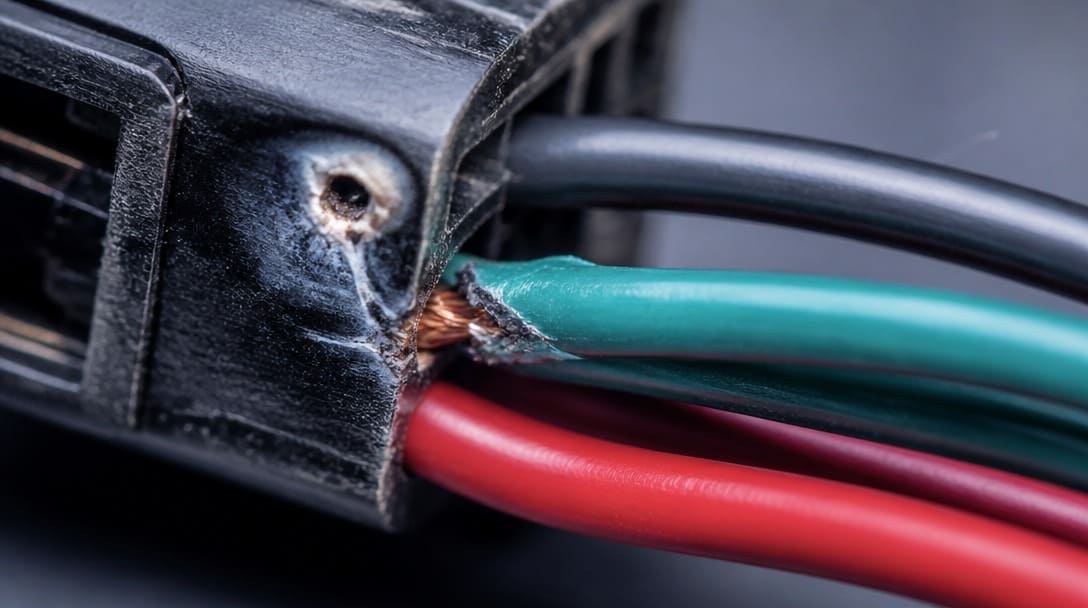
When dwell time is shortened incorrectly, some insulation defects remain hidden at incoming inspection. A pinhole, contamination path, or thin spot may not break down during the brief period when cable capacitance dominates the reading. The charging current looks normal, the tester reports a pass, and the defect is released to the field.
Edge-connector flashover and creepage failures are another concern. These can appear only after sustained voltage stress, especially in high-humidity or dusty operating conditions. A short dwell may not reveal the surface conduction path that would fail a longer dielectric withstand voltage test. The result is a field failure after installation, not a clean reject at receiving.
This is why shortening dwell without documented engineering justification and matching acceptance criteria is a quality-system finding, not a clerical difference. The purchase-spec dwell and the applicable standard are the minimum acceptance gate.
Turning the Checklist into Incoming Acceptance Criteria
- Pull the purchase specification and record the required dwell, voltage, ramp, and leakage current limits for the cable assembly being received.
- Compare the supplier QC report line by line against the Hipot Duration Accept/Reject Decision Checklist. Classify the lot as accept, reject, or conditional with retest.
- For conditional cases, request a retest at the purchase-spec dwell with the same voltage and leakage criteria and a documented ramp. Do not accept a summary “hipot passed” alone.
- For future purchase orders, add a hipot test data sheet template so the supplier must report dwell, voltage, ramp, leakage current, cable length/capacitance, equipment, operator, and date.
Recommended Hipot QC Report Data Sheet Specification
To prevent future incoming inspection disputes, copy and paste this mandatory parameter checklist into your PO quality clauses:
[MANDATORY HIPOT TEST REPORT PARAMETERS]
1. Assembly Part Number & Revision: [ ____________ ]
2. Production Lot / Date Code: [ ____________ ]
3. Test Standard Reference (e.g., IPC-620 Class 3 / MIL-STD-202): [ ____________ ]
4. Test Voltage (V AC or V DC): [ ______ V ]
5. Voltage Ramp-Up Time: [ ______ s ]
6. Dwell / Hold Duration at Voltage: [ ______ s ]
7. Trip Current Limit: [ ______ mA / µA ]
8. Maximum Measured Leakage Current: [ ______ mA / µA ]
9. Ambient Temperature & Relative Humidity: [ ____°C / ____% RH ]
10. Tester Model, Serial Number & Valid Calibration Date: [ ____________ ]
11. Operator ID & QC Supervisor Signature: [ ____________ ]
For future wire harness manufacturing orders, adding a structured hipot test data sheet template is more actionable when the supplier already manages specification review, connector matching, sample confirmation, production follow-up, inspection, and export-ready packaging. Suppliers such as EDOM Electronics support this type of OEM documentation workflow, so QA teams can receive the dwell, ramp, leakage, and capacitance data they need to apply the checklist line by line.

Frequently Asked Questions
How long should a hipot test dwell be for a cable assembly?
Dwell time is not universal. It must match the purchase specification, product standard, or safety standard test condition applicable to the cable assembly. Common dwells range from 1 second to 60 seconds, but the required duration is the only acceptable proof of sustained insulation stress.
Can a supplier use a 1-second hipot test if the requirement is 60 seconds?
Not as equivalent evidence. A 1-second pass does not satisfy a 60-second requirement unless a documented retest at 60 seconds using the same voltage, ramp, leakage limit, and acceptance criteria confirms the result. Otherwise, the lot should be rejected or placed in conditional retest status.
Can a manufacturer raise the test voltage to reduce dwell time from 60 seconds to 1 second?
While certain component standards (such as some UL appliance wire rules) permit substituting a 60-second test with a 1-second test at 120% of the rated test voltage during routine production-line screening, this cannot be applied unilaterally to custom cable harnesses. Over-volting complex multi-pin connectors, shielded twisted pairs, or delicate overmolds can induce irreversible insulation fatigue, punch-through, or spark-over at pin-to-pin creepage paths. Such substitutions require formal engineering approval (ECO) and validation showing the higher voltage does not damage the assembly.
What should be recorded on a supplier hipot test report?
A complete report should record test voltage, ramp time, dwell/hold time, leakage current limit and measured value, cable length or capacitance, test equipment, operator, date, pass/fail result, and the specification or standard used as the acceptance basis.
Does a longer dwell always mean a better test?
No. The dwell must be matched to the insulation material, voltage level, and component stress limits. An arbitrary longer dwell may not add value and could stress some constructions unnecessarily. The acceptance criterion is the specified dwell, not the longest available dwell.
Key Takeaways
- A hipot pass is evidence only when dwell, voltage, ramp, leakage current, and cable length/capacitance are reported and match the purchase specification.
- A reported shorter dwell is not automatically equivalent to a longer purchase-spec requirement; classify it as reject or conditional with retest.
- Use the Hipot Duration Accept/Reject Decision Checklist to evaluate supplier reports parameter by parameter.
- IPC/WHMA-A-620, IEC 60950-1, IEC 62368-1, UL 758, and MIL-STD-202 for defense or aerospace applications all support sustained electrical stress verification, not a one-second flash test.
- Add a structured hipot test data sheet template to future purchase orders so incoming acceptance criteria can be enforced consistently.
For a structured quality inspection and export packaging workflow that supports incoming acceptance of cable assemblies and wire harnesses, explore the quality inspection and export packaging process.