Is what you’re looking at actually a wiring harness?
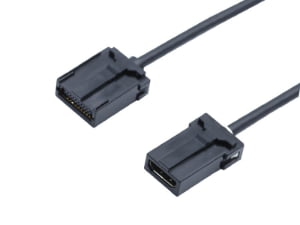
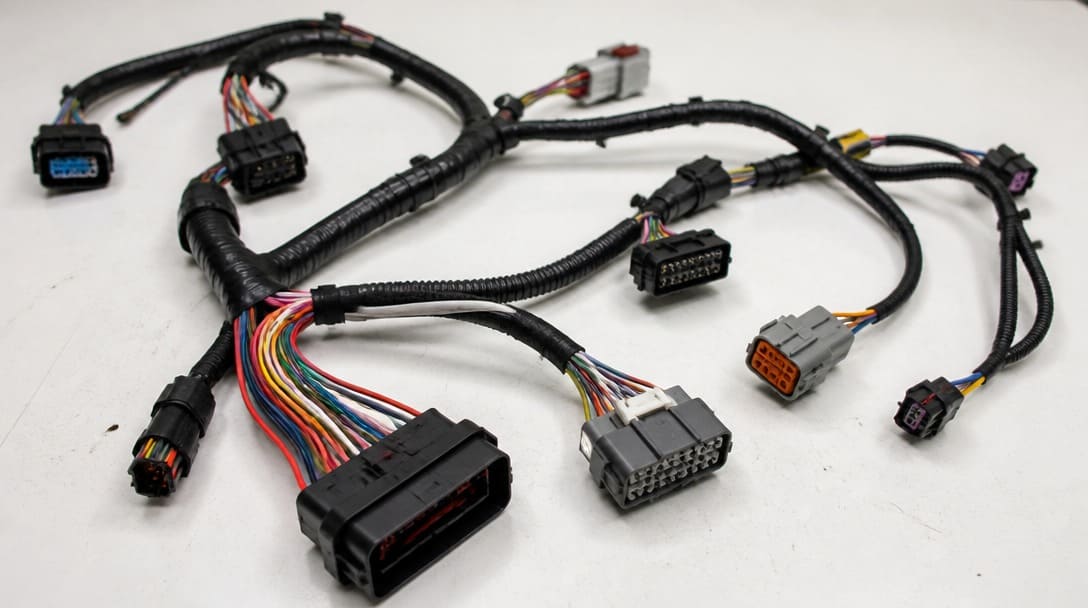
A wiring harness is not just a bundle of wires. It is an engineered sub-assembly designed to carry power and signals along a defined path while protecting conductors from vibration, abrasion, and heat. On a drawing or bill of materials, it will show several distinct elements:
- Conductors (wires): Stranded or solid copper conductors with insulation rated for the operating temperature and voltage. Variants appear as AWG sizes, UL style numbers, and color codes.
- Terminals: Metal contacts crimped or soldered onto wire ends to create a reliable electrical connection. These come in specific families (ring, spade, pin, socket) and plating options (tin, gold, selective gold).
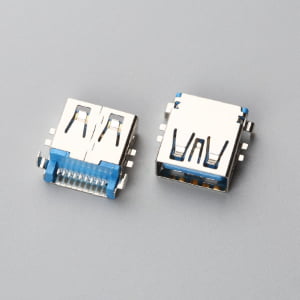
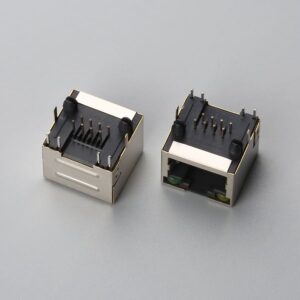
- Connector housings: Molded plastic bodies that hold terminals in a specific mating pattern and provide latch locking, polarization, and environmental protection.
- Protective sleeving and loom: Corrugated tubing, braided sleeving, heat-shrink, or tape that shields the bundle from cuts, fluids, and EMI.
- Labels and markers: Self-laminating or heat-shrink labels identifying each circuit, connector reference, and harness revision.
Because a harness replaces dozens of individual wires that would otherwise be routed, taped, and fixed by hand on the assembly line, it reduces installation labor and eliminates the risk of loose or pinched conductors. For OEM procurement, recognizing this on a drawing means you’re looking at a single part number that must arrive at the production floor ready to plug in, not a handful of loose components.
Wiring harness vs. cable assembly: which one do you have?
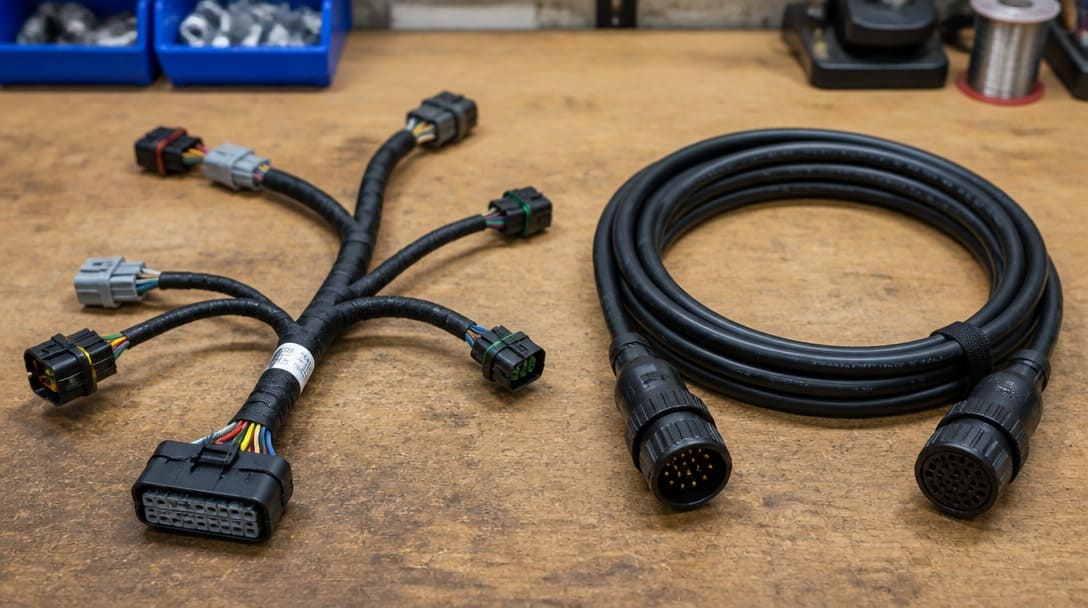
These two terms are frequently confused, and that confusion leads to incorrect quotes, wrong compliance expectations, and prototypes that don’t fit. The table below captures the practical differences OEM buyers need to act on.
| Parameter | Wiring Harness | Cable Assembly |
|---|---|---|
| Typical environment | Inside enclosures, behind panels, under dashboards | External runs, between cabinets, exposed to weather or mechanical stress |
| Appearance | Multiple branches, many breakout points, often partially or entirely unsheathed | Usually a single trunk with a jacket (PVC, PUR, TPE) and one or two end connectors |
| Primary protection | Loom, tape, convoluted tubing; conductor bundle is accessible for repair | A robust outer jacket that resists moisture, oil, and abrasion; rarely intended to be opened |
| Applicable standard | IPC/WHMA-A-620[1] (Workmanship Standard for Assembly) + UL Wiring Harness Traceability (ZPFW2/ZPFW8) | IPC/WHMA-A-620 (Workmanship) + Material-level UL Cable Style (e.g., UL 2464, UL 2586) |
| Flexibility | High; designed to follow complex routing paths inside a structure | Moderate to low; jacket gives the assembly a fixed outer diameter and tighter bend radius |
| Typical BOM trigger | Full-vehicle or panel schematic showing multiple nodes | Point-to-point interconnect drawing, e.g., sensor-to-controller cable |
If your drawing shows a single cable with a jacket and two connectors, you’re likely dealing with a custom cable assembly, not a harness. Sending a harness inquiry for a cable assembly—or vice versa—will inevitably delay the quote because the required material spec and testing criteria are different. Note: UL Style numbers on a drawing identify the safety rating of the bulk wire or jacketed cable material, whereas IPC/WHMA-A-620 defines the acceptable quality criteria for the completed assembly. A harness will use UL-recognized single wires, while a cable assembly uses a UL-recognized jacketed multi-conductor cable.
Need help deciding which one you have? Check out our article on what wiring harness you need to learn key factors for OEM buyers. A supplier familiar with both IPC/WHMA-A-620 and UL documentation can review your drawing and clarify the assembly type before you spend hours formatting a quote.
What you must specify before any supplier can quote accurately
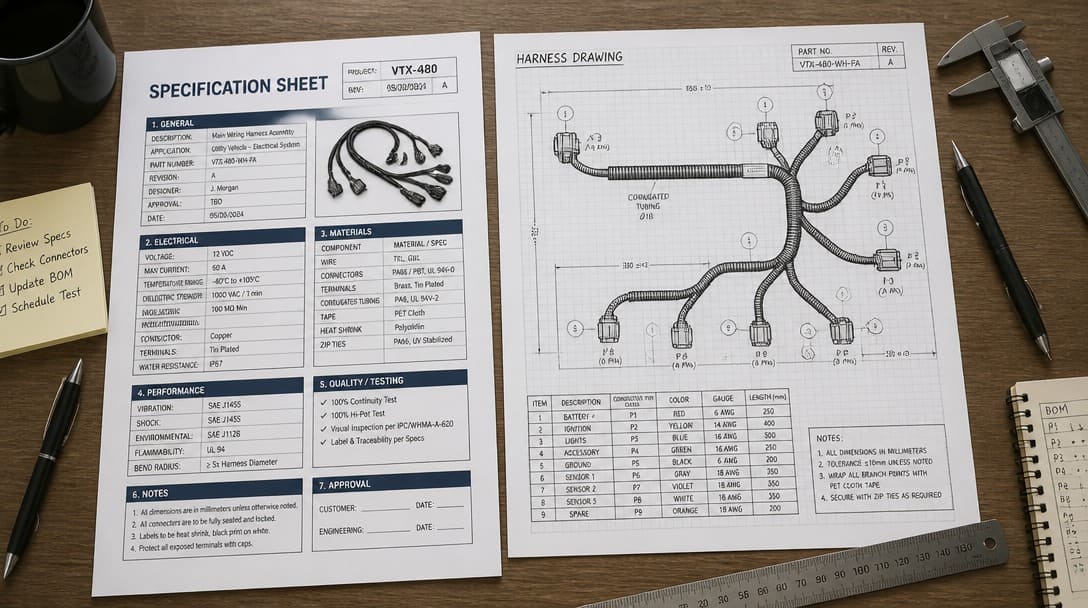
Wiring harnesses demand more upfront detail than many first-time buyers expect. A vague request cannot become an actionable quotation because every missing field forces the supplier to make an assumption—and the wrong assumption almost always adds cost or creates a non-functional part.
“In our experience, the first inquiry from a new buyer almost always arrives without a quantity. Without that one number, we can’t give a meaningful price — material costs shift significantly between 50 units and 500.”
Below are the six specification areas that OEM buyers must close before a supplier can return a realistic lead time and unit price.
- Quantity with MOQ awareness: Is this a 50-piece pilot run or a 3,000-unit annual requirement? Wire and terminal reels have fixed minimum order quantities; if the supplier needs to buy a full reel for a 30-piece order, the unit cost changes. A ballpark figure (e.g., 200 units initially, 1,000/year) is infinitely better than leaving it blank.
- Wire gauge (AWG) and construction: State the gauge in AWG or mm², specify stranded or solid, and provide the insulation temperature rating (80°C, 105°C, 125°C). If a UL style is listed on the drawing (e.g., UL 1015, UL 1007), include it. These variables directly control current capacity, flexibility, and whether the harness meets flammability requirements.
- Connector part numbers with plating: Supply the full manufacturer P/N and the preferred plating option — gold for signal reliability in harsh environments, tin for cost-sensitive dry applications. RoHS compliance is not optional for EU-bound products; list any substance restrictions upfront to avoid a non-conforming batch.
- Color requirements: Standardized circuit colors are available from ready stock. Custom colors or specialty stripes (e.g., brown/yellow) add lead time and minimum order quantities. Leaving color as “standard” without context invites mismatches between what the supplier stocks and what the assembly technician expects on the floor.
- Testing and acceptance criteria: Will you accept 100% continuity testing, or is a hi-pot (dielectric withstand) test required on every harness? Testing requirements drive labour, fixture cost, and quality documentation. Specify pass/fail criteria — IPC/WHMA-A-620 Class 1, 2, or 3 — so the supplier knows exactly what inspection standard to apply.
Specify pass/fail criteria based on your end-market requirements:
– Class 1 (General Electronic Products): Basic functionality, suitable for consumer items.
– Class 2 (Dedicated Service Electronic Products): High reliability and extended life, standard for most industrial equipment.
– Class 3 (High Performance / Harsh Environment): Uninterrupted service required, mandatory for automotive safety systems, medical, and aerospace. Higher classes require stricter crimp inspection and full hi-pot testing, directly impacting unit cost. - Labeling and packaging: Indicate what laser-printed or heat-shrink labels must appear on each branch, and whether harnesses must be individually bagged, kitted, or shipped in returnable containers. These choices affect both recurring cost and export packaging compliance.
Closing these gaps before you send the first email does more than speed up the reply. It shows the supplier that your project is real, your documentation is controlled, and you’re ready to move from concept to a production-ready sample.
Your first-inquiry checklist
The table below is the minimum data set every OEM buyer should have ready. Fill it out and attach it with your drawing — you’ll get a same-week quote rather than weeks of back-and-forth clarification.
| Data point | What to provide | Why it matters |
|---|---|---|
| Quantity | Initial order plus annual forecast (e.g., 200 + 1,200/year) | Sets material reel MOQ, labour planning, and pricing tier |
| Wire specification | AWG, strand count, insulation rating, UL style if known | Determines current capacity, crimp tooling, and harness flexibility |
| Connector P/Ns | Full manufacturer part number and requested plating (tin, gold) | Locks mating compatibility; gold vs. tin impacts cost and field life |
| Color preference | Standard palette (black, red, blue, etc.) or custom stripe / print standard | Stock colors ship faster; custom colors add raw-material lead time |
| Testing requirement | Continuity only, hi-pot voltage, or IPC/WHMA-A-620 Class 2 / 3 | Drives fixture design, cycle time, and quality documentation |
| Labeling | Label type, text content, and placement on each branch | Avoids mismatched circuits and simplifies installation |
| Packaging instruction | Individual bagged, bulk, returnable totes, or export palletizing | Prevents transit damage and customs delays; see inspection & export packaging for details |
Pro-Tip for Buyers: Lead Time Risk & Alternate Sourcing Original brand connectors (TE Connectivity, Molex, Hirose, JST) often suffer from extended lead times during market supply shortages. To protect your production schedule:
- Specify upfront if your engineering design permits validated alternate/equivalent connectors.
- Require First Article Inspection (FAI) and Crimp Pull-Force Test Reports for any secondary-sourced terminals.”
A partner that builds harnesses daily — such as EDOM Electronics — can take this checklist and a clean drawing and return a complete BOM and quote much faster than a general fabrication shop because the whole team speaks harness-language: terminal matching, crimp cross-section review, and continuity test programming.
How wiring harnesses are manufactured — a quick look so you know what to expect
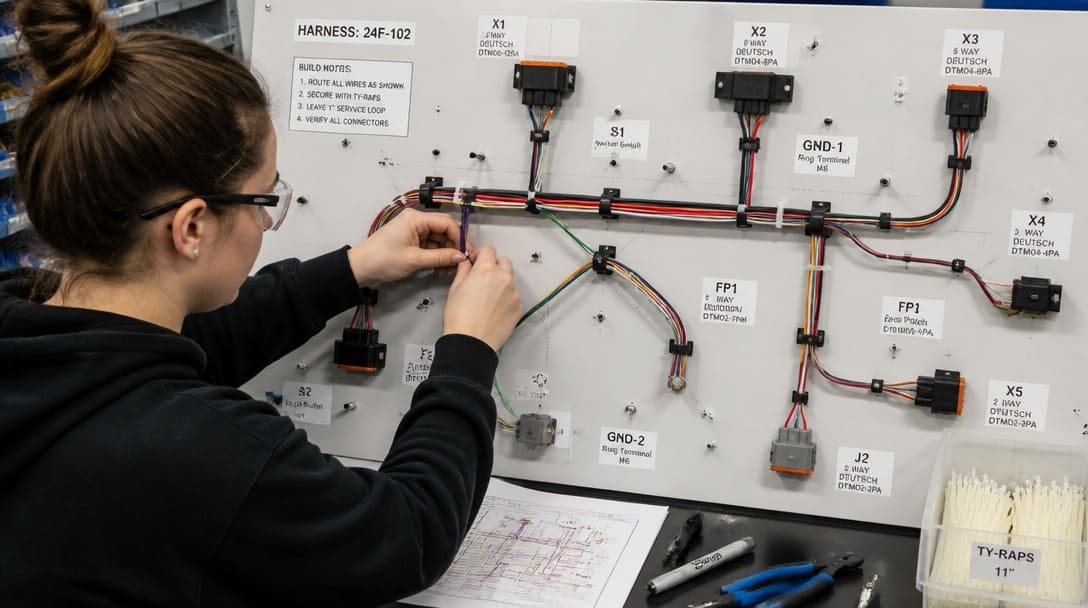
Understanding the basic production flow helps you see why lead times have the shape they do and why the details on your checklist directly affect every station on the floor.
Suppliers who work to IPC/WHMA-A-620, like EDOM Electronics, document crimp cross-sections and pull-test results as part of the standard quality record, so buyers receive not only a tested harness but also the evidence that every joint meets the agreed acceptance class. This documented approach is what gives OEM buyers the confidence to go from first-article approval to full production without renegotiating quality expectations.
Suppliers who work to IPC/WHMA-A-620, like EDOM Electronics, document crimp cross-sections and pull-test results as part of the standard quality record, so buyers receive not only a tested harness but also the evidence that every joint meets the agreed acceptance class. This documented approach is what gives OEM buyers the confidence to go from first-article approval to full production without renegotiating quality expectations. For an in-depth breakdown of root causes and test methods (crimp height, pull force, and hi-pot), see our engineering guide on crimp quality defects troubleshooting.
What goes wrong in the field when specifications fall short
Every failure mode listed below traces directly back to a piece of information that was missing or assumed during the quotation stage.
- Intermittent connections from unspecified connector plating. A tin-plated terminal specified when the application required gold in a high-humidity enclosure will develop fretting corrosion. Contacts that tested fine on the bench become open circuits after weeks in the field. Missing detail: connector part number with plating suffix.
- Insulation breakdown from an undersized wire gauge. A 22 AWG wire chosen because it “fits” the connector but later proven to carry more than 5 A continuous melts the insulation, shorts to an adjacent circuit, and possibly burns through the harness loom. Missing detail: confirmed AWG and ampacity requirements per the system load analysis and ambient temperature derating.
- Color-coding chaos leading to assembly errors. When the drawing says “red” but the supplier’s standard red is a different shade or not stocked for that UL style, an undocumented substitution sends +12 V down a ground path on the assembly line. Missing detail: exact color codes and a reference standard such as RAL or a controlled swatch.
- Connector mismatch from an incomplete part number. A housing number without the keying option or latch orientation results in a harness that physically cannot engage the mating half on the final machine. The entire shipment may be useless until new connectors are sourced and re-terminated. Missing detail: complete manufacturer P/N including all suffixes.
Each of these failure mechanisms is preventable — and each becomes a line item that a disciplined supplier checks during the drawing review. When an OEM buyer chooses a partner that treats specification review as a distinct step (not a quick glance), the chance of field failures drops measurably. EDOM Electronics, for instance, validates every connector combination against the customer’s BOM before cutting the first wire, flagging plating, gauge, or mating incompatibilities before they turn into cost.
Next step: From spec to production — a deeper look at manufacturing
A trustworthy wiring harness manufacturer can take your checked specifications and a clean drawing and turn them into a repeatable production process that stacks quality gates from wire cut to final packaging. If you want to see exactly how that process is controlled — from cut-list generation through hi-pot testing and export-ready packing — explore our detailed wire harness manufacturing walkthrough.
For the foundational concepts that tie all this together — what a wiring harness does, its core components, and where it fits in a larger system — revisit the pillar article: What Is a Wiring Harness?
Frequently Asked Questions
What’s the difference between a wiring harness and a cable assembly?
A wiring harness is a multi-branch bundle that routes conductors inside a product, usually with partial jacketing and many connectors. A cable assembly is typically a single-jacketed cable with one or two end connectors, designed for external environments. Harnesses follow IPC/WHMA-A-620; cable assemblies are often tied to specific UL jacket standards.
Why does quantity matter so much for a wiring harness quote?
Wire, terminals, and connectors are purchased in reels or bulk packs with minimum order quantities. A 50-unit order may require the supplier to buy a full reel, spreading that cost across fewer pieces. For a deeper understanding of harness wire purchasing, check out our complete OEM purchasing guide.
What’s the most common mistake OEM buyers make when requesting a harness quote?
Leaving the quantity blank or unstated. Even a rough estimate (e.g., “200 now, maybe 2,000 over the year”) allows the supplier to structure a quotation with tiered pricing. Other common gaps include omitting connector plating and assuming wire gauge can be chosen later.
How do I know if my harness needs IPC/WHMA-A-620 Class 2 or Class 3?
Class 2 covers general industrial and commercial electronics where continued performance is important but a mission-critical failure does not stop the entire system. Class 3 is for applications where reliable operation on demand is essential, such as medical devices, aerospace, or safety-critical automotive circuits. The class drives inspection frequency, crimp monitoring, and documentation requirements.
Can I use standard colors, or do I need to specify each wire color?
If your drawing shows standard circuit colors (red, black, blue, yellow, green, etc.) and the UL style is commonly stocked, lead time remains short. Custom colors, stripes, or numbering sequences nearly always add raw-material ordering time and may impose an MOQ on the wire itself. Specify exact color callouts early to avoid surprises.
Key Takeaways
- A wiring harness is an engineered sub-assembly of wires, terminals, connectors, and protective sleeving — not just a bundle of wires.
- Distinguishing a wiring harness from a cable assembly (by environment, construction, and governing standard) is the first step to getting an accurate quote.
- The quantity, even a ballpark, is the single most critical number to provide; without it, material pricing cannot be calculated.
- A complete inquiry includes AWG, connector P/Ns with plating, color preferences, testing requirements, labeling, and packaging instructions — all of which directly affect cost and lead time.
- Working with a supplier that validates every specification against IPC/WHMA-A-620 before production catches plating mismatches, gauge errors, and color discrepancies before they become field failures.
Learn more about our wire harness OEM services — from cut list to final inspection, every step built around your specifications.