If you just received a drawing that says wire harness and you’re not sure what that means or what you need to prepare, this is the right place to start.
Quick answer: A wire harness is an engineered, pre‑assembled grouping of conductors, terminals, connectors, protective sleeving, and identification labels that routes power and control signals through equipment or vehicles. Every single component must be specified because a harness is a custom, production‑oriented product—not a handful of wires tied together.If you are starting from the basics of interconnect design, read our foundational guide on cable assembly definitions and components first.
What a Wire Harness Actually Is
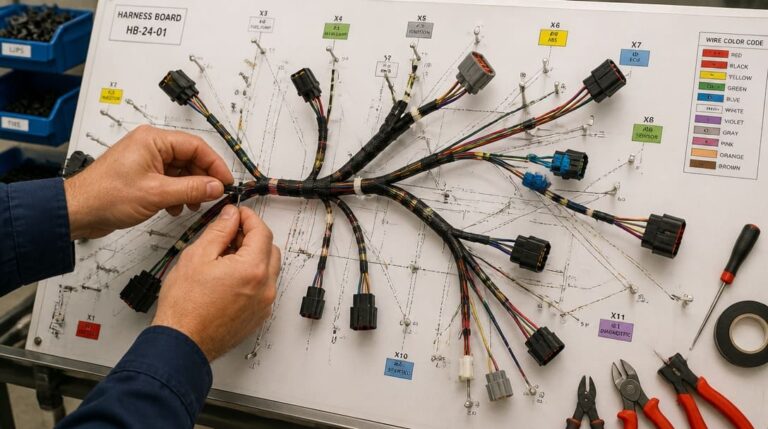
Before diving into the specifications, let’s establish a baseline. As explored in our guide to wiring harness components and functions, a proper wire harness consists of five core elements:
- Conductors: Stranded or solid copper wires (sized by AWG).
- Terminals: Crimped or soldered contacts.
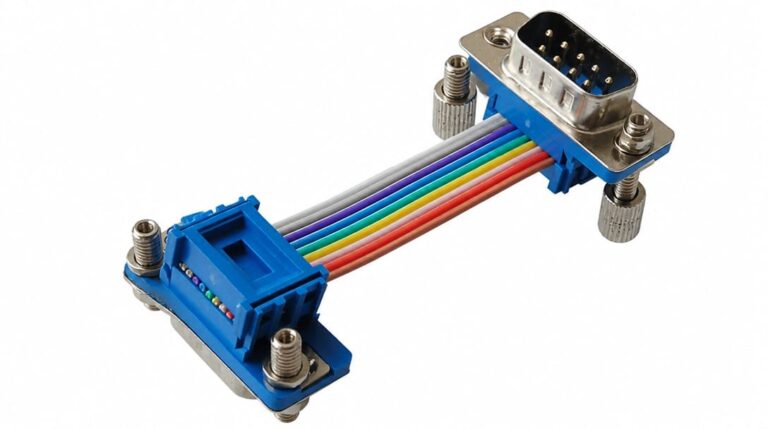
- Connectors: Housings and pin blocks.
- Protective sleeving: Conduit, braided loom, or heat‑shrink.
- Labels: Thermal‑transfer or inkjet‑printed markers.
Even at this fundamental level, the most critical electrical parameter applies immediately: AWG (American Wire Gauge), which determines current-carrying capacity. For a complete OEM purchasing overview, see our guide to harness wire selection and specifications.
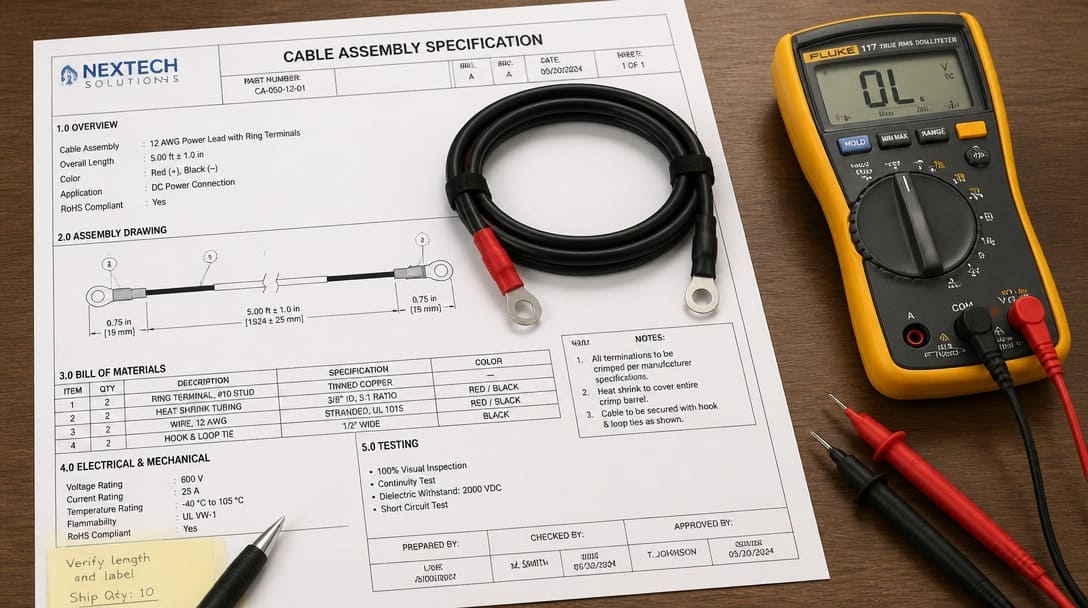
Wire Harness vs. Cable Assembly: Clearing the Confusion
The terms “wire harness” and “cable assembly” are often used interchangeably by non‑technical buyers, yet they describe two different manufacturing orientations. Getting this distinction right early saves both the buyer and the supplier from quoting the wrong product.
A cable assembly is a group of wires or cables enclosed inside a single outer jacket, typically with connectors already attached—often overmolded—and designed to withstand harsh external conditions. A wire harness, by contrast, consists of multiple individual conductors that are routed and tied together but retain their own insulation; protective sleeving is added selectively rather than as a continuous outer sheath. Harnesses excel at internal equipment wiring where space, branching, and serviceability matter more than a full‑jacket armor.
| Feature | Wire Harness | Cable Assembly |
|---|---|---|
| Basic construction | Individual insulated conductors bundled with ties, loom, or conduit; no continuous outer jacket | Multiple conductors enclosed in a common outer sheath, often with molded connectors |
| Typical environment | Inside enclosures, panels, vehicles (protected locations) | External connections, moving parts, exposure to fluids, weather, or vibration |
| Common use cases | Control panel wiring, automotive dash and door harnesses, industrial machine internal routing | Sensor cables, power supply cords, machine‑to‑machine interconnects, outdoor equipment |
| Protection level | Selective—sleeving, tape, or wrap applied only where needed | Continuous jacket offers uniform protection; often IP‑rated when sealed |
| Quote complexity | High—branch points, multiple terminal and connector variations, custom routing | Moderate—fewer junctions but stricter jacket and overmold tooling dependencies |
If the drawing in hand shows multiple branch points, dozens of labeled circuits, and no continuous outer jacket, the request is almost certainly for a wire harness. If it depicts a single cable run with connectors on both ends and an uninterrupted jacket, the project leans toward a custom cable assembly. For details on that side of production, custom cable assembly processes follow their own design and tooling rules.
Why Wire Harnesses Demand More Upfront Detail Than You Expect
New buyers often underestimate the information a harness quotation requires. A wire harness is not an off‑the‑shelf item. Every element—conductor, terminal, connector, label—must be matched to specific electrical and mechanical conditions, and small specification gaps propagate into large cost and lead‑time consequences.
Many suppliers report that the first inquiry from a new buyer almost always arrives without a quantity. Without that one number, a meaningful price is impossible. Material costs shift significantly between 50 units and 500; connector minimum order quantities and wire reel lengths play a much larger role than most imagine. In the vacuum of a missing quantity, any quoted number is a placeholder, not a commitment.
Other hidden dependencies routinely surface:
- Wire gauge and strand count: 20 AWG with 7 strands behaves differently—and costs differently—than 20 AWG with 19 strands. The strand count determines flexibility and resistance to vibration‑induced breakage.
- Insulation material: PVC, XLPE, silicone, or TPE each carry different temperature ratings, chemical resistance, and pricing. An assumption of PVC when the environment demands XLPE creates a latent failure risk.
- Connector plating: Tin plating is economical for benign indoor use. Gold or selective gold is mandatory for low‑level signals, frequent mating, or corrosive atmospheres. A drawing that shows a connector part number but omits the plating preference leaves the supplier guessing—and the guess may not align with the application.
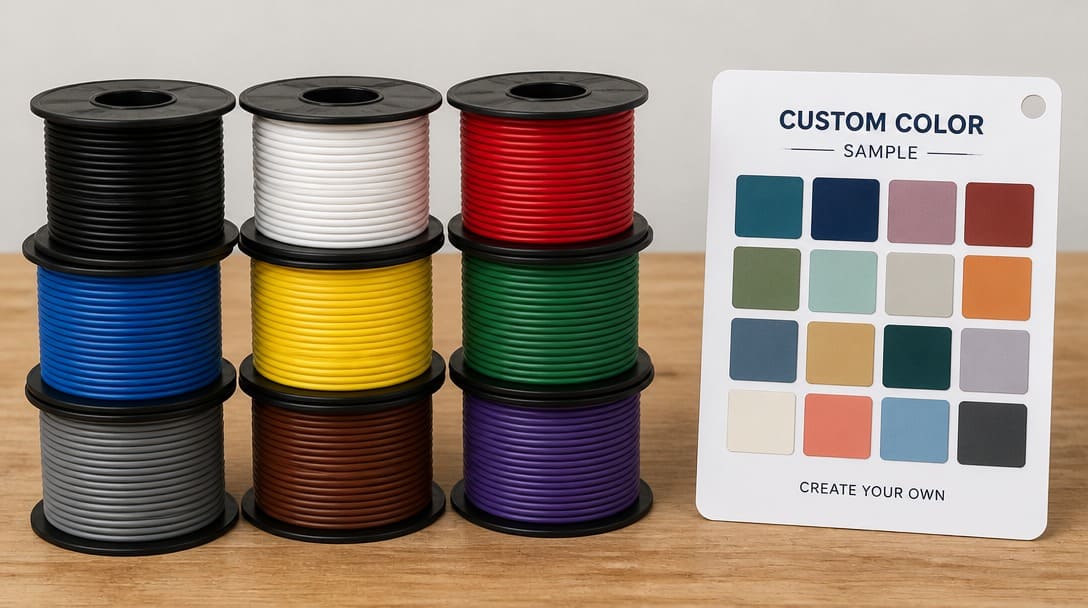
- Color requirements: Standard colors (black, red, white) are readily available in continuous stock. Custom colors often require minimum production quantities and longer lead times because the insulation compound must be specially run.
The quote isn’t slow because the supplier is unresponsive; it’s slow because the problem hasn’t been fully framed yet. Assembling the right information upfront turns a multi‑day email chain into a single, actionable quotation.
The 10 Critical Specifications That Directly Affect Your Quote
When a procurement team or engineer prepares a wire harness RFQ, ten parameters separate a casual inquiry from a production‑ready package. Each specification carries a direct commercial implication.
- Wire gauge (AWG): Dictates current capacity and weight. Under‑specifying AWG can lead to overheating; over‑specifying adds unnecessary cost and bulk.
- Conductor material: Bare copper, tinned copper, or aluminum. Tinned copper offers superior corrosion resistance and is standard for many industrial and automotive harnesses.
- Insulation type: PVC is cost‑effective for indoor general wiring; XLPE withstands higher temperatures; silicone remains flexible at extremes. The insulation must match the operating environment.
- Voltage rating & Segregation (NFPA 79): If the voltage is not stated, experienced manufacturers often default to 300 V. However, under industrial machinery wiring standard NFPA 79 Section 13.1.3 (and UL 508A), if different voltage systems (e.g., 24V DC control signals and 480V AC motor power) are bundled in the same wire harness, all conductors must be insulated for the maximum voltage present in the system (typically requiring 600V, like UL 1015). Purchasing cheaper 300V-rated wires (like UL 1007) for control circuits means they cannot be bundled with 480V lines, forcing the factory to build separate harnesses at double the labor cost.
- Current rating and Derating Factor: Tied to AWG, ambient temperature, and the number of conductors bundled together. High currents demand thicker conductors, but a common engineering trap is ignoring the derating factor. For example, a single 16 AWG wire might safely carry 20A in open air, but when bundled tightly with 10 other power wires in an unventilated harness, it will overheat. You must specify the correct derating factor and potentially upgrade to 14 AWG or high-temperature insulation (e.g., XLPE) to prevent thermal failure.
- Temperature rating: What is the expected continuous and peak temperature? If left unspecified, consumer electronics suppliers may default to standard 80 °C PVC (e.g., UL 1007), whereas automotive and heavy-duty applications strictly require baselines of 105 °C or 125 °C (e.g., SAE J1128 or XLPE). This assumption gap between 80 °C and 125 °C creates severe latent failure risks in high-temp environments.
- Shielding Coverage & Signal Integrity: Foil, braided, or combination shields are needed when the harness routes near noise sources. For proper design, specify the shielding coverage percentage (e.g., 85% or 95% tinned copper braid). For high-frequency data lines, you should also define the required Shielding Effectiveness (dB) or Transfer Impedance. Additionally, always include an integrated tinned-copper Drain Wire. A drain wire simplifies grounding and slashes termination labor costs by eliminating the need to manually comb and solder the shielding braid.
- Connector plating: Gold versus tin affects mating cycles, contact resistance, and unit cost. Selective gold (only on the mating area) is a common cost‑optimization technique.
- Compliance standards: Mentioning UL, RoHS[1], IPC/WHMA‑A‑620, or SAE J1128 tells the supplier exactly which materials and workmanship classes to apply. SAE J1128 governs low‑voltage primary cable used extensively in automotive and marine harnesses; IPC/WHMA‑A‑620 defines acceptance criteria for crimps, soldering, and assembly workmanship; UL recognition adds component‑level traceability; RoHS compliance ensures restricted substances are excluded.
- Continuity and testing requirements: Does every circuit require 100% continuity testing? If your application involves high voltage or critical safety, you must specify the exact Dielectric Withstanding Voltage (DWV / Hi-pot) parameters (e.g., “Test at 1000V AC for 1 minute, max leakage 1mA”) and insulation resistance thresholds (e.g., “> 100 MΩ”). These advanced tests consume time and require specialized equipment, which must be priced into the quote.
Here is a quick reference matrix summarizing these critical specifications for your BOM or engineering drawing:
| Specification Category | Key Parameters to Define | Common Industry Standards / Examples |
|---|---|---|
| Conductor | AWG, Strand count, Derating factor | 18 AWG, 41-strand, Bare Copper |
| Insulation | Material, Temp Rating, Voltage | PVC (80°C/300V), XLPE (125°C/600V), UL 1015 |
| Protection | Shielding Coverage, Drain Wire | 85% Tinned Copper Braid + Drain Wire |
| Termination | Plating, Crimp height/Pull-force | Selective Gold 15µ”, IPC-A-620 Class 2 |
| Compliance & Test | RoHS, UL, Hi-Pot, Continuity | RoHS 3, 100% Continuity, 1000V AC Hi-Pot |
First‑time buyers often feel overwhelmed by this list, but experienced suppliers do not expect perfection. Suppliers such as EDOM Electronics are accustomed to working from incomplete information and systematically identify the three or four critical gaps that most impact cost and lead time. That early clarification loop is a sign of a competent partner, not a barrier.
What Suppliers Need for an Accurate Quote: A Checklist
Translating the top‑10 specifications into a supplier‑ready inquiry is straightforward. The following checklist covers what a harness manufacturer needs to deliver a firm quotation, not a ballpark guess.
- Quantity: Annual estimated usage and first‑batch quantity. Without this, unit pricing is meaningless.
- Wire details: AWG, strand count, insulation material, and any relevant UL style or SAE designation.
- Connector part numbers: Exact manufacturer and part number, including plating preference (e.g., gold flash, 15 µ” selective gold, tin). If the part number is unknown, a clear photo and mating interface description help the supplier cross‑reference.
- Color scheme: Standard black/red circuit identification, or a custom color‑coding table? Custom colors trigger minimums.
- Operational environment: Indoor, outdoor, under‑hood, exposure to oil, fuel, or water. This drives insulation, sealing, and sleeving choices.
- Compliance expectations: RoHS is typically a baseline, but if UL‑recognized components or full IPC/WHMA‑A‑620 Class 2 or 3 assembly is required, state it explicitly.
- Testing requirements: Continuity test only, or additional hi‑pot, pull‑force, or visual inspection criteria.
If only a drawing exists, send it anyway. Reputable manufacturers, including EDOM, will read the drawing to uncover what’s missing and return with the precise questions that matter. Providing as many of the checklist items as possible at the outset frequently collapses three email rounds into one.
How Wire Harnesses Are Manufactured: A Step‑by‑Step Overview
Understanding the factory flow before sending an inquiry helps buyers visualize why lead times are not instant and why quality‑focused suppliers insist on first‑article inspection. While every shop floor has its own rhythm, the typical harness production sequence follows a logical, verifiable chain.
- Wire cutting and stripping: Automated machines cut conductors to programmed lengths and strip insulation to precise dimensions, minimizing scrap and ensuring repeatable strip quality.
- Terminal crimping: Terminals are attached using calibrated crimp presses. Manufacturers that work to IPC/WHMA‑A‑620 criteria validate crimp height, pull‑force, and visual cross‑section samples for each wire‑terminal combination.
- Connector insertion: Crimped terminals are inserted into connector housings with an audible or tactile click. Retention checks confirm that each terminal is fully seated and locked.
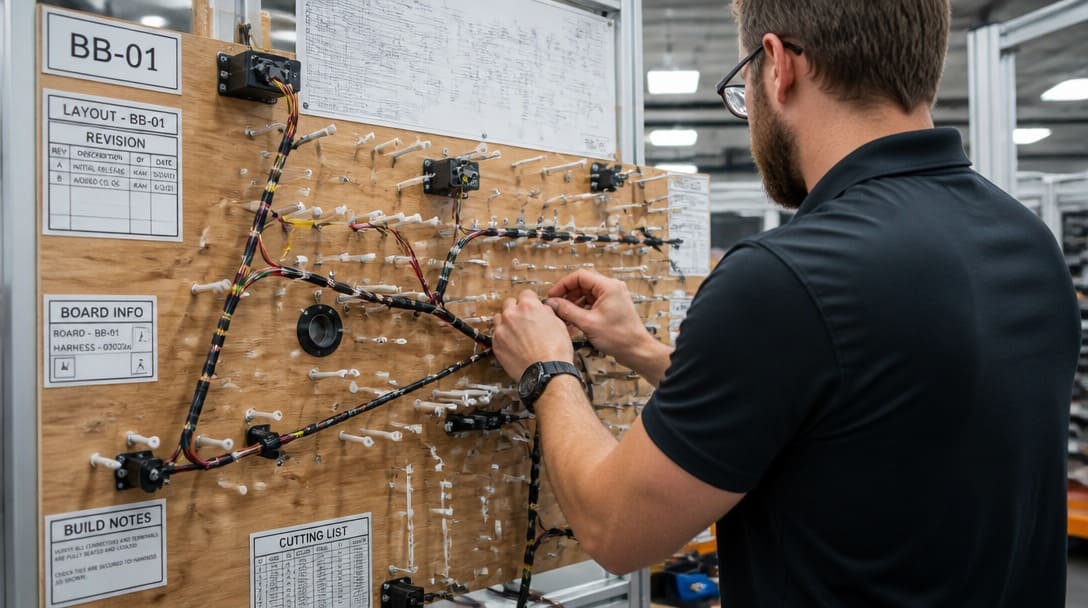
- Routing and looming: Wires are bundled to the drawing’s routing plan. Protective sleeving, conduit, braided wrap, or spiral loom is applied at specified branch points and abrasion zones.
- Labeling: Heat‑shrink or wrap‑on labels identify each circuit according to the customer’s labeling scheme. Label durability and legibility are verified under the expected environmental exposure.
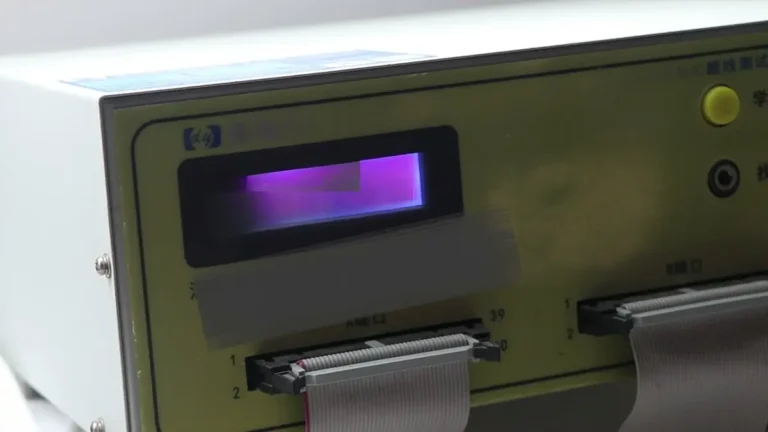
- Continuity and appearance inspection: Every circuit is tested for continuity, shorts, and mis‑wires. A visual check follows for crimp quality, connector integrity, label alignment, and sleeving placement. For additional detail on how final inspection and protective packing are handled for international shipments, export‑oriented quality control and packaging plays a decisive role in damage‑free delivery.
- Final packaging: Harnesses are coiled or laid into export‑grade packaging with desiccants and ESD protection as needed, then labeled for shipment.
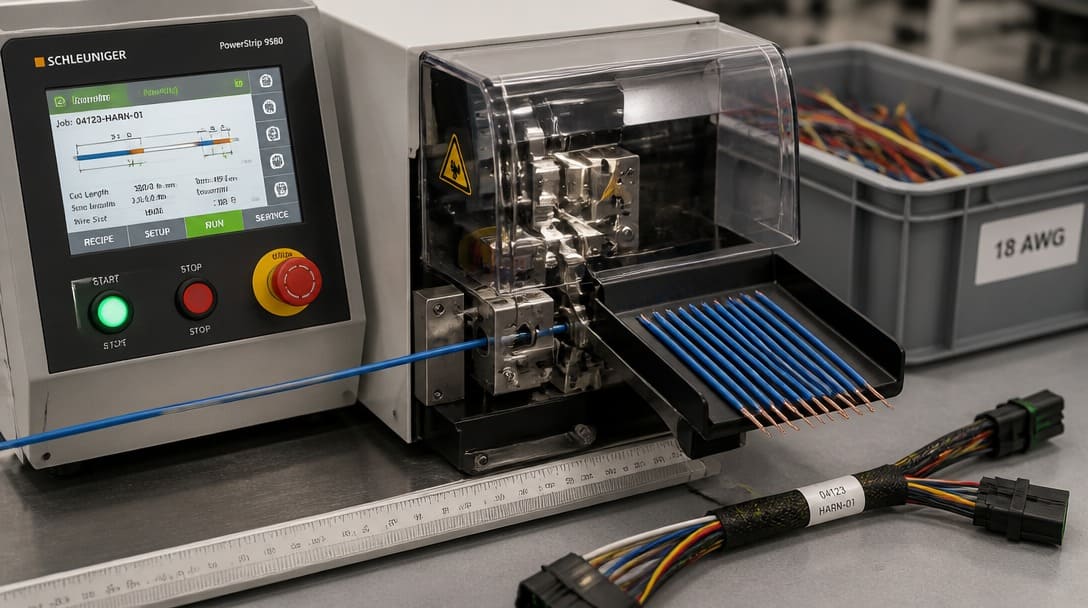
Even a 50‑piece order follows this sequence, which explains why small quantities carry a higher per‑piece cost: the setup effort—machine programming, crimp tooling verification, first‑article sign‑off—is largely fixed, while material savings only emerge at cumulative volumes.
Preparing for Your First Supplier Conversation
Armed with the checklist and process knowledge, the next step is transforming preparation into a productive supplier dialogue. Three common newcomer mistakes can be avoided easily:
- Skipping quantity: Even a rough estimate (100 pieces? 1,000 per year?) moves the conversation forward.
- Conflating a wire harness with a simple cable: When the BOM shows 60 circuits and 12 connector types, the supplier must prepare a harness‑level quotation, not a short cable assembly quote.
- Assuming any connector will work: A generic housing without a brand and part number forces the supplier to guess mating compatibility, often resulting in a connector that doesn’t fit the end‑device.
Before that first email or call, consider adapting the following pre‑conversation template:
Subject: Wire harness inquiry – [Project Name] – Qty [X]
Hello, please review the attached drawing and the following details for a wire harness quotation:
- First batch quantity: [___] / Annual forecast: [___]
- Application environment: [indoor cabinet / automotive under‑hood / outdoor machinery…]
- Wire spec known: [AWG, insulation, any UL style] – or please advise based on current/voltage requirements
- Connector preference: [list any known part numbers or request cross‑reference suggestions]
- Compliance required: [RoHS, UL recognition, IPC/WHMA‑A‑620 Class 2]
- Testing: [continuity only / additional hi‑pot]
If something is missing, please let me know the top questions that need answers for a firm quote.
Even the best drawing leaves room for interpretation. Experienced partners, such as EDOM, will frequently suggest a golden sample—a pre‑production piece built to the drawing and approved by the buyer—to confirm form, fit, and function before full‑batch production begins. Think of the first inquiry as a filtering round: the right supplier will not simply quote; they will question, clarify, and propose refinements that lower long‑term cost and risk.
Frequently Asked Questions
What is the difference between a wire harness and a cable assembly in practice?
A wire harness is a structured set of individual insulated conductors bundled together for routing inside equipment, while a cable assembly is a group of wires enclosed in a continuous outer jacket, usually with connectors pre‑attached and designed for external or harsh environments. The distinction matters because harness quotes account for branching, multiple connectors, and selective protection, whereas cable assemblies emphasize jacket material, overmolding, and IP sealing.
Why do wire harness suppliers ask for so many details before giving a price?
Because a harness is an engineered product, not a commodity. Parameters like AWG, insulation type, connector plating, and color code all change material cost, tooling requirements, and assembly time. Missing information forces the supplier to make assumptions, and each assumption carries risk for both sides. Providing a complete specification package reduces back‑and‑forth and yields a more accurate, often more competitive, quotation.
What does AWG mean and why does it matter for my harness?
AWG (American Wire Gauge) is a logarithmic scale that indicates the cross‑sectional area of a conductor. A smaller AWG number means a thicker wire capable of carrying more current with less voltage drop. In a harness, choosing the right AWG affects heat generation, flexibility, weight, and connector compatibility. Sourcing without specifying AWG leaves the manufacturer unable to select appropriate conductors or crimp terminals.
How do compliance standards like UL, RoHS, and IPC/WHMA‑A‑620 affect what I receive?
RoHS compliance ensures that the harness materials do not contain restricted hazardous substances, a baseline requirement for many global markets. UL recognition provides component‑level safety verification. In regulated industries such as aerospace, the quality and compliance bar is even higher; our aerospace wire harness manufacturers quality and compliance guide covers the critical certifications and supplier qualifications required.
Should I ask for a sample before full production?
Yes. A golden sample built to the approved drawing reveals fit issues, connector orientation mismatches, or labeling problems that even a detailed PDF can hide. It also gives the supplier a chance to validate tooling and process parameters. Most reliable manufacturers offer a first‑article inspection sample as a natural step before ramping up to full quantity.
Next Step: From Specs to Production‑Ready Wire Harnesses
Mastering the top 10 electrical specifications is the fastest way to turn a vague drawing into a firm, competitive quote. When a harness inquiry arrives with quantity, AWG, insulation, connector part numbers, plating intent, color requirements, and the applicable compliance standards already defined, the supplier can respond with confidence—and often with a shorter lead time.
For buyers who want to understand every factory stage in greater depth, explore the full wire harness manufacturing process, from cutting and crimping to final export packaging. You don’t need an electrical engineering degree to get a good harness. You just need the right checklist—and you now have it.