Wire rope end fitting types, a topic within the broader field of Mechanical Cable Assemblies: Types, Components, and Design Basics, are the mechanical terminations that secure a wire rope end to a load, anchor, or linkage, differentiated by swaging, wedging, or socketing method; they transfer tensile load and must be selected for termination efficiency, proof-load access, and corrosion risk in hoist cable assemblies.
Two moments trigger this comparison. First, an engineer reviewing a supplier quote for a new hoist cable assembly sees a list of part numbers and thread specs — swage stud, swage eye, fork, button, wedge socket — but no guidance on which termination survives repeated bending at the drum anchor or can be proof-load tested after swaging. Second, a buyer finalizes the specification after prototype review, needing acceptance criteria to freeze before the production order. Do either of these situations sound familiar?
Are You Comparing Termination Options on a Hoist Cable Assembly Quote?
The core confusion is that fitting catalogs organize terminations by mechanical form, not by whether they create a fatigue notch, can be proof-load tested after swaging, or introduce a corrosion path. A swage stud and a swage fork may look interchangeable on a drawing, but one can concentrate bending at the swage exit while the other improves pin alignment. This article evaluates wire rope end fitting types through three decision filters: termination efficiency, in-situ verification, and corrosion/inspectability.
Instead of a definitions list, the filters below work as a go/no-go screen before you accept any quote. Each termination must justify itself against the lifting standard your design must follow — not against a catalog page.
Which Wire Rope End Fitting Types Can Be Proof-Loaded After Installation?
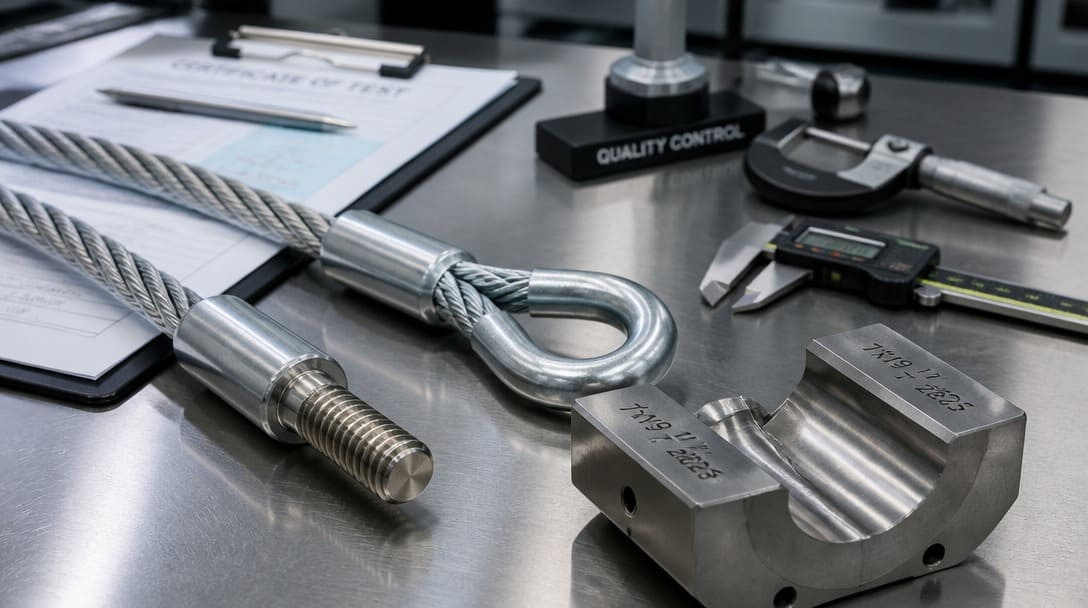
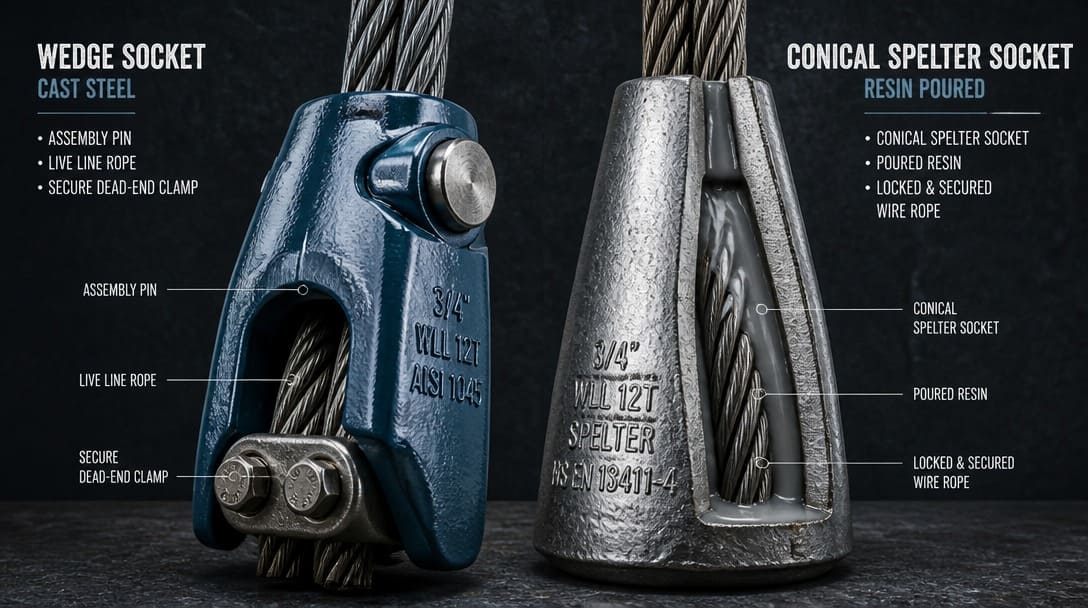
On a typical hoist cable assembly quote, the terminations include a swage sleeve (an oval or cylindrical sleeve compressed onto the rope), a swage stud with a threaded shank for anchor attachment, a swage eye for pin or shackle connection, a swage fork with clevis geometry, a button that terminates inside a socket cavity, a wedge socket that grips the rope by wedge and friction, a spelter socket poured with zinc or resin around the rope end, and a wire rope thimble that is a formed protective insert inside an eye splice. A ferrule may be either a load-bearing swage ferrule or a non-load-bearing tag ferrule — the quote must state which.
The proof-load decision separates these types. Swaged terminations can be proof-loaded after swaging only if the test fixture isolates the fitting and the supplier documents die-set traceability to the specific rope diameter and construction. A wedge socket can be proof-loaded in-situ only after the initial load cycles have seated the wedge; before that, the dead end may move. A spelter socket is usually shop-poured and inspected before installation, so field proof-loading is not the acceptance path. A wire rope thimble protects the rope eye from flattening and abrasion but is not by itself a load-rated termination; it must be combined with a swage or splice.
Use conditional checks at quote review. If the supplier’s standard swage does not state termination efficiency, die-set traceability, or proof-load acceptance, it is not yet a lifting-appliance-ready termination under EN 13411-3 or ASME B30.26.
What Termination Efficiency Does Your Lifting Standard Actually Require?
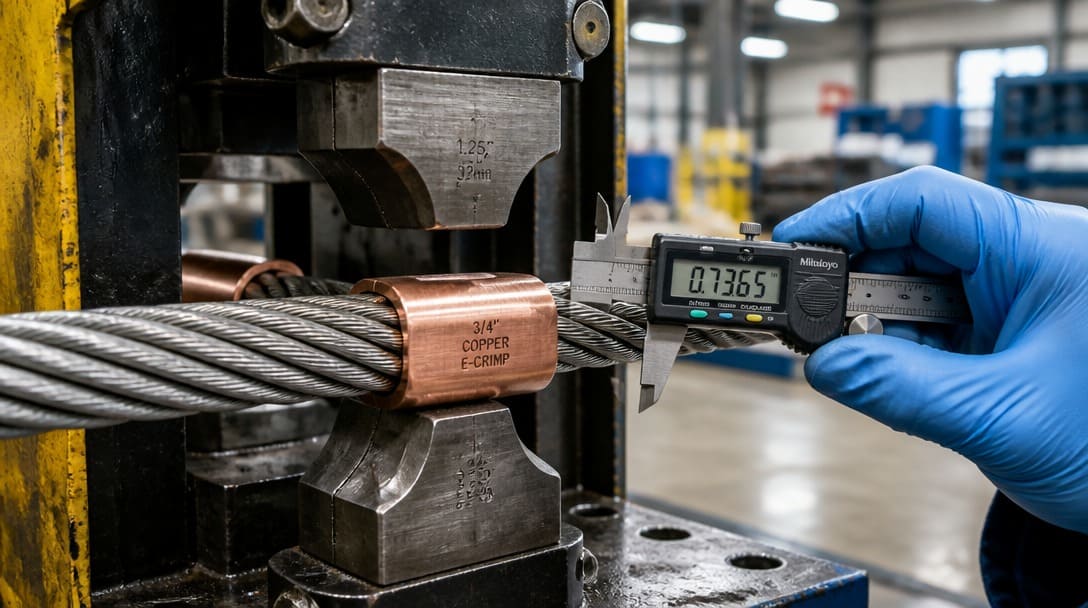
Cable assembly buyers cannot evaluate a termination by part number alone. EN 13411-3 covers ferrule-secured terminations and requires that termination efficiency be proven by destructive testing on the specific rope, ferrule, and die combination — not by catalog assumption. ASME B30.9 applies to slings, while ASME B30.30 applies to ropes; ASME B30.26 addresses rigging hardware such as wedge sockets and shackles. A supplier’s “standard swage” matters only if the quoted termination efficiency and proof-load acceptance meet the lifting appliance standard your design must follow.
Do not rely on unattributed efficiency percentages printed on a generic data sheet. Ask for the standard clause, test certificate, or at minimum the exact rope construction used for the efficiency claim. If the quoted termination efficiency is below the minimum required by the applicable standard for the rope class, reject the termination or require matched-die revalidation. This transforms termination efficiency from a marketing phrase into a verifiable spec item.
Engineering Reference Benchmark (Nominal Efficiency):
- Spelter Sockets (Resin/Zinc): Typically achieves 100% of rope catalog breaking strength.
- Swaged Sleeves / Studs (Matched Dies): Typically 90% – 100% (dependent on rope grade & construction per EN 13411-3).
- Wedge Sockets: Typically 80% (requires verification per ASME B30.26).
- Note: Always verify matched-die test certificates rather than relying on generic percentages.
Which Fitting Passes the Go/No-Go for a Drum Anchor?
The table below is a screenshot-ready selection tool for comparing swage stud, swage eye, fork, button, and wedge socket against four decision criteria: fatigue sensitivity at the drum anchor, in-situ proof-load access, corrosion path, and inspectability. Use it as a go/no-go screen before accepting a supplier quote — not as a replacement for proof testing or engineering review.
| Fitting Type | Fatigue Sensitivity at Drum Anchor | In-Situ Proof-Load Access | Corrosion Path | Inspectability |
|---|---|---|---|---|
| Swage Stud | High — stiff transition at swage exit concentrates bending | Conditional — requires isolated fixture and die-set traceability | Moderate — depends on material match with rope | Poor after installation — shank hides swage neck |
| Swage Eye | Moderate — reduces sharp bend if pin fits eye | Conditional — same swage verification rules | Moderate — eye crevice can retain moisture | Fair — eye opening visible, swage barrel partially inspectable |
| Fork | High — similar stiff exit as stud | Conditional — swage verification rules apply | Moderate — clevis area can trap water | Fair — open geometry helps visual check |
| Button | Low to moderate — compact but can be inside housing | Difficult — socket encloses termination | Moderate — enclosed by socket, less external path | Poor — hidden after installation |
| Wedge Socket | Moderate — wedge can seat and maintain grip | Conditional — only after initial load cycles seat the wedge | Moderate to high — exposed wedge and dead end may corrode | Good — wedge position and dead end visible for retorque |
If a fitting scores poorly on in-situ proof-load access and the assembly cannot be shop-tested, reject it unless redundant retention is specified. For drum anchor applications, a wedge socket may allow visual wedge retightening after load cycles, while a swage stud or fork must rely on documented die-set matching and shop proof-load verification.
What Goes Wrong in the Field After Installation?
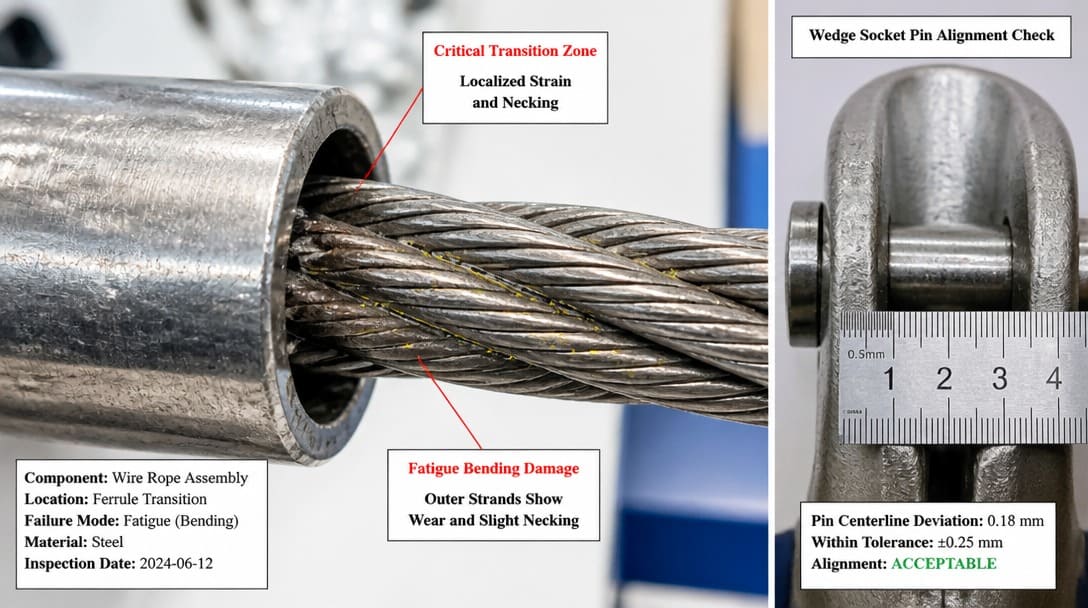
Field failures appear after installation, not at final inspection. The first failure mode is necking at the swage exit: a mismatched die set or wrong die closure can concentrate strain at the sleeve-to-rope transition, passing a first dimensional check but failing after repeated bending at the drum anchor. If the supplier cannot confirm die-set matching to the rope diameter and construction, reject the swage termination for cyclic service.
Wedge socket relaxation occurs after first load cycles when the wedge seats and the dead end slips if live/dead line is mis-rigged. Under ASME B30.26 rigging practice, require retorque and wedge recheck after initial loads. A third failure path is corrosion from dissimilar fitting and rope materials: a stainless fitting on galvanized rope or an aluminum ferrule on stainless rope can create a galvanic path. Specify compatible materials or isolation. Finally, a wire rope thimble that is not sized to the rope construction can allow the rope to flatten and individual wires to break at the eye contact point. Use a thimble sized to the rope diameter and verify with a prototype bend test.
Each failure translates into an if-then check: if the supplier cannot provide die-set records, reject the swage; if the wedge socket will be used in live-line service, require documented seating and retorque; if materials are dissimilar, change the fitting or isolate the interface.
How Do You Specify a Termination That Survives Repeated Bending at the Drum Anchor?
Define acceptance criteria on the drawing or purchasing spec: rope construction and diameter, fitting type and material, die set, termination efficiency test reference, proof-load acceptance(a quality-control topic covered in How Manufacturers Ensure Consistent Cable Assembly Quality?), and post-installation inspection. Require a matched die set and sample approval; if the supplier changes rope lot or fitting lot, revalidate the swage.
At the drum anchor, prefer geometry that reduces sharp bending at the swage exit. Use a correctly sized wire rope thimble or link if the eye must wrap a pin. Ask for continuity, dimensional, and appearance inspection on the termination, plus a proof-load certificate where the lifting standard requires it. Use prototype review to freeze these criteria before the production order — not after tooling or first article is already committed.
For OEM cable assembly programs, custom cable assembly specification review should include these acceptance points before sample confirmation. If the standard requires EN 13411-3 conformance, make that revision and test reference explicit on the drawing.
How Do You Move from Prototype Review to Production-Ready Cable Assembly Spec?
Convert the quote comparison into a purchase specification: part number, thread spec, rope construction, termination standard, test and inspection requirements. Use drawing review and sample confirmation to catch interface issues such as end fitting thread, shank length, eye dimension, and drum anchor fit. Production process controls must cover rope cutting, swaging or crimping, die-set records, dimensional or continuity checks, appearance inspection, and export packaging that protects terminations in transit.
Request production follow-up evidence: incoming material inspection, die-set record, proof-load or break test if required, and final verification before shipment. For buyers coordinating global supply, quality inspection and export packaging become part of the same release decision: a proof-loaded swage that is damaged by poor export packing is not a production-ready part.
Suppliers such as EDOM Electronics support OEM buyers with requirement review, connector matching, sample coordination, production follow-up, inspection, and export-ready packaging for custom cable assemblies and wire harnesses. This support is most valuable at the handoff from prototype sign-off to stable production supply. The conditional release rule is simple: if any acceptance element is missing or ambiguous, hold the PO until the criteria are explicit.
Frequently Asked Questions
Can a swage sleeve be proof-load tested after installation?
Yes, but only if the test fixture isolates the fitting and the supplier documents die-set traceability to the specific rope diameter and construction. Without traceability, the swage sleeve cannot be verified to EN 13411-3 termination efficiency requirements.
Is a wire rope thimble a load-rated termination?
No. A wire rope thimble protects the rope eye from flattening and abrasion, but it is a protective insert, not a load-bearing end fitting. It must always be combined with a swage, splice, or other load-rated termination.
What is the difference between a swage stud and a swage eye for a drum anchor?
A swage stud terminates in a threaded shank, creating a stiff transition at the swage exit that can concentrate bending at the drum anchor. A swage eye provides a closed loop for a pin or shackle, which typically reduces the sharp bend if the eye is sized to the rope and pin.
When should a spelter socket be used instead of a swage termination?
A spelter socket is usually shop-poured and inspected before installation, making it appropriate where field proof-loading is not practical and the application requires a controlled socket-to-rope interface. It is not the first choice for field-verifiable drum anchor assemblies.
How do I verify that a supplier’s swage meets EN 13411-3?
Ask for the standard clause, test certificate, or at minimum the exact rope construction and die set used for the efficiency claim. A catalog statement of “standard swage” is not sufficient; the proof load and termination efficiency must be traceable to EN 13411-3 or the applicable ASME standard.
Key Takeaways
- Evaluate wire rope end fitting types by termination efficiency, in-situ proof-load access, and corrosion/inspectability — not by catalog mechanical form.
- Swaged terminations require die-set traceability and proof-load acceptance under EN 13411-3 or ASME B30.26 to be lifting-appliance-ready.
- A wedge socket can be field-verified only after initial load cycles seat the wedge; a wire rope thimble is not a load-rated termination.
- Use the go/no-go table to screen swage stud, swage eye, fork, button, and wedge socket for drum anchor fatigue, proof-load access, corrosion, and inspectability.
- Freeze acceptance criteria during prototype review and convert them into a production purchase spec before releasing the PO.
Explore wire harness manufacturing support for OEM cable assembly programs.