Direct answer: A Deutsch connector (see What Is a Connector? A Practical Overview for OEM Buyers for a broader connector overview) is a family of sealed, thermoplastic electrical connectors originally developed by Deutsch and now part of TE Connectivity, built around replaceable contacts, wedge locks, and interface seals for wire-to-wire, device, and panel connections in off-highway, commercial vehicle, and industrial equipment.
At a Glance
Deutsch is not a single interchangeable part number. A DT housing, a DTM housing, and a DTP housing differ by contact size, wire range, current capacity, sealing profile, and crimp tooling. Before BOM approval, procurement should treat each Deutsch line item as a system of series, mating shell, keying, contacts, wedge locks, and tooling — not as a standalone housing.
A Supplier BOM Just Landed with Deutsch DT and DTM Part Numbers—What Do You Check First?
A supplier BOM lists Deutsch DT06-4S and DTM06-3S as line items, but there is no mating connector, no wedge lock, and no contact part number next to either entry. Nearby, a design engineer asks whether an existing sealed connector on the drawing can simply be swapped for a Deutsch part. Both situations point to the same verification gap: the word “Deutsch” is being treated as a system, when it is really a family of housings, contacts, wedge locks, and mating shells with different ratings and tooling requirements.
Before approving a custom cable assembly order, the four fields that clear or block the line item are: series/family, mating shell and gender, contact part number and wire range, and wedge-lock/sealing-compatible tooling. Each field must be confirmed against the drawing, not inferred from a partial supplier description.
How Do I Confirm the Deutsch Series and Gender Before Approving This Line Item?
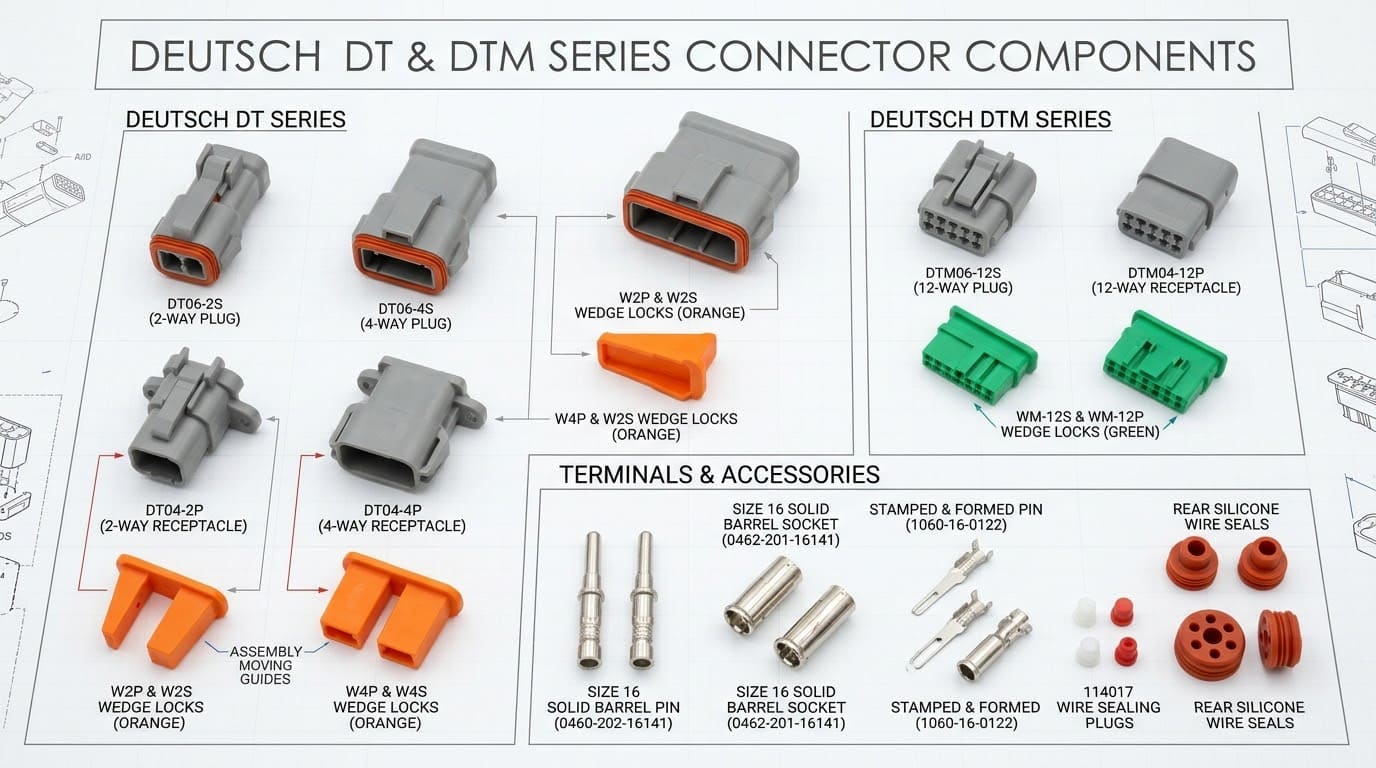
Deutsch spans several sealed connector families, and they are not drop-in compatible just because they share a similar black thermoplastic appearance. The DT series is built around size 16 contacts (rated at 13 A continuous, typically accepting 14–20 AWG wire) and serves general signal and moderate-power branches. The DTM series uses smaller size 20 contacts (rated at 7.5 A continuous, accepting 16–22 AWG wire), which reduces current capacity and requires dedicated miniature crimp tooling. The DTP series moves to size 12 contacts (rated at 25 A continuous, accepting 10–14 AWG wire) for higher-current power circuits. Meanwhile, the HD10 and HDP20 circular thermoplastic families appear in industrial diagnostics and bulkheads where bayonet or threaded coupling, flange options, and panel-mount sealing interfaces differ entirely from the rectangular DT/DTM lineage.
Because Deutsch is now part of TE Connectivity, a drawing may show legacy Deutsch part numbers while the supplier quotes TE cross-reference part numbers. That cross-reference must be verified against the part-number nomenclature rather than assumed. In standard DT/DTM numbering, 06 denotes a plug housing and 04 denotes the mating receptacle housing, followed by the cavity count (e.g., -4) and the contact gender (S for socket/female contacts used in 06 plugs; P for pin/male contacts used in 04 receptacles). For example, a DT06-4S plug requires a DT04-4P receptacle and matching W4S / W4P wedge locks to form a complete mated pair, while keying orientation (A, B, C, D) and wire seals (such as reduced-diameter -CE or -E003 modifications) must be confirmed against the wiring diagram.
A DTM housing is not a substitute for a DT housing. Smaller contacts change both the acceptable wire size and the crimp die. If the BOM writer cannot say which series is on the drawing, the next step is to freeze that field before moving to contacts or tooling.
What Mating Shell and Keying Does the BOM Actually Need?
A housing-only line item is a red flag. Without the mating shell listed, gender, keying, locking, and sealing cannot be verified as a complete connection. The same cavity count can hide different keying positions, orientation, color codes, or panel-mount variants. For a Deutsch DT or DTM connector, the mating shell must be specified along with its keying and locking interface, and any flange or panel-mount variant must be called out separately.
Deutsch DT and DTM connectors use a wedge lock to retain contacts and support the sealing interface. The wedge lock is a separate component, not an optional accessory. A BOM that lists only the housing and calls the assembly “complete” has not yet established whether the connector can retain contacts under vibration or maintain the sealed environment.
Before accepting the line item, procurement should ask for the mating connector part number, keying position, cavity-plug requirements, and any panel-mount or flange variation. This turns a single part number into a verified mating-pair system.
Which Contact Part Number and Wire Range Will the Crimp Tooling Support?
A Deutsch housing part number does not specify the contact. For each cavity, the contact part number, plating, wire seal, and acceptable wire gauge range must be confirmed. The DT series, DTM series, and DTP series use different contact sizes; using a generic stamped contact may pass a visual check while creating the wrong crimp height, insufficient retention, or a current-carrying gap.
Crimp tooling and die sets must match both the contact size and the manufacturing style: solid (machined) contacts (such as the 0460/0462 series) require a closed-barrel, 4-indent radial crimp tool, whereas stamped-and-formed contacts (such as the 1060/1062 series) require an open-barrel B-crimp applicator that simultaneously crimps the conductor wings and insulation wings. Attempting to terminate solid contacts in a stamped-contact die—or mixing DT (size 16) and DTM (size 20) locators—causes severe under-crimping, cracked barrels, or bell-mouth distortion. In a wire harness manufacturing environment, this verification extends across every cavity on the harness board: a mixed DT/DTM or solid/stamped contact list requires separate applicator setups and individual crimp-height and pull-force validations.
For RoHS-sensitive applications, confirm the contact plating and housing material against the supplier’s declaration rather than assuming legacy Deutsch part numbers meet current restrictions. Ask the supplier for the contact part number, wire gauge range, seal compatibility, and a tooling validation report before approving the assembly. If the supplier cannot produce the contact detail, the housing line item is not ready for sample approval.
Deutsch BOM Go/No-Go Checksheet: A Four-Field Approval Gate
The checksheet below turns the four approval fields into an explicit gate. The four fields are expanded into six checkable rows because keying and cavity count should be verified separately from the mating shell.
| Field | Verification question | Pass condition | Red flag |
|---|---|---|---|
| Series/family | Is the advertised family actually DT, DTM, DTP, HD10, or HDP20, and what contact size does it use? | The series, contact size, and intended current/wire range match the drawing or application requirement. | The supplier calls any sealed Deutsch-style housing a “DT” without series confirmation; DTM is treated as interchangeable with DT. |
| Cavity count and keying | Does the cavity count match, and are keying/orientation called out from the drawing? | Cavity count, keying position, color, and orientation are listed and match the mating system. | Only cavity count is present; no keying or orientation data exists. |
| Mating shell and gender | Is the mating half listed with gender, locking, and any flange or panel-mount variant? | Mating shell part number, gender, locking type, and panel-mount variant are explicit. | A single housing line item appears with no mating half specified. |
| Contact part number and wire range | What contact part number, plating, and wire gauge range apply to each cavity? | Contact size, plating, wire seal, and wire range are listed per cavity. | The supplier offers generic stamped contacts without part numbers or wire-range validation. |
| Wedge lock | Is the wedge lock part number included and seated correctly? | Wedge lock part number and seating requirement are confirmed; interface seal and contact retention are checked. | Housing appears sealed from outside, but wedge lock is missing from BOM or subassembly. |
| Crimp tooling | Does the crimp tooling and die set match the contact size and contact design? | Tooling report or validation confirms proper crimp for stamped-and-formed or solid contacts. | Mixed DT/DTM tooling is used without die-set verification; no crimp cross-section validation. |
How Do I Anchor Sealing and Vibration Expectations Before Sampling?
An IP67 marking on a Deutsch housing does not by itself prove finished assembly performance. IEC 60529 defines IP67 as dust-tight and protected against temporary water immersion, but that rating applies to the connector system when correctly mated and terminated with the specified contacts, seals, and wedge lock. A housing shell with an IP rating is not a performance guarantee for the completed cable assembly.
For off-highway applications, sealing and vibration expectations should be anchored to SAE J2030 heavy-duty connector test criteria or IPC/WHMA-A-620 workmanship acceptance criteria, depending on whether the requirement is component-level validation or production assembly acceptance. The evaluation should include continuity, insulation resistance, crimp pull force, and a conditional seal or moisture test matched to the expected environment.
Furthermore, a missing or unseated wedge lock compromises secondary contact alignment under vibration, while two overlooked sealing gaps frequently cause water ingress even when the housing is intact: unplugged open cavities (every unused cavity must be sealed with a dedicated plastic sealing plug such as 114017) and wire-insulation OD mismatches (thin-wall automotive wires like TXL or GXL often require extra-thin-wall -CE rear seals rather than standard seals to prevent capillary wicking along the jacket). The verification gate must therefore confirm rear seal compression, cavity plug installation, and wedge-lock seating—not just electrical continuity at rest.
Request a first-article inspection report that covers continuity, insulation resistance, crimp cross-sections or pull force, and conditional seal verification. A supplier that cannot provide that evidence before first-article approval is asking the buyer to accept a housing rating as a system result.
Field Failure Modes: What Nobody Tells You Until the First-Article Fails
Several failure modes appear repeatedly when Deutsch-family line items are approved from a partial BOM:
- Swapped DT and DTM contacts — the connection may pass initial continuity but fail current capacity, wire retention, or sealing because the contact size and crimp no longer match the housing or application.
- Missing wedge locks — a connector can pass bench-level visual inspection while losing moisture resistance and vibration retention later, because the contact is not positively retained against the seal.
- Aftermarket plated contacts — continuity may be acceptable at first, but plating porosity, thickness variation, or terminal geometry can fail moisture or vibration testing in the field.
- Housing-only BOMs — when the mating connector, contacts, and wedge lock are not listed, the assembly cannot be verified as a system, and the same failure modes repeat across batches.
These failures are rarely caused by the connector family itself. They come from treating a Deutsch part number as a complete interchangeable system while leaving mating, termination, and retention details unconfirmed.
How to Put the Deutsch Decision to Work Before the Purchase Order Goes Out
The final approval gate is a sequence, not a single signature:
- Complete the Deutsch BOM Go/No-Go Checksheet for every DT, DTM, DTP, HD10, or HDP20 line item.
- Request the missing mating half, contact part numbers, wire seals, wedge locks, and a tooling report from the supplier.
- Where the drawing is ambiguous, ask for drawing review and connector matching before sample confirmation or production.
- Confirm first-article inspection against the applicable SAE J2030 or IPC/WHMA-A-620 criteria before accepting the cable assembly order.
- Use production follow-up, continuity and appearance inspection, and export packaging requirements as the final approval gate before shipment.
When a BOM arrives with only a legacy housing callout, proceeding blindly guarantees costly rework during first-article testing. At EDOM Electronics, our engineering team performs a pre-quote DFM and BOM gap audit—verifying mating shells (04/06), matching solid or stamped contact crimps, specifying required W-series wedge locks and cavity plugs, and offering 3–5 day rapid prototyping with full IPC/WHMA-A-620 pull-force and continuity reports. Whether your build requires genuine TE Connectivity / Deutsch components or cost-optimized, validated equivalents with matching crimp cross-sections, send us your drawing or partial BOM for a complete system cross-reference before you issue a purchase order.
Frequently Asked Questions
Is a Deutsch DT connector the same as a DTM connector?
No. The DT series uses larger size 16 contacts, while the DTM series uses smaller size 20 contacts, which changes wire gauge range, current capacity, and crimp tooling. They are not drop-in substitutes.
Do I need to specify a wedge lock separately?
Yes. For Deutsch DT and DTM connectors, the wedge lock is a separate component that retains contacts and supports the sealing interface. A housing-only line item cannot be considered a complete sealed connector system.
Does an IP67 rating guarantee that my finished cable assembly is waterproof?
No. IP67, as defined by IEC 60529, describes a dust-tight enclosure protected against temporary water immersion, but the finished assembly must be evaluated with the correct mating pair, contacts, seals, and wedge lock against the applicable application standard.
What should I do if my supplier lists a Deutsch housing but no contacts or mating half?
Put the line item on hold and request the missing mating shell, contact part numbers, wire seals, wedge locks, and tooling validation. Approve only after the entire mating system has been confirmed.
Can I use generic stamped contacts in a Deutsch DT connector?
Only if the contact part number, size, plating, wire range, and crimp tooling are validated for that series. Generic substitution creates a risk of incorrect crimp, reduced retention, and sealing or current-carrying failure that may not appear until first-article testing or field use.
Key Takeaways
- Deutsch is a family of sealed connector systems — DT, DTM, DTP, HD10, and HDP20 — not a single interchangeable part number.
- Every Deutsch BOM line item should be checked for series, mating shell and keying, contact part number and wire range, wedge lock, and crimp tooling.
- An IP67 housing rating is not a system guarantee; sealing and vibration expectations should be tied to SAE J2030 or IPC/WHMA-A-620 acceptance criteria for the application.
- Missing wedge locks, swapped DT/DTM contacts, and aftermarket plated contacts are common causes of first-article sealing and retention failures.
- Approve only after the mating pair, contact detail, and tooling validation are confirmed as one system.
For more on sealed connector selection, mating-part verification, and electronic connector sourcing support, buyers can review connector specification and sampling workflows before the first purchase order.