A wire harness is an organized assembly of conductors, terminals, connectors, protective sleeving, and identification labels that routes power or signal through a larger system. In aerospace, those elements must meet specific material, marking, and testing requirements — such as MIL-W-22759 wire and AS50881 workmanship expectations — before a supplier can quote or build.
What a Wire Harness Actually Is: Components You’re Looking At on the Drawing
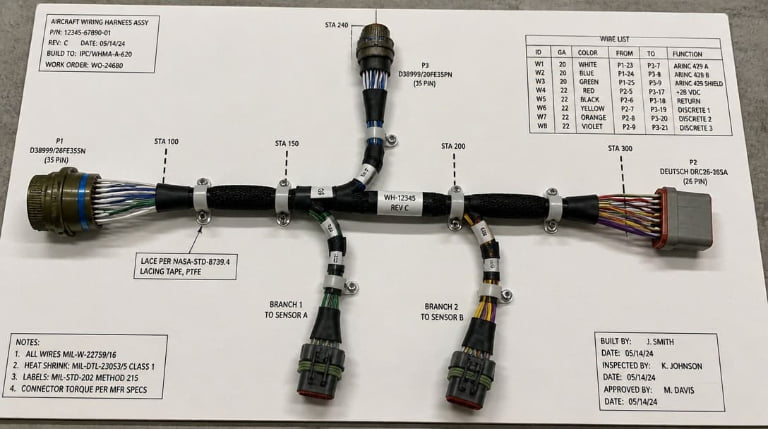
A wire harness is not simply a handful of wires tied together. It is a structured bundle that consolidates multiple conductors into one installable assembly, replacing loose individual wires inside an equipment panel, avionics rack, or airframe section. The drawing or bill of materials may not use the word “bundle,” but the geometry — branches, breakouts, connector endpoints, and length callouts — tells you it is a harness.
The core components likely to appear on the BOM or drawing include:
- Conductor/wire — the base conductor, often defined by an aerospace specification such as MIL-W-22759 with ETFE insulation.
- Terminal or crimp contact — the conductive component crimped to the stripped wire end and inserted into a connector housing.
- Connector housing — the shell and insert arrangement that receives the terminated contacts, frequently a circular connector such as MIL-DTL-38999.
- Protective sleeving or conduit — braided sleeving, convoluted tubing, tape, or other protection applied along the bundle form.
- Heat shrink — used at branch transitions, connector backshells, and splice points for insulation, strain relief, or marking coverage.
- Labels and markers — printed heat-shrink sleeves, tie-on labels, or adhesive markers for wire identification and traceability.
- Shield termination — a controlled termination method for braided or foil shields at connectors, backshells, or grounding points.
When an aerospace conductor callout such as MIL-W-22759 appears, it should not be treated as generic commercial wire. The specification defines insulation system, conductor construction, temperature behavior, and performance characteristics that directly affect whether the finished harness is acceptable for its intended location.
Wire Harness vs. Cable Assembly: Where First-Time Buyers Get Confused
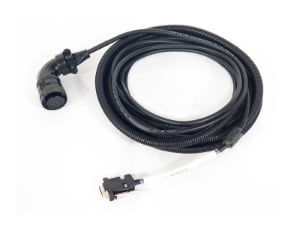
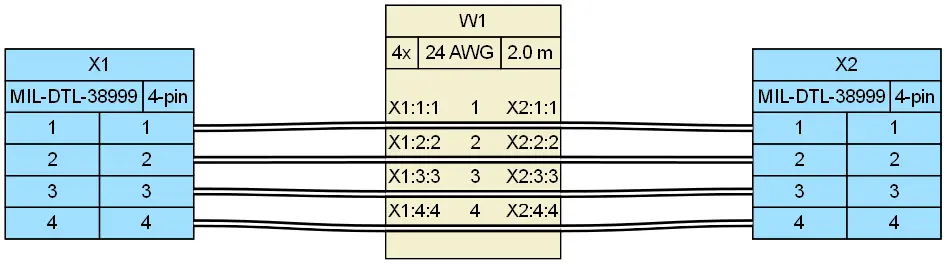
The distinction between a wire harness and a cable assembly(see our What Are Aerospace Cable Assemblies? Key Specifications and Applications guide) causes more early-stage quoting errors than almost any other terminology issue. A wire harness is usually a bundled group of wires with branch breakouts and limited outer protection. A cable assembly generally has an overall jacket or continuous protective covering that makes it more suitable for environmental resistance and external routing.
The same drawing may call out a MIL-DTL-38999 connector while still being a wire harness, not a cable assembly, because the connector termination points, bundle routing, and form are the defining features. A harness can terminate in multiple connectors without requiring an overall cable jacket. A cable assembly may contain one or more conductors inside a common jacket and often includes overmolded or transitioned connector entry points.
| Parameter | Wire Harness | Cable Assembly |
|---|---|---|
| Outer protection | Limited sleeving, tape, loom, or exposed bundle sections | Overall jacket, molded boot, or continuous outer covering |
| Typical operating environment | Inside panels, avionics racks, or protected airframe zones | Wet bays, wing areas, external routing, or moving sections |
| Connector integration | May terminate in MIL-DTL-38999 connectors without a full cable jacket | Often includes overmolded or transitioned connectors and strain relief |
| Common aerospace examples | Panel-to-panel signal bundles, test lead sets, cockpit equipment routing | Engine sensor cables, exterior lighting assemblies, data bus links |
| Primary test emphasis | Continuity, point-to-point routing, workmanship, harness form | Environmental sealing, shield continuity, mechanical pull, jacket integrity |
If the drawing instead shows a round cable with an overall jacket and overmolded connectors, the project may require custom cable assembly evaluation rather than a wire harness. Confirming this before preparing an RFQ prevents the supplier from pricing the wrong construction.
Request a pre-RFQ drawing review checklist to confirm whether the project is a wire harness or cable assembly before gathering quote details.
Why Wire Harness RFQs Need More Upfront Information Than Buyers Expect
In our experience, the first inquiry from a new buyer almost always arrives without a quantity. Without that one number, we can’t give a meaningful price — material costs shift significantly between 50 units and 500.
Quantity is not a formality. It determines how wire and connector raw materials are purchased. Wire and connector raw materials carry minimum order quantities and tiered pricing— see our Aerospace Cable Harness: Key Design and Sourcing Considerations for OEMs guide. A proof-of-concept run at five pieces may be priced from short reels or small-lot cuts, while a 500-piece requirement allows full-reel purchasing and a different cost structure. The same part number can produce significantly different unit pricing at different volume levels.
Wire specifications must also be exact. A generic callout such as “MIL-W-22759 wire” is not enough. The supplier needs the full wire type, gauge, conductor construction, and insulation material. ETFE insulation, for example, is common in aerospace harnesses but changes processing and cost compared with other insulations. Different MIL-W-22759 slash-sheet types are not automatically interchangeable without checking voltage, temperature, and conductor details.
Connector plating is another source of quoting variance. MIL-DTL-38999 shells are available in multiple finishes that directly affect conductivity, EMI shielding effectiveness, and RoHS/REACH compliance. A drawing marked only “38999 connector” leaves suppliers guessing between olive drab cadmium (Class W, high corrosion resistance but restricted under hazardous substance regulations), electroless nickel (Class F, conductive for EMI but lower salt-spray rating), or black zinc-nickel (Class Z). Buyers should confirm shell finish callouts early to avoid requoting.
Color requirements also affect the quote. Standard color codes may be available from stock or small coils. Custom or uncommon colors, custom striping, or printed identification can increase minimums, extend lead time, and require additional setup. If a drawing specifies non-standard colors only for cosmetic reasons, a buyer may want to challenge that requirement before locking the design.
What Information a Supplier Actually Needs to Quote Accurately
A quotable aerospace wire harness RFQ is not just a drawing or a photo. It is a package of specifications that tells the supplier how to buy material, configure tooling, plan the build, and verify the result. The following checklist organizes the details that matter most.
| RFQ Item | What to Specify | Why It Changes the Quote |
|---|---|---|
| Quantity | Prototype, pilot, and annual demand tiers | Raw material MOQs and tiered wire and connector pricing shift with volume |
| Wire gauge and construction | AWG, stranding, insulation system, voltage and temperature rating, specification | MIL-W-22759 types with ETFE insulation cost and lead time differently from commercial wire |
| Connector part numbers | Shell size, insert arrangement, contact gender, finish, keying, and whether equivalents are acceptable | Plating, keying, and availability change corrosion resistance, price, and sourcing options |
| Color and marking | Functional color code, custom stripes, printed identification | Custom or uncommon colors increase minimums, setup time, and lead time |
| Test requirements | Continuity, insulation resistance, dielectric strength, visual inspection, shield termination acceptance criteria | Additional electrical tests require fixtures, documentation, and inspection labor |
Suppliers such as EDOM Electronics support OEM buyers with requirement review, connector matching, sample coordination, production follow-up, inspection, and export-ready packaging for custom cable assemblies and wire harnesses. That type of support becomes more useful when the RFQ already contains the data points above.
How Wire Harnesses Are Manufactured: A Pre-Supplier Overview
Understanding the basic manufacturing sequence helps buyers recognize why drawings, samples, and specifications govern every step before supplier engagement. A wire harness is not assembled from memorized lengths or approximate colors; it is built from documented data.
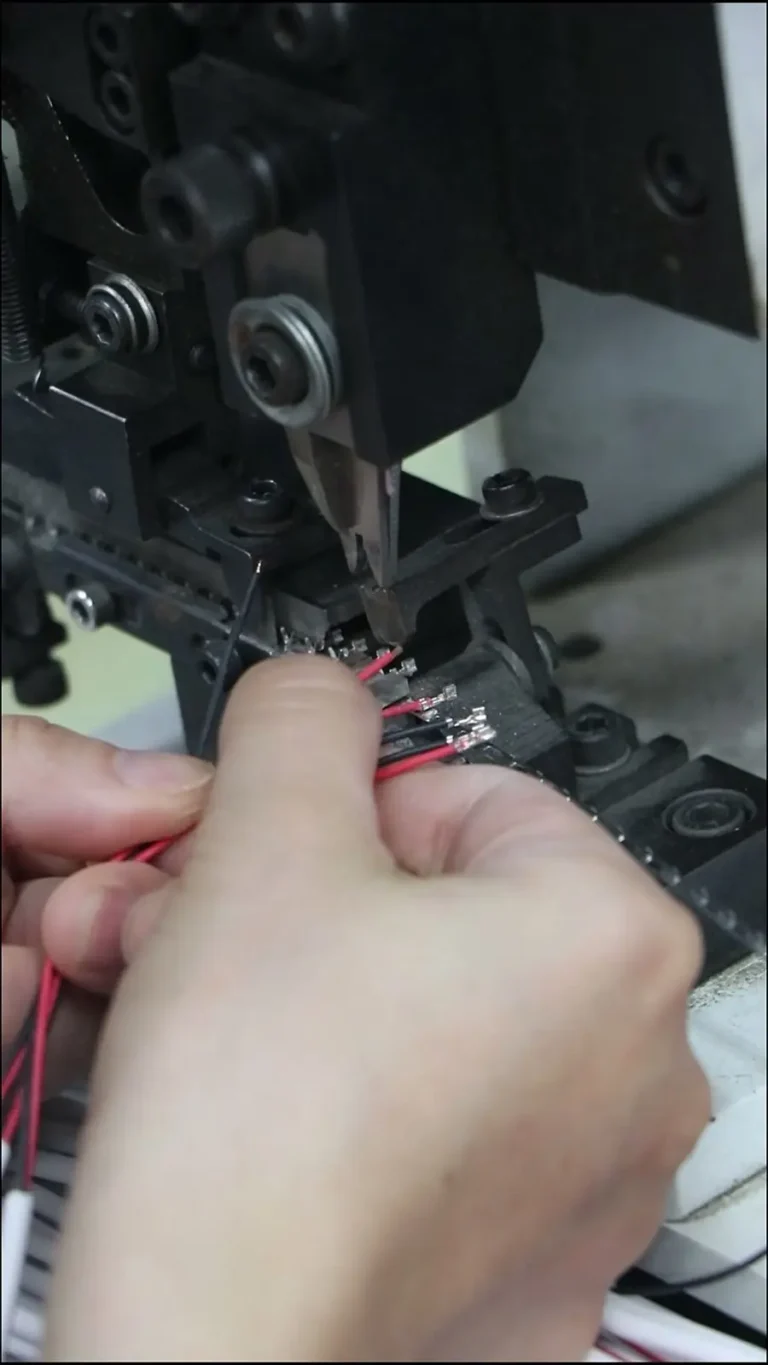
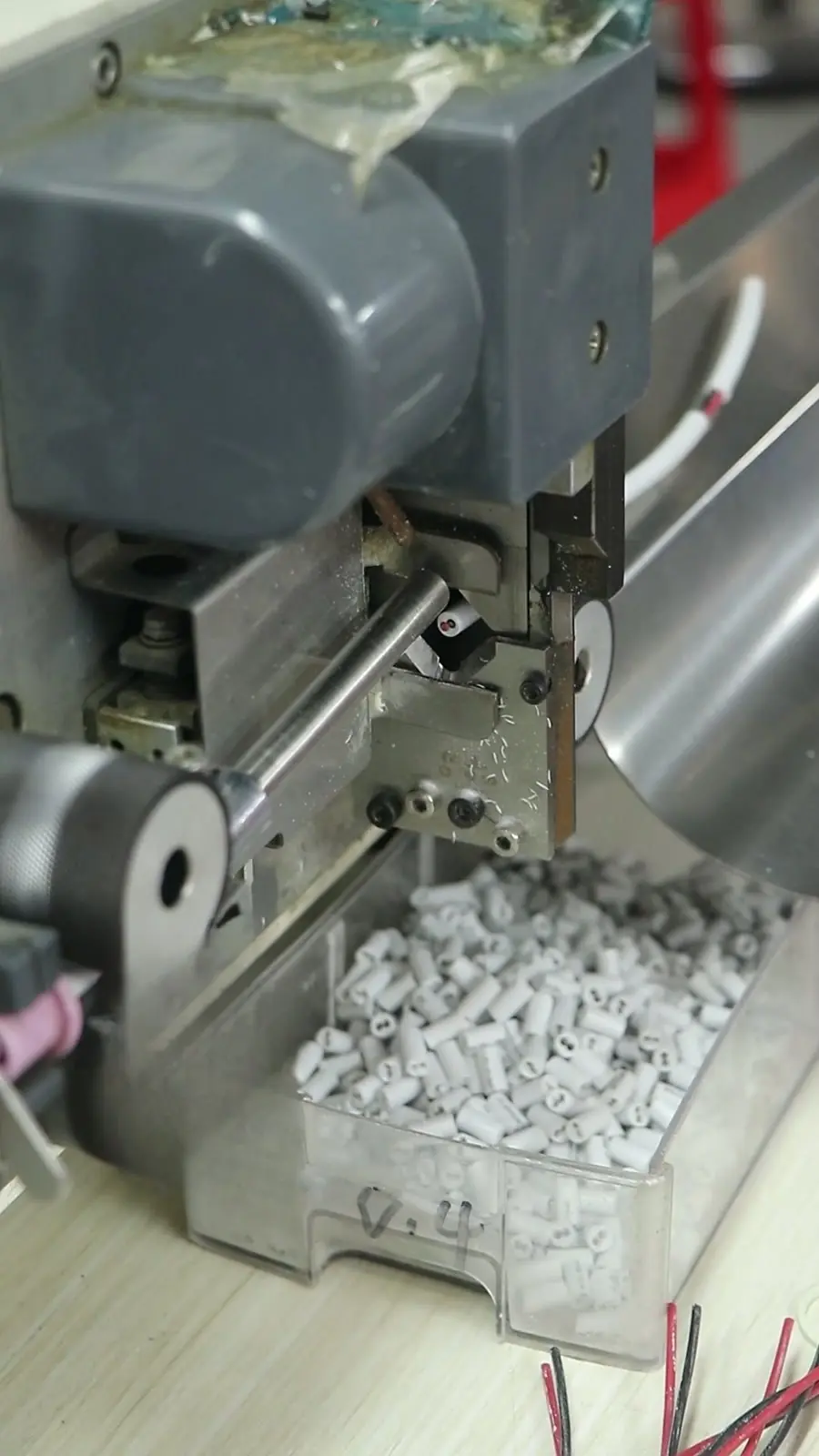
- Cut and strip. Wire is cut to controlled lengths and stripped to specified tolerances. The cut list is derived from the drawing’s point-to-point lengths and breakout positions.
- Crimp. Terminals are crimped onto stripped conductors using controlled tooling. Pull-force verification is performed to confirm mechanical integrity. High-reliability standards such as NASA-STD-8739.4 illustrate why solid wire and solder-tinned stranded wire require careful evaluation before crimping.
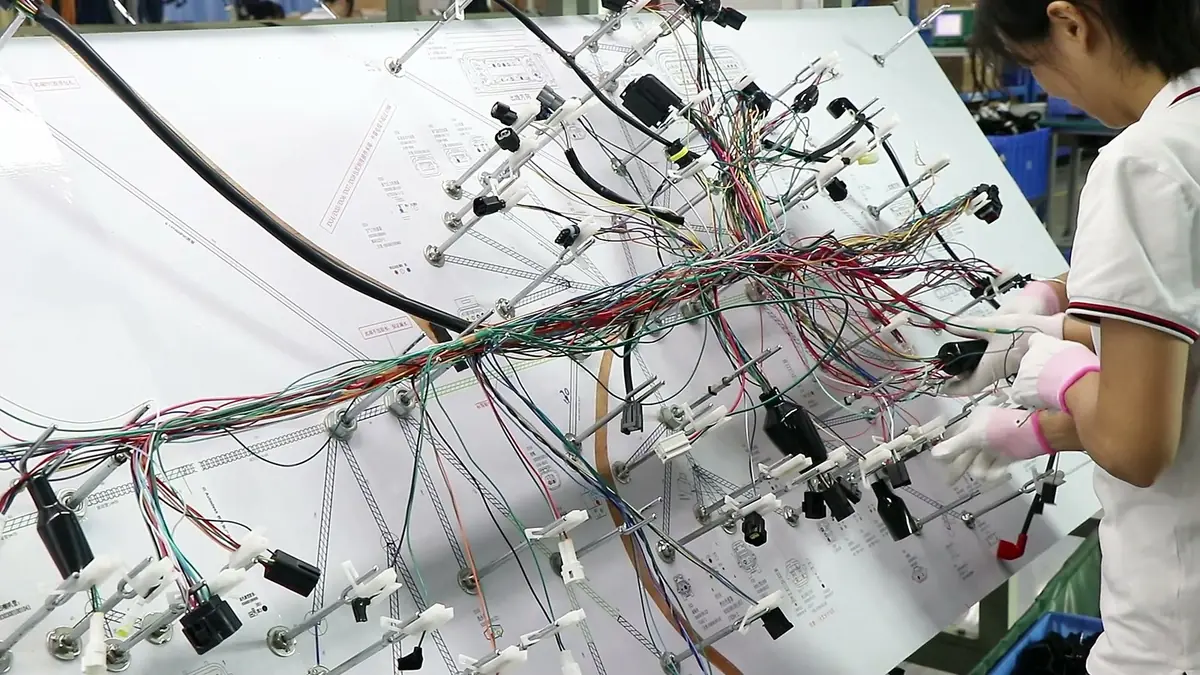
- Route and loom. The wires are routed, formed, and loomed into the intended bundle shape, including branch breakouts, service loops, and transition points where the harness changes direction or splits.
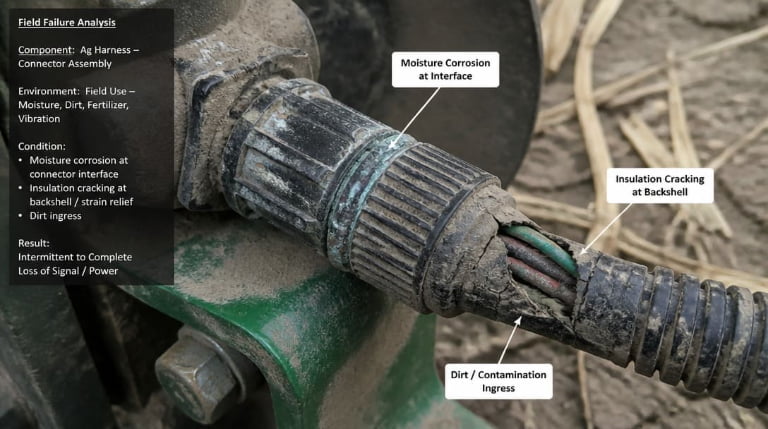
- Label and sleeve. Protective sleeving, heat shrink, labels, and shield termination are applied at the points defined on the drawing. Shield termination method is critical at connector backshells and grounding transitions, especially where MIL-DTL-38999 interconnects carry shielded signal lines.
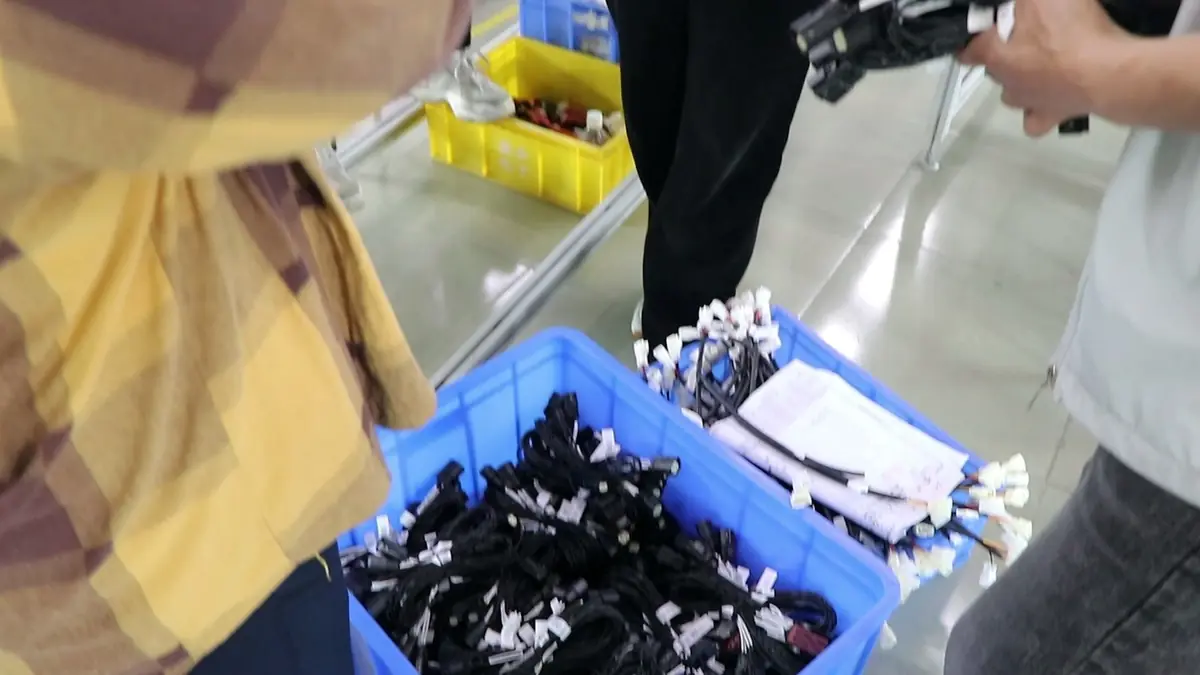
- Test and pack. Continuity and appearance inspection are performed along with any required electrical tests. Issues found during continuity testing must be corrected before final appearance inspection and export-level protection. For buyers shipping to overseas facilities, quality inspection and export packaging should be defined as part of the order and not left to the shipping department.
Aerospace Specifications You May See on a Harness Drawing
Harness drawings often reference multiple aerospace standards in different line items. Each standard carries a distinct scope and should be treated as a control point, not background text.
AS50881 may appear as a general reference for aerospace vehicle wiring and harness assembly requirements. It sets workmanship and acceptance expectations for routing, support, and assembly quality. IPC/WHMA-A-620(see our Aerospace Wire Harness Manufacturers: Quality & Compliance Guide) is often used alongside it for cable and wire harness assembly acceptance criteria, defining three workmanship classes with increasing inspection and documentation rigor.
MIL-STD-1553B and ARINC 429 are data bus standards rather than wire specifications. MIL-STD-1553B defines a dual-redundant military avionics data bus using a shielded twisted pair, with requirements that affect bus couplers, terminators, shield treatment, and stub lengths. ARINC 429, common in commercial aircraft, defines a point-to-point data bus where one transmitter communicates with multiple receivers using a shielded twisted pair. On a harness drawing, these standards typically appear as signal wiring notes that constrain pair routing and shield termination.
M27500 covers certain aerospace cable constructions. It should not be assumed interchangeable with MIL-W-22759 without checking conductor construction, shield presence, and voltage rating. Both are legitimate callouts, but they address different cable or wire forms.
| Standard / Specification | What It Governs | Where It Appears on a Harness Drawing |
|---|---|---|
| SAE AS22759 (MIL-W-22759) | Aerospace fluoropolymer-insulated wire, often ETFE insulation | Individual conductor callouts for point-to-point runs |
| NEMA WC 27500 (M27500) | Aerospace cable constructions with shielding and jacketing | Multi-conductor or shielded cable callouts |
| AS50881 | Aerospace vehicle wiring and harness assembly workmanship | General assembly note or acceptance reference |
| MIL-DTL-38999 | Circular connector shell, insert arrangement, finish, and keying | Connector termination points and backshells |
| MIL-STD-1553B | Dual-redundant military data bus with shielded twisted pair | Avionics bus wiring, couplers, and terminators |
| ARINC 429 | Point-to-point commercial avionics data bus signal wiring | Twisted pair routing and connector pin assignments |
Shield termination is the common thread across many of these callouts. At a MIL-DTL-38999 backshell, the shield may be terminated through a dedicated shield ring, a conductive adapter, or a pigtail lead. The method affects continuity, grounding, and electromagnetic performance. If the drawing does not define the method, it must be confirmed before production.
Next Step: Turn Your Draft Drawing into a Quotable RFQ
Do not send an incomplete BOM or a smartphone photo of a single connector and expect an accurate aerospace wire harness quote. Assemble quantity, wire type, connector part numbers with finish and keying, color plan, test requirements, and target date first. If the drawing calls out standards you do not recognize, flag them for the supplier rather than guessing or deleting the callout. A wrong assumption about MIL-W-22759 wire type or MIL-DTL-38999 plating is harder to correct after material has been ordered.
If no internal electrical engineering support is available, ask for a drawing review or feasibility review before committing to tooling or samples. Once those details are ready, the next logical step is to understand the full manufacturing flow — explore custom wire harness OEM services and how production documentation carries from first article through final inspection.
Frequently Asked Questions
Is a MIL-DTL-38999 connector always a cable assembly?
No. MIL-DTL-38999 defines the circular connector shell, insert, and related mechanical requirements. The same connector can be used on a wire harness with branch breakouts or on a cable assembly with an overall jacket. The bundle construction, not the connector alone, determines the classification.
Can a supplier quote an aerospace wire harness without a quantity?
A meaningful quote is difficult without quantity. Wire and connector raw materials carry minimum order quantities and tiered pricing. A 50-unit requirement and a 500-unit requirement may involve different material purchasing strategies, setup amortization, and unit costs.
Do I need to specify wire colors for a quote?
Yes. Standard color codes may be readily available, but custom or uncommon colors, custom striping, and printed identification can change minimums, lead time, and cost. If the drawing requires non-standard colors only for internal preference, ask whether a standard color plan is acceptable.
What should I do if the drawing references AS50881 and I do not know what it means?
Flag the callout to the supplier during the RFQ stage. AS50881 relates to aerospace wiring and harness assembly workmanship. Rather than deleting it or guessing, ask the supplier to explain which routing, support, and acceptance requirements may apply to the part.
What inspection is typical before export?
Continuity testing, appearance inspection, and any specified electrical tests such as insulation resistance or dielectric strength are common. The exact tests depend on the assembly, end-use environment, and the acceptance criteria referenced by the drawing. Export packaging requirements should be defined before shipment, especially for harnesses with exposed lead tips or multiple branches.
Key Takeaways
- A wire harness is an organized bundle of conductors, terminals, connectors, sleeving, and labels — not simply a set of loose wires.
- Wire harnesses and cable assemblies differ mainly in outer protection, operating environment, and environmental testing emphasis.
- Quantity is the first quoting gate; without it, material pricing and MOQ evaluation cannot move forward.
- Exact wire specifications, connector part numbers with plating and keying, color plans, and test requirements all change the quote.
- Aerospace callouts such as MIL-W-22759, AS50881, M27500, MIL-DTL-38999, MIL-STD-1553B, and ARINC 429 must be read as specific engineering constraints, not generic labels.
- Shield termination method at connectors and backshells is a critical aerospace detail that must be confirmed before production.