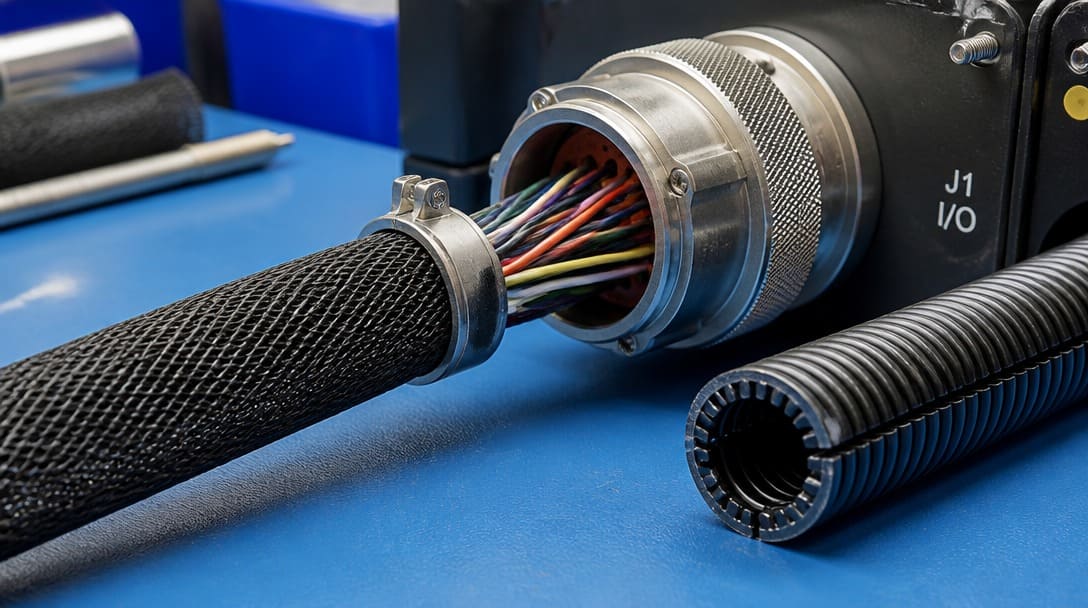
Braided sleeving capacity in cable assemblies, as detailed in our What Is a Cable Assembly? Definition, Components, and Applications guide, is the installed bundle outer diameter an expandable textile cover can accept without fraying or forcing the split open, used for irregular mixed-gauge harnesses. Split convoluted tubing capacity is the maximum bundle outer diameter a semi-rigid slitted conduit can accept while retaining a closed profile, used for consistent-diameter wire harness runs.
A production BOM that lists both braided sleeving and convoluted tubing often creates a specification conflict. The buyer or engineer is left to confirm which cover fits a mixed-gauge harness when the real constraint is the connector backshell, the service bend radius, and the split or braid edge at the connector exit. The following guide walks through the installed-condition checks needed before a purchase order goes out.
How to Choose Between Braided Sleeving and Convoluted Tubing Capacity in Cable Assemblies
Step 1: Check the Installed Connector-Exit Condition First
Do not start at the middle of the harness. A mixed-gauge bundle may fit the nominal cover inside diameter but still force the split or braid open at the connector exit. Expandable braided sleeving flexes around irregular fill but can ride up or fray at a backshell unless the cut end is captured or clamped. Split convoluted tubing locks a fixed split or closed profile, so the split gap must not expose conductors or transfer stress at the termination. Ask whether the installed shape is circular at the connector exit or flattened by routing; this determines whether the published capacity specification is actually usable. If the backshell dimension is not shown on the assembly drawing, request the wire harness manufacturing documentation or first-article dimensional report before comparing cover sizes.
Step 2: Measure Installed Bundle OD Along the Service Bend Path
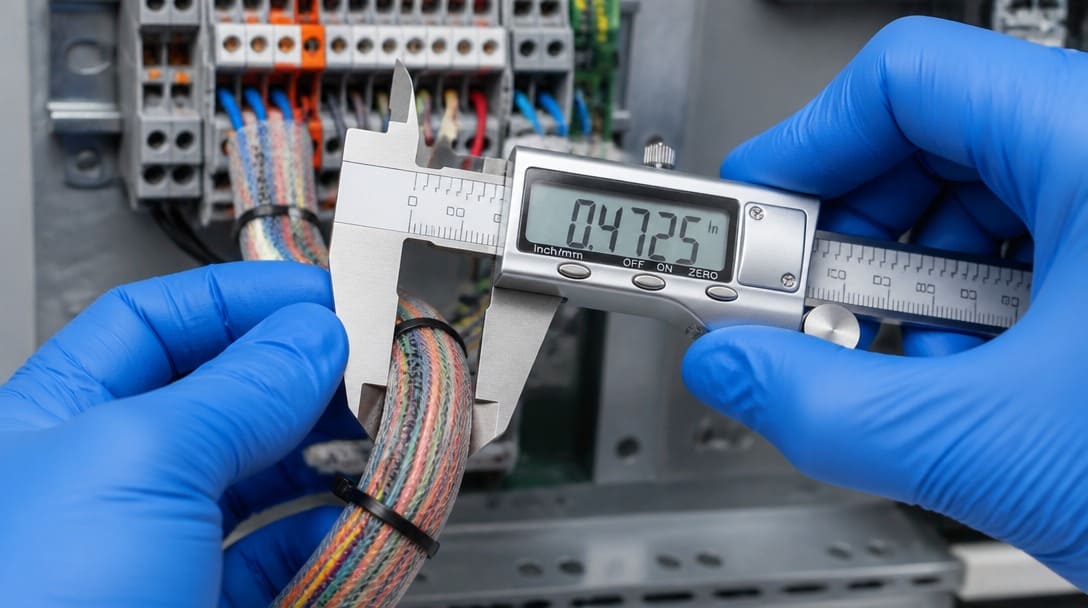
Published maximum bundle diameter is only a starting screen. It rarely accounts for bundle ovality, drain wires, foil shields, tape build-up, or breakouts. Installed bundle OD measured along the service bend path is the go/no-go metric because it includes actual wire lay, transition points, and connector-exit shape. Compare both cover options against the same measured bundle, not against separate supplier maximum-ID tables that may use different test conditions.
Step 3: Evaluate Mixed-Gauge Transition Allowance
Expandable braided sleeving opens over the largest connector or breakout and recovers over smaller segments, allowing a variable-diameter harness to be covered in one piece. Split convoluted tubing has a more rigid profile; step changes in bundle size can open the split, kink the wall, or leave a visible gap at gauge transitions. Use braided sleeving where the harness has multiple diameter steps between breakouts. Use convoluted tubing where the bundle is consistent and the split can be clocked away from the connector exit.
Step 4: Select PET or Polyamide Material with Compliance Confirmed per Part Number
Polyethylene terephthalate (PET) expandable braided sleeving is common for general wire harness coverage and can provide good cut-through and chemical resistance, but grades vary by supplier. Polyamide (nylon) sleeving or convoluted tubing options tend to suit higher temperature or tougher abrasion resistance applications, but may cost more and require sharper inspection at the split edge. Confirm UL 94[1] rating and RoHS[2] compliance per part number, not per general material family. A PET or nylon base does not guarantee that a specific finished sleeving lot meets the BOM requirement. RoHS restricts lead, mercury, cadmium, hexavalent chromium, PBB, PBDE, and four phthalates to a 0.1% by-weight limit, with cadmium restricted to 0.01%, in electrical and electronic equipment. UL 94 defines flammability ratings for plastic materials used in device components, including ratings such as UL 94 V-0.
Step 5: Verify Against IPC/WHMA-A-620[3] Acceptance Criteria
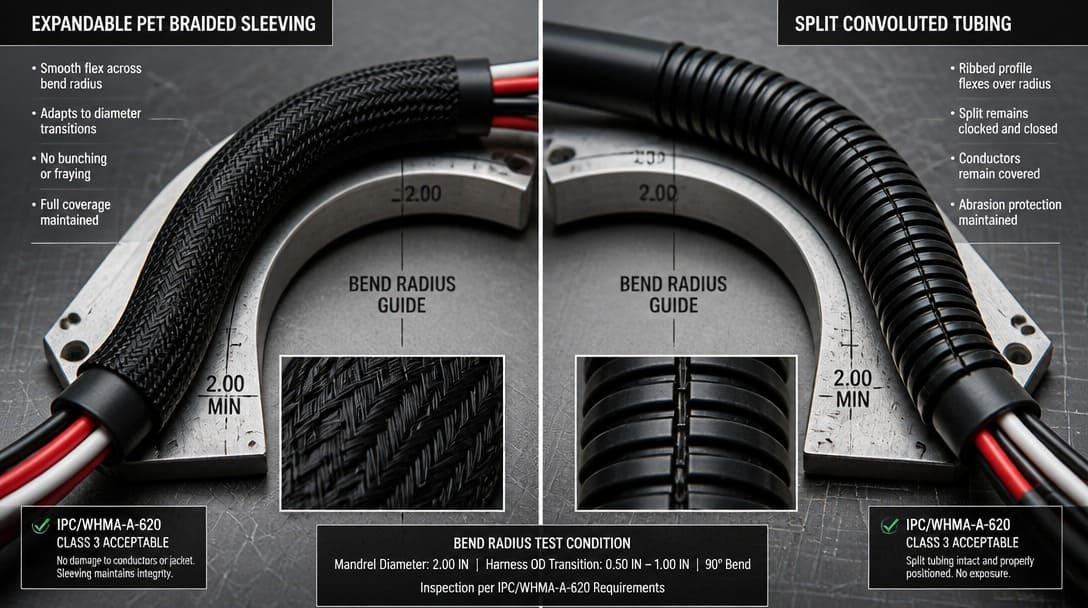
IPC/WHMA-A-620 defines acceptance requirements for cable and wire harness assemblies based on visible workmanship, stress, and termination strain relief. A cover that fits at rest but pushes against the backshell or connector exit can fail inspection because it transfers force into crimps, contacts, and strain relief. Use the standard as the pass/fail lens: when installed bundle OD, split gap, and bend radius create no visible stress at termination, the capacity choice is acceptable. For export-bound orders, the same pass/fail check should be documented before final quality inspection and export packaging.
Step 6: Screen for Hidden Field Failure Risks at Backshells and Bends
Expandable braided sleeving can fray at the connector backshell if the cut end is not secured, if the backshell clamp does not capture the braid, or if a short bend repeatedly rubs the cut edge. Split convoluted tubing can crack along the split or at the crest of a bend near the connector when the installed bend radius is tighter than the tubing profile can follow. These failures usually appear after installation, not on a bench measurement. Request a sample with the actual connector and bend path rather than a cut length before committing to full production.
Step 7: Run the Fill-Capacity Decision Tool and Issue a Supplier-Ready Specification
Compare both cover types against installed bundle OD, split/gap at connector exit, minimum bend radius, and mixed-gauge transition allowance. Mark each option as pass, fail, or conditional per criterion. Do not aggregate the result into a single maximum-ID value because a pass in one column can coexist with a fail in another.
| Decision Criterion | Expandable Braided Sleeving | Split Convoluted Tubing |
|---|---|---|
| Installed bundle OD | Pass if installed OD stays within the selected expansion range at the largest point; verify supplier expansion chart under actual fill. | Pass if installed OD remains within the fixed or closed profile without opening the split beyond the manufacturer limit. |
| Split/gap at connector exit | Check that the cut end is captured or clamped at the backshell; no frayed filaments should enter the connector body. | Clock the split away from the connector exit; the split gap must not expose conductors or transfer stress at the termination. |
| Minimum bend radius | Confirm the service bend radius stays above the supplier-recommended minimum for the selected braid style and material. | Confirm the convolute crest and split edge follow the bend without kinking, opening, or wall compromise. |
| Mixed-gauge transition allowance | Verify one-piece coverage over the largest connector and recovery over smaller segments without excessive looseness. | Flag any visible step changes that open the split, kink the wall, or leave a gap; use only if bundle diameter is consistent. |
After the decision tool is marked, send the supplier the installed bundle OD at the largest point and at connector exits, the connector backshell inside dimension, the minimum service bend radius, and the mixed-gauge transition map. Specify whether the cover must be split or expandable, the preferred PET or polyamide material, and any UL 94 or RoHS part-number-level requirement. Request a first-article sample with the actual connectors and termination points so the supplier can confirm fit before production, packaging, and export shipment. For buyers consolidating custom cable assemblies or wire harnesses, suppliers such as EDOM Electronics support OEM projects with requirement review, connector matching, sample coordination, production follow-up, inspection, and export-ready packaging.
Frequently Asked Questions
Does braided sleeving always fit a mixed-gauge harness better than convoluted tubing?
Expandable braided sleeving usually handles mixed-gauge transitions better because it opens over the largest connector and recovers over smaller segments. Split convoluted tubing can work only if the diameter steps are small and the split can be clocked away from the connector exit. The final choice must still pass the installed connector-exit check.
Is published maximum bundle diameter the correct sizing parameter for a connector backshell?
No. Published maximum bundle diameter is a starting screen only. The go/no-go metric is installed bundle OD measured along the service bend path, including ovality, tape build-up, foil shields, drain wires, and breakouts.
Does UL 94 apply to the sleeving or the finished harness?
UL 94 defines flammability ratings for plastic materials used in device components, such as UL 94 V-0. A specific finished sleeving or convoluted tubing part number must carry its own UL 94 rating. A PET or polyamide base does not guarantee that a particular lot meets the BOM requirement.
Can split convoluted tubing be used with a tight service bend near the connector?
It can be used only if the installed bend radius stays above the tubing profile’s minimum and the split does not open or crack at the bend crest. If the harness must bend sharply just after the connector, expandable braided sleeving with a captured cut end is often the safer cover choice.
How should I specify PET versus polyamide for abrasion resistance?
PET expandable braided sleeving can provide good cut-through and chemical resistance for general wire harness coverage. Polyamide (nylon) sleeving or convoluted tubing tends to suit higher temperature or tougher abrasion resistance applications but usually costs more. Confirm grade, UL 94 rating, and RoHS compliance per part number before specifying.
Key Takeaways
- Start the capacity decision at the connector backshell, not at a nominal maximum-ID table.
- Use installed bundle OD along the service bend path as the go/no-go metric for both braided and convoluted cover options.
- Run the Fill-Capacity Decision Tool against installed bundle OD, split/gap, minimum bend radius, and mixed-gauge transition allowance before issuing a purchase order.
- IPC/WHMA-A-620 acceptance focuses on installed stress and termination strain relief, not raw published diameter.
- Specify PET or polyamide material, UL 94 rating, and RoHS compliance per part number, and request a first-article sample with actual connectors and bend path.
For projects that require coordinated connector matching, sample validation, and production follow-up for custom cable assemblies or wire harnesses, explore custom cable assembly solutions.