If your cable assembly supplier evaluation started with how many employees do you have, you may be measuring the wrong thing. Factory size and production quality are less correlated than most buyers expect.
A cable assembly specification checklist for China sourcing is a structured evaluation tool that uses engineering review strength, component sourcing traceability, and verified long-term communication behavior to predict supplier performance, rather than relying on headcount or initial price.
How to Build a Cable Assembly Specification Checklist for China Sourcing
Step 1: Reframe Headcount and Floor Size as Weak Predictors
Headcount tells you how many people are on a production floor. It does not tell you whether those people can interpret a drawing, flag a tolerance risk, or propose a connector alternative without degrading the electrical and mechanical specification. For custom cable assemblies, the three evaluation pillars that actually predict outcomes are engineering capability, component sourcing control, and communication reliability after the first order.
We’ve seen factories with hundreds of employees that couldn’t produce a custom overmolded assembly to spec, and small teams that could turn around a complex multi-conductor shielded assembly with full documentation in two weeks. The difference is not scale; it is process discipline, engineering depth, and the ability to apply workmanship standards such as IPC/WHMA-A-620[1] (Class 2 for commercial electronics, Class 3 for high-reliability medical/industrial assemblies) for crimp/solder acceptance, alongside material standards like UL 758[2] (Appliance Wiring Material styles such as UL1007, UL1061, UL2464) and UL 94 flammability ratings (V-0/V-1/VW-1). For readers who need a refresher on conductor types, shielding, connector matching, and overmolding before moving into the evaluation checklist, the pillar article on what a cable assembly is and how it is constructed provides the foundational layer.
Step 2: Gate Suppliers on Engineering Capability Before Sampling
Engineering capability is the supplier’s ability to review a drawing, flag manufacturability issues, and deliver actionable design-for-manufacturing feedback before any sample is built. This is the first gate in a China sourcing checklist because it filters out trading companies and low-end assemblers that can only quote against fully documented RFQs.
Measure engineering depth with these questions:
- How quickly does the supplier return a drawing review, and does the review identify tolerance, strain relief, or conductor sizing concerns without being prompted?
- Can the supplier propose connector, terminal, or insulation changes that maintain the full electrical and mechanical specification while improving cost or lead time?
- Does the supplier demonstrate understanding of IPC/WHMA-A-620 workmanship classes and UL 758 requirements for appliance wiring material when relevant to the assembly?
- How does the supplier handle projects that start from a drawing, a physical sample, a target application, or a limited specification — not only a complete bill of materials?
A strong engineering team will also review conductor size in AWG against current-carrying and voltage-drop requirements, as covered in our top 10 electrical specifications for cable assembly and wiring harness, check insulation material compatibility with the operating environment, and ask about flex cycles, pull force, and shielding coverage before quoting.
Step 3: Lock Specification Fields Before Comparing Quotes
Quotes are only comparable when every supplier receives the same locked specification package. Loose wording such as “suitable wire” or “standard connector” invites different suppliers to quote against different assumptions. Tighten these fields before you release an RFQ:
- Conductor: AWG size, stranding, material, and insulation/jacket compound. Smaller AWG numbers indicate larger conductor diameter, which changes current capacity, flexibility, and crimp tool selection.
- Connector: Connector series, mating part number, crimp and terminal requirements, and the policy for acceptable OEM-equivalent parts.
- Compliance: RoHS[3] restriction of ten substances to a 0.1% by-weight limit (0.01% for cadmium), REACH[4] substance-of-concern requirements, UL 758 material performance where applicable, and IPC/WHMA-A-620 workmanship class.
- Mechanical Integrity: Terminal pull-force thresholds per UL 486A-B / IPC-620, bend/flex life cycles (e.g., ±90° bending under 500g load for >5,000 cycles), strain relief Shore hardness (e.g., Shore A 65 vs. 85), and mating retention force.
- Electrical & Test Parameters: 100% Continuity and Pinout verification, Insulation Resistance (e.g., DC 500V, ≥100 MΩ), Dielectric Withstanding Voltage (Hi-Pot, e.g., AC 1000V for 1 min), and characteristic impedance matching for high-speed differential pairs (e.g., 90Ω ±10% for USB).
- Logistics and handling: Labeling, packaging, export carton marking, and incoming warehouse receiving requirements. These affect landed quality and downstream efficiency, and they connect directly to wire harness manufacturing control points such as routing, labeling, and looming, as well as quality inspection and export packaging.
Complete Cable Assembly Specification Checklist (RFQ Data Fields)
| Parameter Category | Required Engineering Specifications | China Sourcing Verification Standard |
|---|---|---|
| Conductor & Core | Conductor material (OFC bare/tinned copper), AWG gauge, stranding count (e.g., 28AWG 7/0.127), jacket material (PVC/PUR/TPE/LSZH). | Spark test report, UL Style verification, RoHS 3 (EU 2015/863) test report. |
| Connector & Terminals | Exact Manufacturer P/N (Molex/JST/TE or approved alt), terminal base metal (Phosphor Bronze/Brass), plating specs. | Original manufacturer packaging, terminal cross-section micro-graph analysis (CH/CW). |
| Shielding & Drain | Shield type (Al-Mylar foil, braided tinned copper with ≥85% optical coverage), drain wire AWG and termination method. | Transfer impedance verification, 360° shield termination to connector shell. |
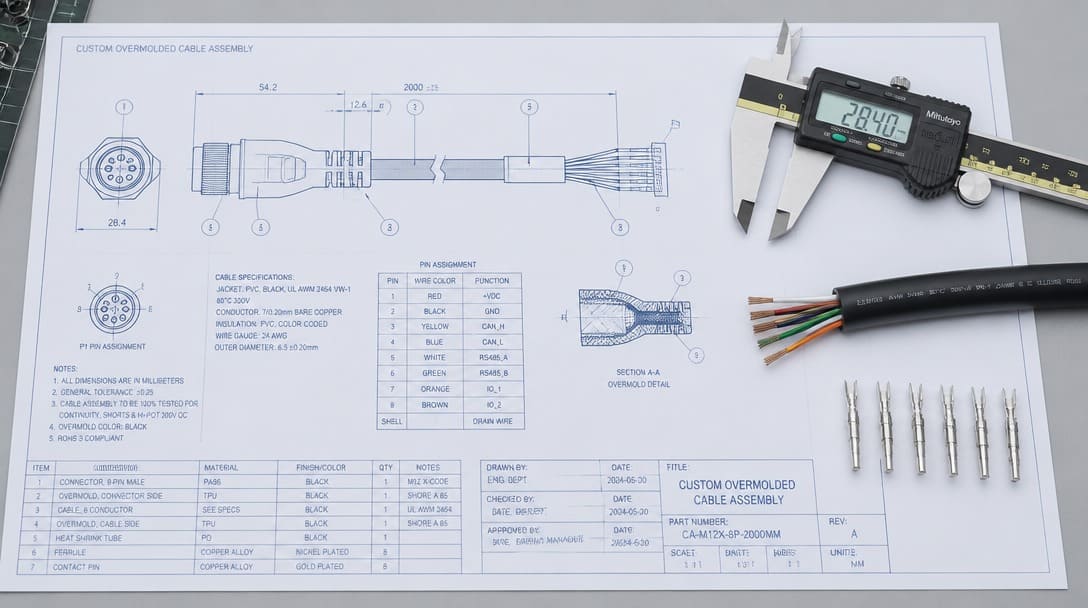
| Overmolding / Housing | Overmold material, Shore hardness, inner/outer mold design, cable OD tolerance, customized strain relief (SR) profile. | 3D step file sign-off, pull-relief test (>50N – 100N depending on cable size). |
| Quality & 100% Testing | 100% Continuity, Hi-Pot test voltage/leakage current, pull-force test records, dimensional drawing tolerances. | Automated harness tester report, IPC/WHMA-A-620 Class 2/3 inspection sign-off. |
Download Our Cable Assembly RFQ Specification Checklist (Excel Template) →
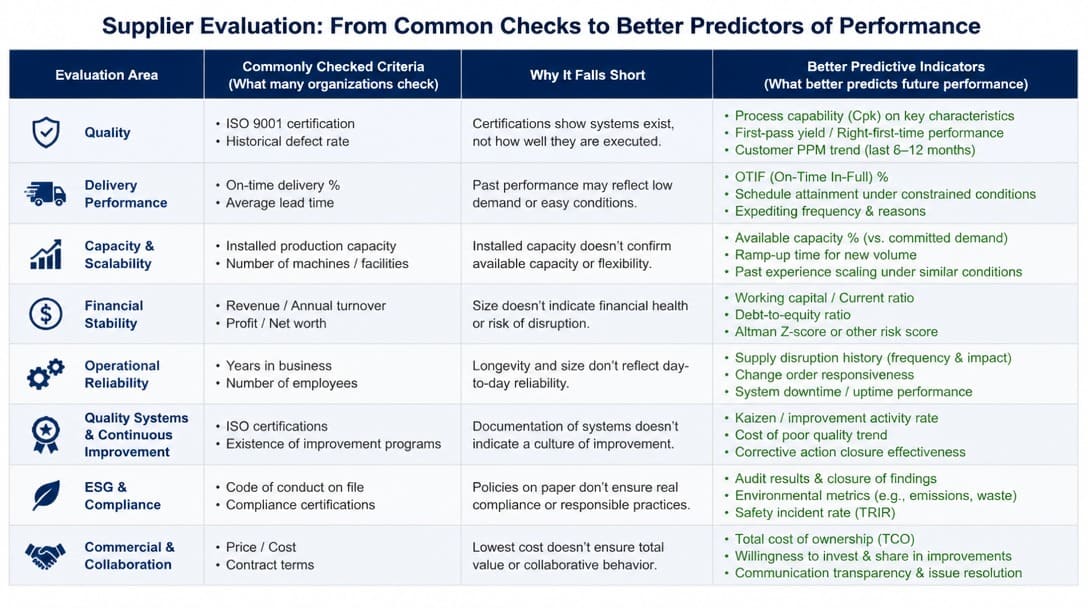
Supplier Evaluation Table: Replace Surface Checks with Predictive Indicators
Step 4: Apply the Evaluation Table to Your Shortlist
Most procurement teams already run a supplier evaluation, but many of the commonly checked criteria are weak predictors of custom cable assembly performance. The table below maps the surface-level check against what it actually tells you and a better indicator to use instead.
| Commonly Checked Criteria | What It Actually Tells You | A Better Indicator |
|---|---|---|
| Factory employee count | Indicates scale only | Engineering review turnaround and DFM feedback quality |
| Years in business | Indicates longevity, not current capability | Recent similar projects and documented process control |
| Lowest unit price | Often masks specification assumptions | Landed cost, substitution policy, and sample-first gates |
| Certificate wall | Indicates compliance awareness | Verification of certificates for specific part numbers and materials |
| Equipment list | Indicates available machines | First-article workmanship samples and ongoing defect data |
| Branded connector claims | May reflect spot-market buying | Part-level traceability for Molex, JST, and TE Connectivity |
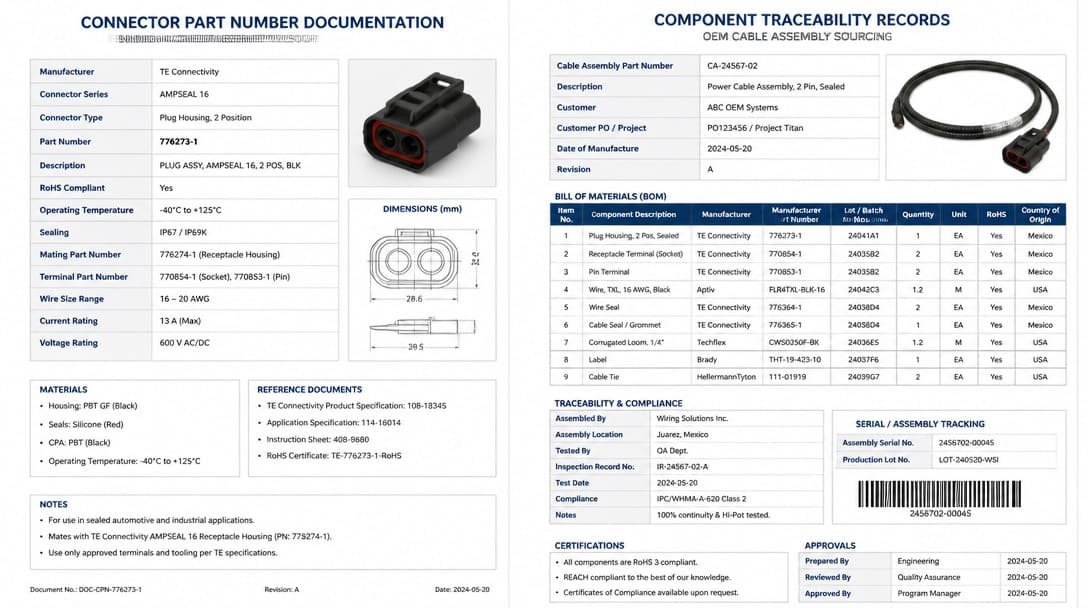
Component sourcing depth for Molex, JST, and TE Connectivity is better evaluated through part number documentation than by supplier profile language. Use this table against your current RFQ: if a supplier cannot show engineering feedback quality, documented component traceability, and reference-backed communication history, remove them from the shortlist before sampling starts.
Component Sourcing and Communication Reliability Verification
Step 5: Verify Component Sourcing Capability for OEM Brands and Substitutes
Connector and terminal sourcing is where many cable assembly projects fail. A quote that says “Molex-compatible” without a manufacturer and part number is not a specification; it is a risk transfer. Require every quote to identify the exact manufacturer and part number for connectors, terminals, and wire.
- OEM Brand & Authorized Channel Proof: Mandate original reel packaging labels with intact Date Codes and QR lot numbers, combined with franchised distributor CoC (Certificate of Conformance) / packing slips (e.g., from Arrow, DigiKey, Mouser, or direct tier-1 franchised agents) to eliminate open-market/counterfeit risks.
- Equivalent/Alternative Validation Protocol: Any domestic alternative must be backed by a dual-spec engineering report comparing pin retention force, contact resistance (initial <10mΩ), plating thickness (e.g., Gold 15μ” / 30μ” over Nickel), and thermal aging tests before tool sign-off.
- Shortage handling: Ask how the supplier handles component shortages or allocation. Do they notify before production, propose documented alternatives, and obtain written approval before substitution?
- Alternative documentation: For any substitute component, require a comparison of electrical, mechanical, and environmental performance plus sample approval before release.
- Traceability: Treat incoming inspection records, lot tracking, and COC/COO documentation as hard evaluation criteria, not optional paperwork.
A genuine cost-down alternative maintains the full specification. A downgrade that changes conductor size, insulation material, or connector contact plating shifts the failure risk to the buyer’s field performance. Suppliers such as EDOM Electronics support OEM buyers with requirement review, connector matching, sample coordination, production follow-up, inspection, and export-ready packaging for custom cable assemblies and wire harnesses.
Step 6: Test Long-Term Communication Reliability Before Awarding Repeat Business
Pre-order responsiveness is easy to fake. Steady-state communication after a supplier wins repeating business is a different metric. Many buyers discover too late that a supplier becomes slow or defensive once the first order is delivered.
Ask every shortlisted supplier for customer references with more than 12 months of repeat ordering, not just first-project references. In reference calls, probe how the supplier behaves when production is delayed, when an engineering change is needed, or when a quality issue appears after delivery. Look for proactive behavior: production follow-up updates, delay notification before the promised date, and export documentation support for international receiving. A supplier that becomes unresponsive after the first order is a higher total-cost risk than a slightly higher unit price with a communicative engineering partner.
Final Decision Gate and Pre-Production Sample
Step 7: Make the Final Supplier Decision with a Pre-Production Sample Gate
After narrowing the shortlist, send the same locked specification package to three suppliers so quotes are comparable line by line. Score each supplier on engineering feedback quality, component documentation, and communication history — not only unit price. Remove any supplier that cannot produce a drawing review within a defined window, cannot identify risks in your sample, or cannot provide part-level component traceability for Molex, JST, or TE Connectivity components.
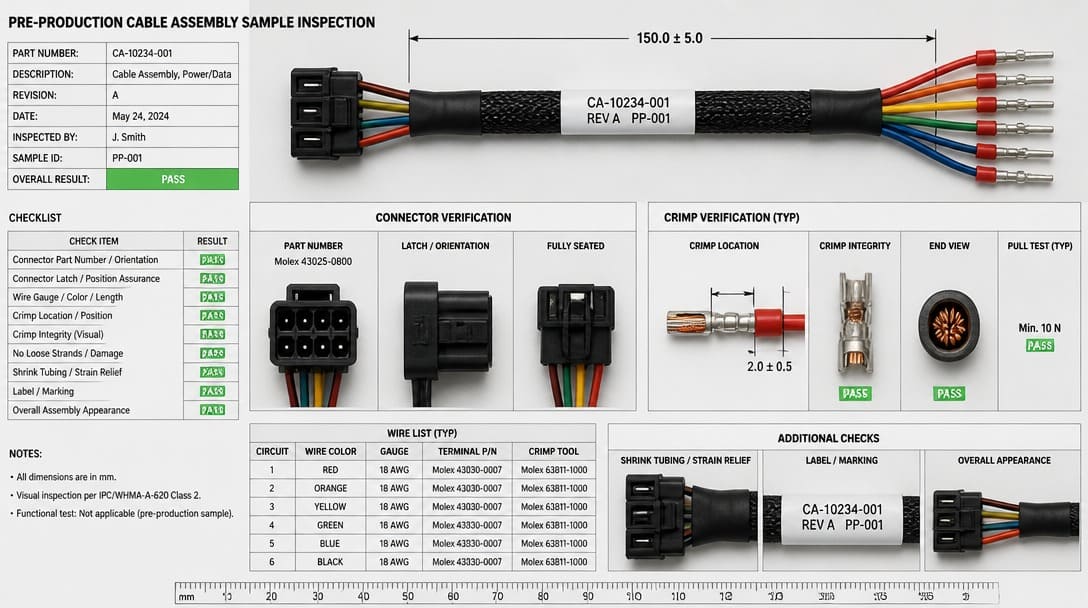
Require a pre-production sample as the final gate before placing a production order. The sample must be built with the same materials, connectors, tooling, and workmanship class as the production run. Approving the sample locks the reference standard for incoming inspection and reduces the chance of silent substitutions later. Buyers ready to move from a specification checklist to a concrete production project can explore custom cable assembly solutions built around this type of disciplined review process.
Frequently Asked Questions
Does a higher employee count mean better cable assembly quality?
No. Employee count indicates production scale, not engineering depth, component sourcing control, or communication reliability. A smaller team with strong drawing review and IPC/WHMA-A-620 workmanship discipline often outperforms a larger factory that only assembles standard products.
What connector brands should I require in a China sourcing specification?
Specify Molex, JST, or TE Connectivity by exact manufacturer and part number, not by brand name alone. This allows verification of direct brand access versus spot-market buying and prevents vague “equivalent” substitutions that change contact plating, housing material, or mechanical retention.
How do I verify a supplier’s component traceability?
Request incoming inspection records, lot tracking documentation, and certificates of conformance or origin for the specific part numbers used in your assembly. A supplier that cannot provide part-level traceability may be sourcing from unauthorized channels or mixing inventory.
Is a pre-production sample really necessary before a production order?
Yes. The pre-production sample is the final gate that locks the reference workmanship standard, connector orientation, crimp quality, labeling format, and packaging method. Skipping the sample transfers all undiscovered specification gaps into the production batch.
What standards should I reference in my cable assembly RFQ?
Reference IPC/WHMA-A-620 for workmanship acceptance classes, UL 758 for appliance wiring material performance where applicable, RoHS for the ten restricted substances including lead and cadmium, and REACH for substances of very high concern in the finished article.
Key Takeaways
- Replace headcount and floor size with engineering capability, component sourcing traceability, and communication reliability as the three evaluation pillars.
- Lock AWG, stranding, insulation compound, connector part number, compliance, environmental conditions, and packaging requirements before comparing quotes.
- Require exact Molex, JST, and TE Connectivity part numbers with documented substitute approval for any alternative component.
- Ask for customer references with more than 12 months of repeat orders to verify steady-state communication, not just pre-order responsiveness.
- Approve a pre-production sample as the final gate before committing to a production order.