ISPM 15 is the International Plant Protection Convention (IPPC) standard for wood packaging material (WPM) moving in international trade, requiring debarking and approved treatment—approved treatments under ISPM 15 (primarily Heat Treatment [HT] requiring a minimum core temperature of 56°C for 30 minutes, Dielectric Heating [DH], or approved fumigation such as Methyl Bromide [MB])—plus an official IPPC mark carrying the ISO country code, producer code, and treatment code, used to prevent the spread of regulated pests.
Which Reader Are You? The Incomplete Mark at the Receiving Dock Versus the Next China PO
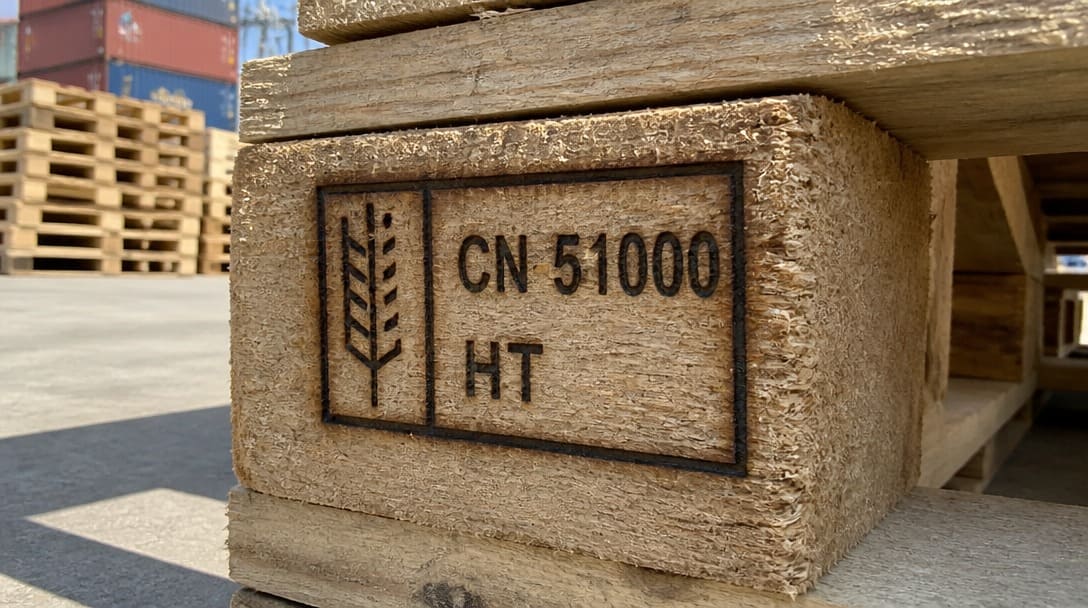
An ISPM 15-compliant wood pallet requires four components: the IPPC cereal symbol, an ISO two-letter country code (e.g., CN for China), a registered manufacturer/treatment code (e.g., 31000), and the treatment method code (HT or MB). Missing any single element invalidates the entire shipment at the destination port. The IPPC symbol is visible, but the country code is not. A customs broker places the shipment on hold—not because the wood was untreated, but because the mark is incomplete. Meanwhile, a second manager is preparing a new purchase order from a Shenzhen supplier and reviewing a pallet photo. The photo shows part of an IPPC mark, but the country code is cut off by the angle. That manager is deciding whether one photograph is enough to clear EU border inspection. Which reader are you?
Both scenarios share the same failure point: the IPPC mark exists, but one required field is missing or unreadable. At the dock, that shifts the burden to the importer, even when heat treatment was performed correctly. A pre-shipment go/no-go filter is cheaper than a customs hold, and it starts with understanding what ISPM 15 actually requires.
ISPM 15 and the IPPC Mark: Required Elements and Importer Liability
The International Plant Protection Convention (IPPC) publishes ISPM 15 to regulate wood packaging material used in international trade. Wood packaging material includes pallets, crates, dunnage, and other solid wood components that can carry forest pests across borders. The standard has two control layers: the wood must be debarked and treated, and the packaging must carry an official IPPC mark showing where and how the treatment was applied.
Under ISPM 15, approved treatments are heat treatment (HT) at a core temperature of 56°C maintained for 30 minutes, or methyl bromide (MB) fumigation. Debarking is a baseline requirement for most wood packaging material, because bark can harbor pests even after treatment. A compliant IPPC mark contains four elements: the IPPC symbol, the ISO country code, the producer or treatment provider code, and the treatment code—either HT or MB. If the country code, producer code, or treatment code is missing or illegible, the mark is noncompliant, even if phytosanitary treatment was completed.
Importer liability follows the mark itself, not the supplier’s verbal assurance. Customs officers cannot verify that a pallet reached 56°C at the dock. They verify whether the IPPC mark is complete and legible. A missing country code is enough to trigger hold, quarantine, or return. A phytosanitary certificate is a separate document that some destination countries require in addition to the IPPC mark; it does not repair an incomplete mark.
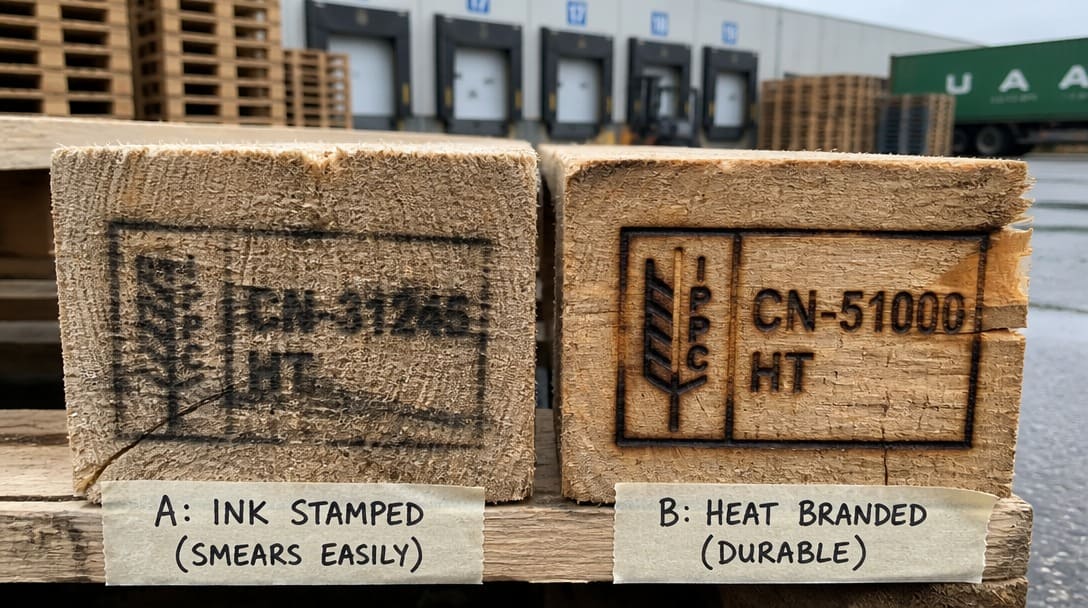
Stamped Versus Branded Pallet Marks: Dock-Level Accept or Reject Decision
China-origin pallets commonly carry either ink-stamped IPPC marks or heat-branded marks. Under sea freight conditions, the two marking methods behave differently. Ink stamps can smear, bleed, or fade when exposed to humidity, condensation, or rubbing against adjacent pallets. Heat-branded marks generally retain legibility through transit, but the branded recess can crack or fill with debris, obscuring individual characters.
The dock decision is binary: if the country code or treatment code cannot be read, the pallet is rejected or quarantined—regardless of whether the marking was stamped or branded. Stamped marks are more common on lower-cost solid wood pallets, while branded marks often indicate a repeat export program with stronger marking control. Neither method is automatically acceptable without a legibility check.
Accept a pallet only when a complete IPPC mark appears on at least two opposite sides of the wood packaging material, as the standard calls for visible placement. Reject the pallet if the mark is painted over, sanded off, partially missing on a repaired block, or applied with water-soluble ink that has run.
| Marking Method | Sea Freight Durability | Common Failure Mode | Dock Decision |
|---|---|---|---|
| Ink stamp | Moderate; can smear or fade under humidity and contact | Running ink, faded country code or treatment code | Accept only if all fields remain legible |
| Heat brand | High; characters generally retain legibility | Branded recess cracks or fills with debris | Accept if all fields readable; reject if obscured |
ISPM 15 Pallet Mark Go/No-Go Checklist: Dock-Level Filter Before Customs
Use the following ISPM 15 Pallet Mark Go/No-Go Checklist as a dock-level filter before customs involvement. It operationalizes the required mark elements into accept, reject, and conditional pass decisions. A conditional pass is not a final pass—it means the pallet can be held pending supplier confirmation and photo evidence before being moved into inventory or production.
| Check Element | Go | No-Go | Conditional Pass |
|---|---|---|---|
| IPPC symbol | Present and undistorted | Missing, painted over, or sanded off | — |
| ISO country code | Visible and matches country of treatment | Missing or unreadable | Scuffed but identifiable in supplier photo |
| Producer/treatment provider code | Legible and traceable | Missing or illegible | Partially obscured but supplier confirms with full mark photo |
| Treatment code HT or MB | Clearly stamped or branded | Absent or incorrect code | — |
| Placement | Mark visible on at least two opposite sides | Hidden by strapping, wrap, or cargo | Not visible at dock but photo proof from supplier |
| Documentation | Mark matches packing list and treatment certificate or phytosanitary certificate where required | Mismatch or no documentation | Supplier confirmation and photo pending |
The checklist also requires a legibility check after transit: characters must remain readable, with no ink bleeding, no obscured digits, and no sanded or repaired surface breaking the mark. If the mark is complete but partially scuffed, obtain a supplier confirmation and clear photo before customs involvement. If the country code is missing, fail the pallet and move it to quarantine.
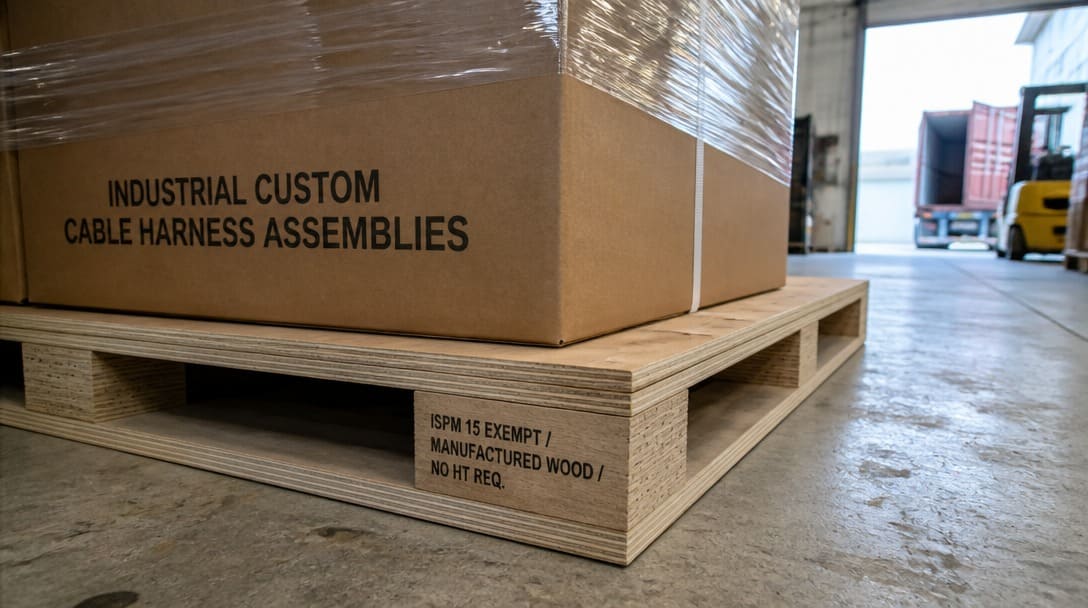
Alternative: Engineered Wood & Plastic Pallets (Exemption Pathway)
For many procurement teams, the fastest way to eliminate ISPM 15 compliance risk is to bypass solid timber entirely. Under Section 2.1 of ISPM 15, wood packaging made entirely from processed wood materials—such as plywood, oriented strand board (OSB), particleboard, or hardboard—is exempt from heat treatment and IPPC marking requirements because the high-heat and pressure bonding processes destroy regulated plant pests. Plastic pallets and metal skids are likewise fully exempt.
For export-bound electronic components, custom wire harnesses, and cable assemblies—cargo that is typically high in density and sensitive to physical damage—specifying export-grade plywood pallets or engineered wood crates directly in your purchase order (PO) represents the most cost-effective safeguard. This eliminates the risk of customs holds triggered by smudged ink stamps, missing country codes, or unreadable treatment marks at destination ports.
What to Require from a China Supplier Before Container Sealing
The hold at the receiving dock begins weeks earlier, when the supplier seals the container without verifying the IPPC mark. Procurement teams can prevent that sequence by adding packaging requirements directly to the purchase order. All wood packaging material must be ISPM 15 compliant, and the IPPC mark must include the country code, producer code, and treatment code.
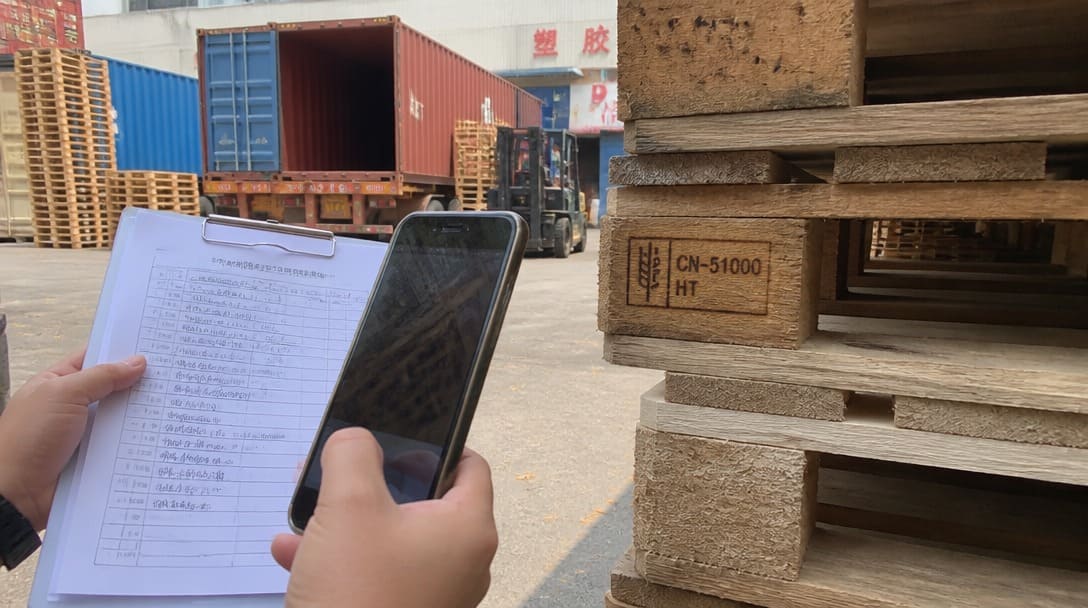
Request pre-shipment photographs of two opposite marked sides, not just one pallet in a stack. Ask for a close-up that can be zoomed for legibility. The packing list should state the pallet material, treatment code, and mark location. If the destination country enforces additional phytosanitary controls, confirm whether a phytosanitary certificate is needed in addition to the IPPC mark.
Have the supplier confirm whether the pallets are new, reused, or repaired. Reused and repaired pallets are frequent sources of missing country codes because replacement boards or blocks may carry no mark. Make container sealing contingent on mark completeness: no complete mark photos, no approval to load.
When sourcing high-density wire harnesses and electronic connectors, packaging failure risks damaging high-precision terminal pins and creates costly warehouse transit delays. At EDOM Electronics, our export packaging protocol standardizes fumigation-free plywood crating and pre-verified ISPM 15 heat-treated pallets with mandatory multi-angle photographic validation before container dispatch.
Field Failure Modes: Heat-Treated Pallets That Still Fail Inspection
Heat treatment is not the only variable. Export teams often assume that a heat-treated pallet will clear inspection, but field failures occur when the mark itself fails. One common mode is ink that runs in transit: the treatment was valid, but water-soluble or low-adhesion ink smears under humidity, leaving the country code unreadable. Another is the missing country code on reused or repaired pallets, where partial replacement boards carry no mark or the original mark is cut off during repair.
Mixed loads create a third failure mode. Treated and untreated wood packaging material consolidated in the same shipment contaminates the lot, even if most pallets are correctly marked. The root cause of failure often shifts from treatment absence to mark integrity. A missing country code points to a supplier repair or reuse issue. Running ink points to a marking method issue. A mixed load points to consolidation and packing control. Dock inspectors cannot assume treatment from a partial mark, so procurement teams must inspect mark completeness as aggressively as they inspect product quality.
Action Plan: From Customs Hold Risk to a Repeatable Supplier Packaging Standard
When an incomplete-mark pallet arrives, quarantine the affected pallets immediately. Do not move them into production or warehouse racking until customs provides direction or replacement packaging is confirmed. Document the failure with photographs and send the evidence to the supplier in the same working day.
Update the supplier packaging specification to include ISPM 15 mark fields, placement, and photo evidence before container sealing. Train receiving teams to run the ISPM 15 Pallet Mark Go/No-Go Checklist on every inbound China shipment, not only suspicious ones. Escalate incomplete marks to the supplier even if the shipment is ultimately released, because a documented supplier failure improves corrective action. Turn the dock hold into a preventive requirement by making the IPPC mark a mandatory field on the inbound packaging checklist.
Frequently Asked Questions
Does an IPPC mark guarantee that a pallet was heat-treated?
No. The IPPC mark indicates that a treatment provider applied heat treatment or methyl bromide fumigation and marked the wood according to ISPM 15. Customs can only verify the mark, not the actual thermal history of the wood. A complete mark is the primary evidence of compliance at the border.
What happens if the IPPC mark is missing the country code but the HT code is visible?
The pallet is noncompliant under ISPM 15. The country code is a required mark element because it identifies where the treatment provider operates. Missing or unreadable country codes trigger quarantine or hold, even if the treatment code is visible.
Are plastic pallets subject to ISPM 15?
No. ISPM 15 applies to wood packaging material, including solid wood pallets, crates, and dunnage. Plastic pallets, plywood, and processed wood materials are generally exempt because they do not carry the same pest risk.
Does a phytosanitary certificate replace an IPPC mark?
No. A phytosanitary certificate is a separate document issued by a national plant protection organization. The IPPC mark is applied directly to the wood packaging material. Some destination countries require both, but neither replaces the other.
What should a procurement manager require from a Chinese supplier before container sealing?
Require ISPM 15-compliant wood packaging material with a complete IPPC mark—IPPC symbol, country code, producer code, and HT or MB treatment code—on at least two opposite sides. Require pre-shipment photos of those two sides and a packing list that states the pallet material, treatment code, and mark location before approving the container for sealing.
Key Takeaways
- ISPM 15 requires debarked, treated wood packaging material and a complete IPPC mark with the IPPC symbol, ISO country code, producer or treatment provider code, and HT or MB treatment code.
- An incomplete IPPC mark shifts the burden to the importer at the dock, even when heat treatment was performed correctly.
- Dock-level acceptance is binary: if the country code or treatment code cannot be read, reject or quarantine the pallet.
- Pre-shipment photo evidence and a packaging specification in the purchase order prevent most customs holds before container sealing.
- Use the ISPM 15 Pallet Mark Go/No-Go Checklist on every inbound shipment to convert customs risk into a repeatable supplier packaging standard.
For structured incoming inspection and export packaging support that includes ISPM 15 mark verification, explore the quality inspection and export packaging resources.