Direct answer: A banana connector is a generic 4 mm or 2 mm single-wire interconnection system with a spring-loaded male pin and matching socket, used for test leads, bench instruments, and temporary panel connections. Its mating reliability depends on spring tension, shroud geometry, termination style, and safety category—not just the 4mm diameter.
What Counts as a Banana Connector: 4mm and 2mm Plugs, Jacks, and Binding Posts
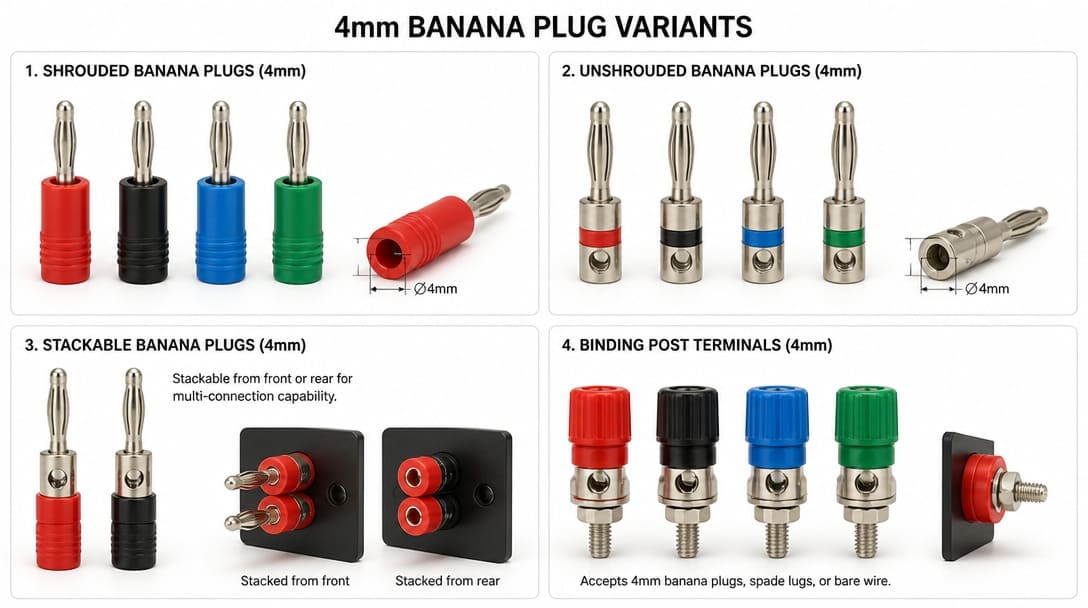
In test and measurement, the term “banana” covers a family of single-pole connectors designed for quick, repeatable connections. A banana plug is the male pin with a spring-cage or leaf-spring tip that provides outward normal force against the socket wall. A banana jack is the matching female socket, often panel-mounted behind an insulating mounting bushing, that accepts the male pin. A binding post is a related panel terminal that accepts a banana plug, bare wire, spade lug, or alligator clip; its threaded cap provides an additional clamping force independent of the banana spring.
The 4 mm connector is the dominant size for bench instruments, power supplies, multimeters, and ATE fixtures. The 2 mm version appears mainly in low-current or dense patch panel applications, where center-to-center spacing must be minimized. The “banana” name refers to a generic industry shape—a slightly bulging spring contact—not a brand, series, or controlled part number. No single standard defines every banana connector; compatibility is determined by physical geometry, contact force, and the mating design of the socket or panel.
Within the 4 mm family, shrouded banana connectors have an insulating sleeve that extends beyond the metal tip, reducing exposed conductive surface during partial insertion. Unshrouded plugs leave the conductive pin exposed for their full length. A stackable banana plug includes a rear 4 mm socket in the body, allowing another plug to be inserted from the back for daisy-chaining test leads. Non-stackable plugs are solid and cannot accept a second plug from the rear.
The Four Specification Decisions That Determine Mating Compatibility
A banana connector that measures 4 mm on a caliper can still fail in production or field use. The decisions that determine whether the connection will remain stable are termination method, shroud geometry, stackability, and safety category. Wire gauge range and cable outside diameter then determine whether the chosen plug can be assembled correctly.
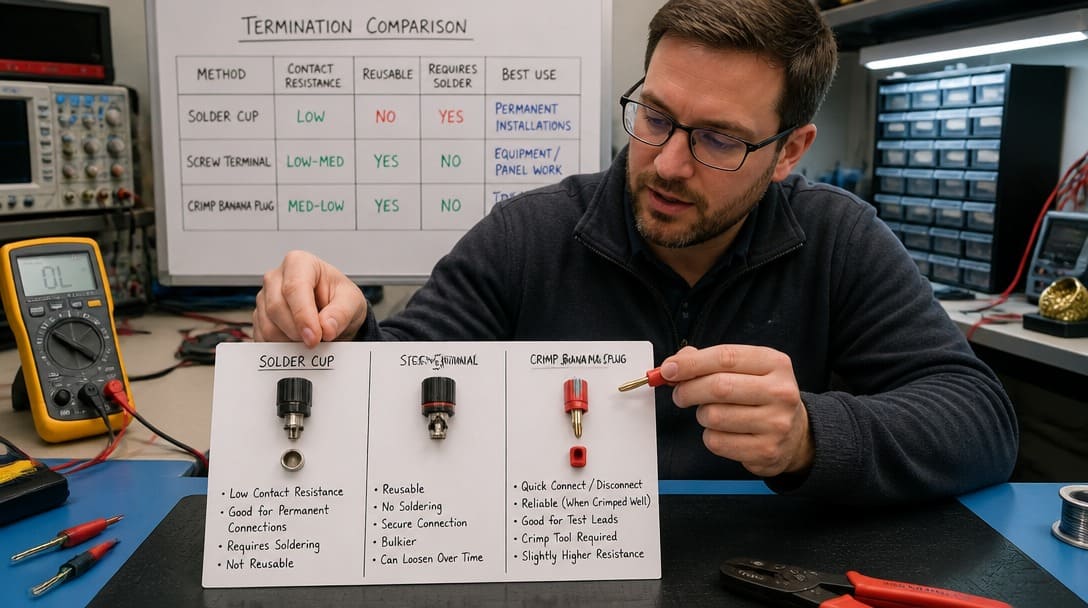
Termination method changes the wire gauge range, assembly process, and vibration tolerance. Solder cup terminations are rigid and common on bench test leads, but they require controlled soldering and strain relief. Screw terminals allow tool-less field termination and accept a wider range of wire sizes, but the clamping force depends on correct torque and can relax under vibration. Crimp terminations provide the most repeatable production termination when the correct crimp tooling is used, but they require matching the connector contact to the exact wire gauge and insulation diameter.
| Parameter | Solder Cup | Screw Terminal | Crimp |
|---|---|---|---|
| Typical wire gauge range | Narrower; matched to cup depth | Wide; determined by clamp opening | Controlled by contact and tooling |
| Assembly environment | Bench soldering | Field or panel wiring | Production crimp tooling |
| Vibration tolerance | Rigid; requires strain relief | Can back off under vibration | High when tooled correctly |
| Inspection method | Visual joint inspection | Torque check and pull test | Crimp height and pull test |
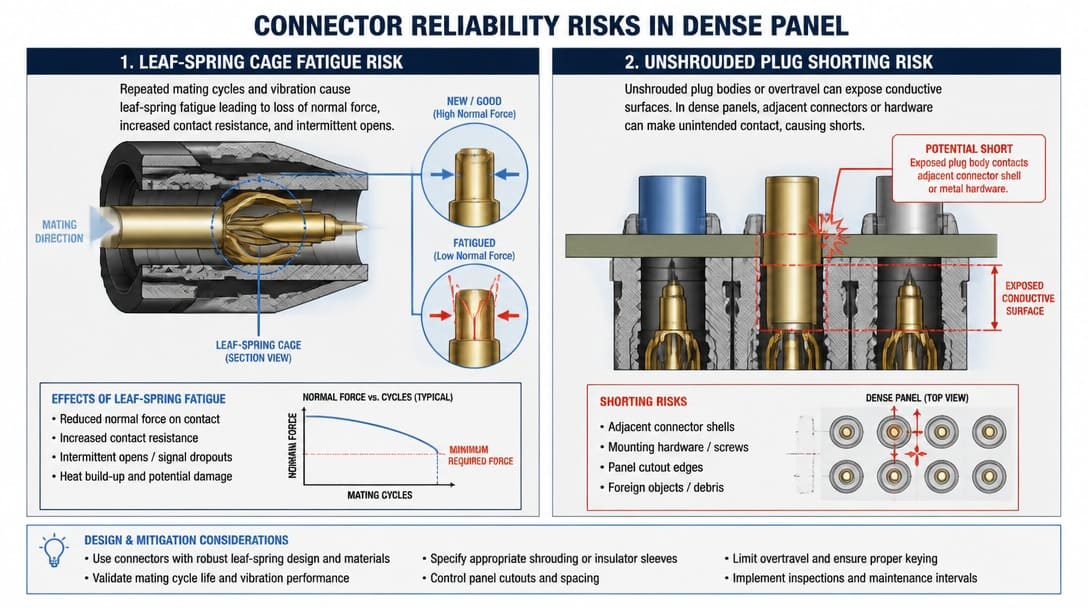
Shrouded versus unshrouded is not a cosmetic choice. A shrouded banana connector reduces shorting risk in dense panel layouts because the insulating sleeve covers the conductive tip until the plug is fully seated. Unshrouded plugs require more panel clearance, accessory shields, or operator guarding, especially where adjacent jacks are at different potentials.
Specify a stackable banana plug only if daisy-chaining test leads is actually required. The rear socket adds length, creates an additional contact interface, and may not be safe for all voltage levels. In most single-point measurement setups, a non-stackable plug is the simpler, lower-risk choice.
For hand-held test probe assemblies and accessory probes, IEC 61010-031 applies. The standard addresses construction and safety requirements for probe assemblies used in measurement circuits. A CAT II, CAT III, or CAT IV rating on a test probe assembly is a measurement overvoltage category rating—not a general bench-power rating. It tells the user where the probe may be safely used in relation to the mains supply, but it does not replace shrouded geometry for casual contact protection.
For broader termination and plating rules, the pillar article at what is a connector? A practical overview for OEM buyers provides the general connector fundamentals.
Why “Fits Tight on Day One” Fails in the Field: Banana Connector Failure Modes
Field observation: We regularly see banana plugs that feel tight on day one but lose contact after repeated insertion cycles—spring tension and shroud geometry are the compatibility criteria, not color.
A quick bench fit check confirms that the plug enters the jack and feels snug. It does not confirm how the connector will behave after hundreds of insertion cycles, under vibration, or in a dense panel where a technician’s hand can bridge adjacent terminals. The failure modes below are the common reasons a banana connection works initially and then degrades.
- Spring cage fatigue: The leaf-spring normal force drops after repeated mating cycles. Contact resistance rises, and the connection becomes intermittent even though the plug still seats fully.
- Unshrouded plug shorting: A hand slip during insertion can bridge adjacent panel jacks, especially in dense ATE fixtures or bench power distribution. Shrouded plugs reduce this risk by covering the conductive tip until seating.
- Solder joint cracking: Flex or strain on a rigid solder-cup plug creates hairline fractures that visual inspection often misses. Without a strain relief or backshell, the solder joint becomes the mechanical weak point.
- Screw terminal loosening: Vibration on a test rack can back off screw terminations, raising resistance or dropping the wire entirely. This is a well-known issue in wire harness manufacturing environments where cables are routed and tied.
- Plating wear on low-cost plugs: Thin or porous plating wears through, exposing base metal and creating unstable measurements. Contact resistance drifts upward, and low-level signals become noisy.
None of these failures are caused by the 4 mm diameter being wrong. They result from specifying a connector without matching the spring contact, shroud geometry, termination, and plating to the actual mating environment.
Banana Connector Selection Checklist: A Screenshot-Ready Decision Sequence
Use the following sequence before selecting color, cable length, or part number. It forces the electrical, mechanical, and safety decisions to happen before cosmetic choices.
- Confirm voltage and current rating against the actual circuit, not just the connector body size. A 4 mm banana connector can be rated for bench use, measurement use, or higher-power panel use depending on the contact material and body construction.
- Decide shrouded vs unshrouded based on panel clearance, adjacent contact risk, and operator handling. Shrouded plugs reduce shorting risk in dense layouts.
- Choose termination type—solder, screw, or crimp—and verify the wire gauge range matches the cable or harness conductor.
- Select stackable vs non-stackable only if daisy-chaining test leads is actually required. Do not default to stackable.
- Set expected mating cycles and choose a spring/contact design with sufficient normal force for that duty. This is a qualitative judgment, not a single number.
- If used with hand-held probes or measurement circuits, confirm the IEC 61010-031 CAT rating for the probe assembly—not just the plug body.
- Only after all of the above: pick color and lead length. These are final cosmetic and routing choices, not compatibility decisions.
Shrouded vs Unshrouded and CAT Ratings: Reading IEC 61010-031 Correctly
Shrouded banana connectors are preferred or required wherever exposed conductive tips can short against panel hardware or adjacent sockets. In a dense ATE fixture, an unshrouded plug halfway inserted can touch a neighboring jack at a different potential. The shroud does not change the electrical performance of the 4 mm interface; it changes the safety envelope during handling.
Unshrouded plugs remain common for legacy instruments and low-voltage bench power, but they demand larger spacing, accessory shields, or dedicated protective covers when not in use. If a panel drawing calls for a banana jack next to a grounded terminal, the shroud decision directly affects whether the assembly is safe to operate.
IEC 61010-031 addresses hand-held test probe assemblies and accessory probes. A banana plug used as a probe tip must meet the relevant CAT rating for the measurement environment. CAT ratings do not replace shrouded geometry. They address overvoltage transients and probe assembly construction, not casual contact with adjacent metal. A CAT III-rated probe with an unshrouded plug can still create a short if the tip touches a nearby conductor during insertion.
From Panel Drawing to Stable Supply: Specification Details Procurement Should Capture
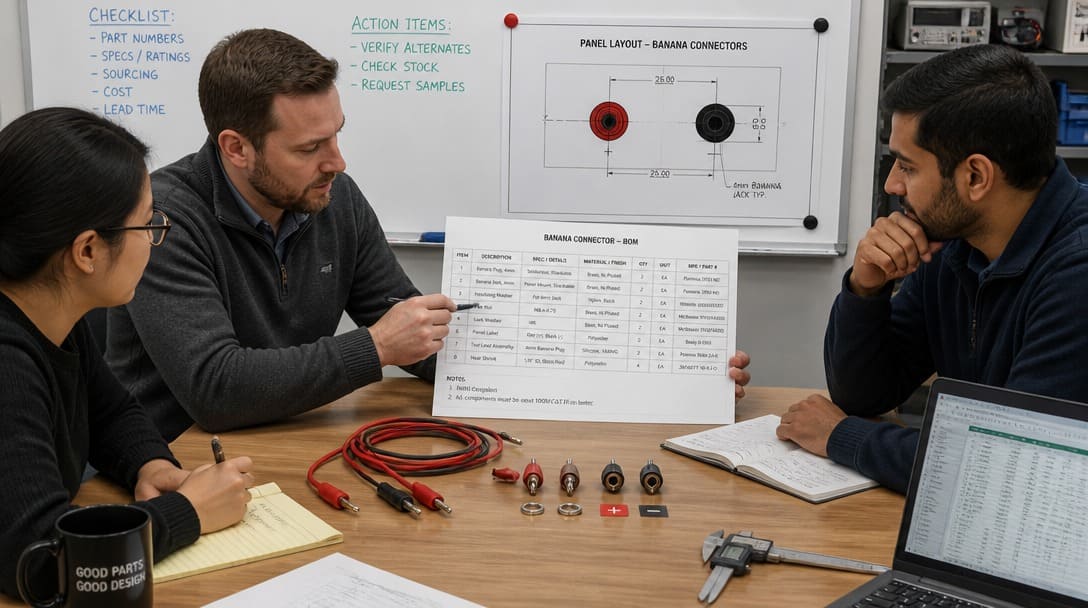
When sending a BOM or panel drawing, capture more than “4mm banana plug.” Specify termination style, wire gauge range, shroud requirement, stackability, and the expected mating cycle target. This prevents the buyer from receiving a plug that physically fits the jack but fails in production or field use.
Specify plating and spring contact material if the datasheet or drawing includes them. Do not assume all nickel-plated or gold-plated plugs have equivalent life. Gold over nickel underplate behaves differently from thin flash gold on bare brass, especially in low-level measurement circuits.
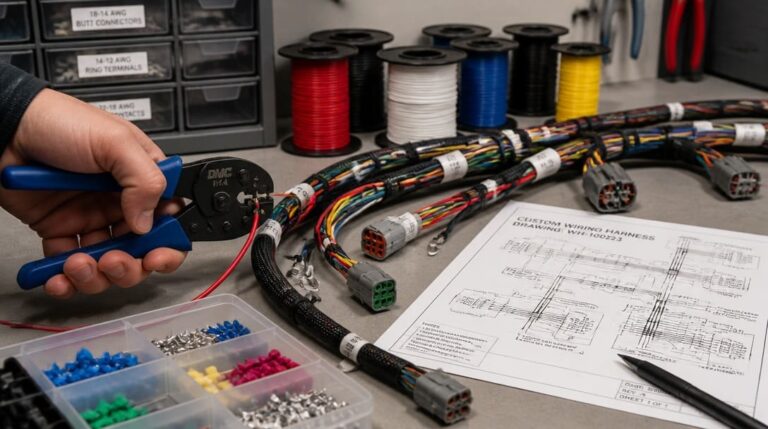
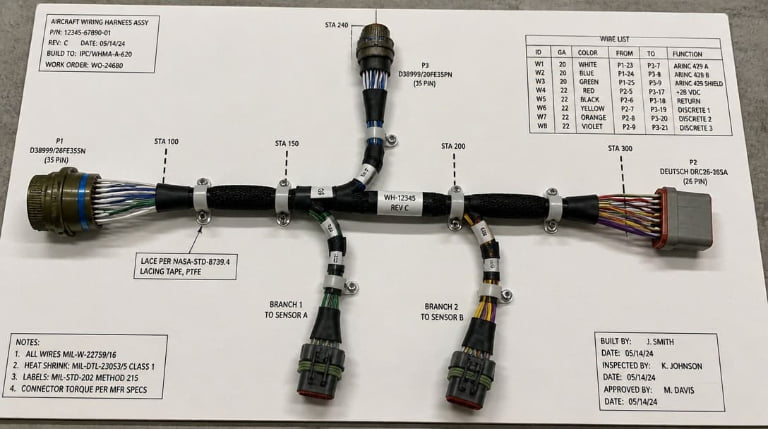
For cable assembly or wire harness builds, request sample confirmation with the actual mating jack or panel socket before batch production. A sample that is terminated and tested against the real panel is the most reliable way to confirm spring force, shroud clearance, and crimp or solder joint quality. This is a standard step in custom cable assembly projects where banana plugs are installed on multi-conductor leads.
Confirm export packaging needs early. Individual bagging, tray packing, or bulk packing affects connector contact and shroud protection during international shipping. Shrouded plugs are less prone to contact deformation than unshrouded plugs, but loose bulk packing can still damage springs or bend pins. Review the packaging plan as part of the quotation, not after production. Quality inspection and export packaging controls determine what arrives at the buyer’s dock.
Suppliers such as EDOM support OEM buyers with requirement review, connector matching, sample coordination, production follow-up, inspection, and export-ready packaging for custom cable assemblies and wire harnesses that include banana connectors or mating panel jacks. This level of coordination is most valuable when the panel drawing is incomplete or when the buyer needs to match an existing socket without knowing the original part number.
Where Banana Connectors Fit in the Broader Connector Landscape
Banana connectors are one interconnect family within a much larger set of panel, cable, and PCB-level connection systems. Buyers troubleshooting a banana jack on a panel often benefit from stepping back to the connector fundamentals—contact systems, plating, termination, and mechanical retention—covered in the pillar guide to connectors for OEM buyers.
In production cable assemblies and wire harnesses, banana connectors are often specified alongside ring terminals, spade terminals, binding posts, and multi-pin connectors. A test harness may combine a banana plug for power, a shielded BNC(see our BNC connector FAQ) for signal, and a multi-position connector for control lines. Each family has its own mating and inspection rules, but the underlying procurement logic is the same: capture the interface, termination, and environmental requirements before committing to a part number.
For buyers who need to move from a single banana connector decision into a broader electronic interconnect sourcing program, review electronic connector sourcing options to compare connector families, supplier coordination, and production support.
Frequently Asked Questions
What is the difference between a banana plug and a banana jack?
A banana plug is the male pin with a spring-cage or leaf-spring tip. A banana jack is the matching female socket, often panel-mounted, that accepts the 4 mm plug. The two terms describe opposite sides of the same interconnection interface.
Are all 4mm banana plugs compatible with all 4mm jacks?
Not necessarily. The 4 mm diameter is only one dimension. Spring contact force, shroud depth, and total plug length all affect whether a plug mates correctly with a specific jack or binding post. A fit check on the actual mating part is always recommended.
When should I use a shrouded banana connector instead of an unshrouded one?
Use a shrouded banana connector when exposed conductive tips can short against panel hardware or adjacent sockets, especially in dense ATE fixtures or bench power distribution. Unshrouded plugs require more panel clearance or accessory shields.
What does IEC 61010-031 apply to?
IEC 61010-031 applies to hand-held test probe assemblies and accessory probes used for measurement. A banana plug used as a probe tip must meet the relevant CAT rating for the measurement environment. The CAT rating is a measurement overvoltage category, not a general bench-power rating.
How do I evaluate a banana connector supplier for OEM production?
Look for a supplier that can review panel drawings, confirm connector matching against the actual mating jack, provide samples for confirmation, coordinate production follow-up, and control export packaging. Suppliers such as EDOM support this range of sourcing and inspection tasks for custom cable assemblies and wire harnesses.
Key Takeaways
- A banana connector is a generic 4 mm or 2 mm single-wire connection system; it is not a brand, series, or controlled standard part number.
- Compatibility is determined by spring tension, shroud geometry, termination style, and safety category—not just the 4 mm diameter.
- Shrouded banana connectors reduce adjacent-contact shorting risk; stackable plugs should be specified only when daisy-chaining is truly needed.
- Solder, screw, and crimp terminations each carry different wire gauge ranges, vibration tolerances, and assembly inspection requirements.
- Sample confirmation with the actual mating jack or panel socket is the most reliable way to validate a banana connector before batch production.