Direct answer: Waterproofing must be chosen with the connector family, cable exit, assembly process, and operating environment. The four common OEM approaches are sealed connector bodies, cable glands, overmolding, and potting compound. Each has different tooling, rework, and strain-relief trade-offs.
At a Glance
A waterproof connector is not a single component you order by part number. It is an assembly-level sealing system that includes the mating interface, the cable exit, and the internal termination area. The correct method depends on cable OD, number of conductors, flexing, washdown exposure, and whether field repair is required. Sealed bodies, cable glands, overmolding, and potting are the four primary approaches.
Waterproofing Is a System Decision, Not a Single Component Choice
Waterproofing in OEM cable assemblies is not solved by selecting a “waterproof” part number. A connector body rated IP67 or IP68 protects the mated interface, but it does not automatically seal the cable exit or the internal crimp terminations. The assembly becomes waterproof only when three sealing zones are designed and executed correctly: the connector mating interface, the cable entry point, and any internal voids around terminations.
Suppliers such as EDOM Electronics support OEM buyers with requirement review, connector matching, sample coordination, production follow-up, inspection, and export-ready packaging for custom cable assemblies and wire harnesses. In practice, a drawing that calls for a sealed connector still requires the production partner to specify the sealing method, cable OD tolerance, backshell torque, and unused cavity plugs. If pin count and housing dimensions match but the sealing method doesn’t match the production process, the assembly can pass visual incoming inspection and fail later in the field.
For teams building custom cable assemblies, the sealing decision must be made before connectors, cable, and backshells are ordered. Changing from a gland to overmolding after the cable is cut and terminated usually means rework, wasted parts, and a new sample cycle.
What the Connector Name Actually Tells You: Brand, Series, and Generic Terms
Drawings mix proprietary brand names, standardized series names, and generic descriptors. A BOM may list a “Deutsch DT connector,” an “M12 A-coded connector,” or simply “sealed circular connector.” Each type of callout carries different information.
- Proprietary brand name: Deutsch DT identifies a specific connector family with defined wedge locks, wire seals, and cavity plugs. The part number identifies a mating interface and family, but not necessarily the termination type, plating thickness, wire gauge range, or sealing components.
- Standardized series name: M12 is defined in IEC 61076. The coding letter (A, B, D, X, etc.) identifies the contact arrangement and keying. Waterproofing relies on an O-ring, thread torque, and a correctly sized cable exit seal.
- Generic descriptor: “Waterproof circular connector” provides almost no engineering information. It must be treated as a functional requirement, not a specification.
Before comparing replacements, classify whether the callout is a manufacturer-specific part, an industry-standard interface, or a functional description. Using the connector family to narrow the search is valid, but a series name alone does not capture the full specification. A generic substitute that matches the housing outline may differ in plating stack, contact retention, and sealing component geometry.
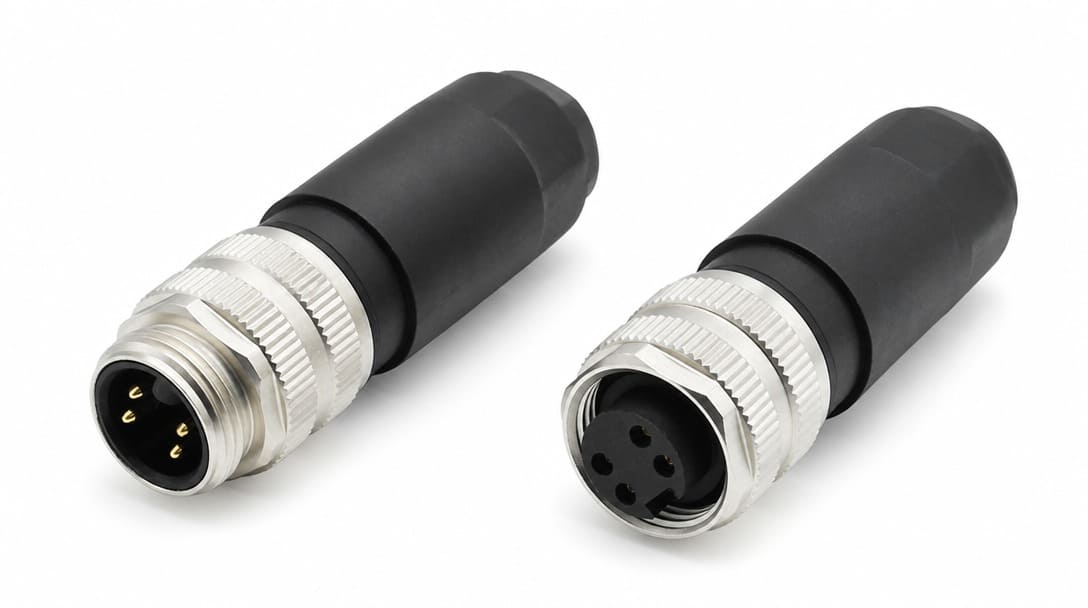
IP67 vs IP68: What Ingress Protection Ratings Do and Do Not Guarantee
IP ratings come from IEC 60529[1]. IP67 indicates dust-tight and protected against temporary immersion in water up to 1 meter for 30 minutes. IP68 indicates protection beyond IP67, but the depth and duration are specified by the manufacturer — there is no universal IP68 depth. One supplier’s IP68 connector may be rated for 2 meters for 24 hours; another may mean 1.5 meters for 1 hour. The code alone does not tell the buyer.
IP tests are performed with connectors mated and specified sealing components installed. Unmated connectors, open cavities, and cable exits are not automatically sealed. A connector rated IP67/IP68 can still fail in production if the cable gland is sized for the wrong cable OD or the panel cutout tolerance breaks the seal path.
Ask for test conditions including temperature cycling, chemical exposure, pressure differential, and vibration. For food, beverage, and pharmaceutical equipment, DIN 40050-9 / ISO 20653[2] defines IPX9K high-pressure washdown rating, which requires a different seal design than a static IP67 application.
What Dimensions Don’t Tell You: Termination, Plating, and Mechanical Retention
Two connectors can look identical in a datasheet and still behave differently on the production line. The hidden parameters are termination compatibility, plating material and thickness, and mechanical retention method.
Termination compatibility: Crimp-type connectors specify a wire gauge range and insulation diameter range. If a replacement connector accepts 20–22 AWG but the harness uses 18 AWG, the crimp will be unreliable or impossible. PCB-mount types have soldering process windows, footprint tolerances, and through-hole anchor requirements that differ even between visually similar parts.
Plating material and thickness: Plating governs contact resistance, corrosion resistance, solderability, and mating-cycle life. A visually identical housing can hide a different contact plating stack — for example, gold over nickel versus tin over copper. In humid or washdown environments, the wrong plating can cause early contact failure. RoHS[3] compliance also matters for global distribution; suppliers should offer RoHS-compliant options where required.
Mechanical retention method: Board locks, through-hole anchors, latches, panel threads — each affects vibration resistance and seating force. A replacement with the same pin count but a weaker latch may intermittently disengage in a vibrating machine.
“We regularly see connectors that pass visual incoming inspection but fail during assembly — the termination interface or plating stack was engineered for a different process than the one running on the production line. The part looks right; the process doesn’t know it’s wrong.”
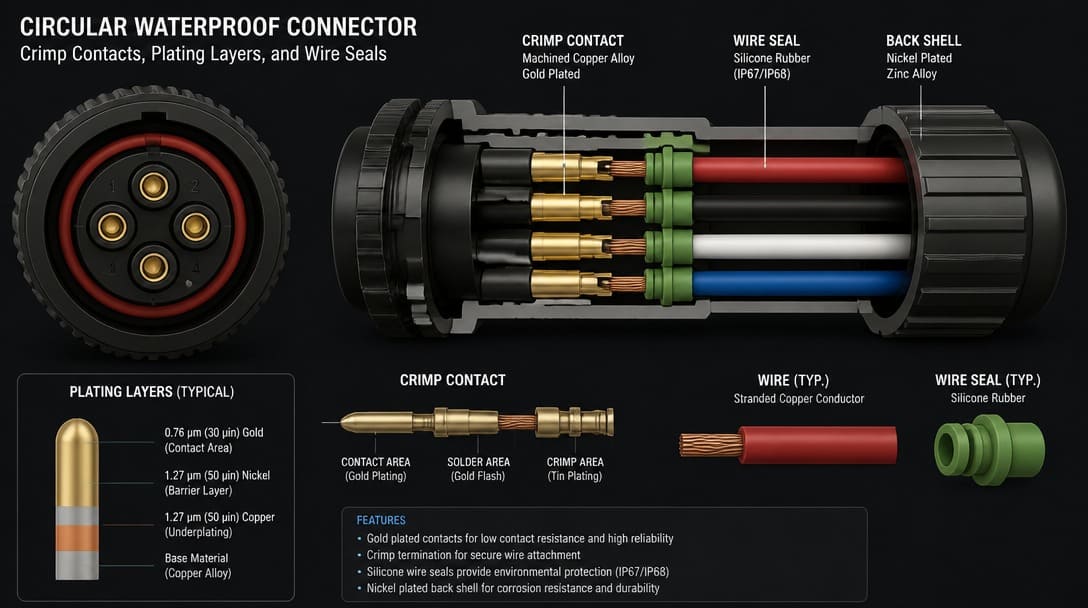
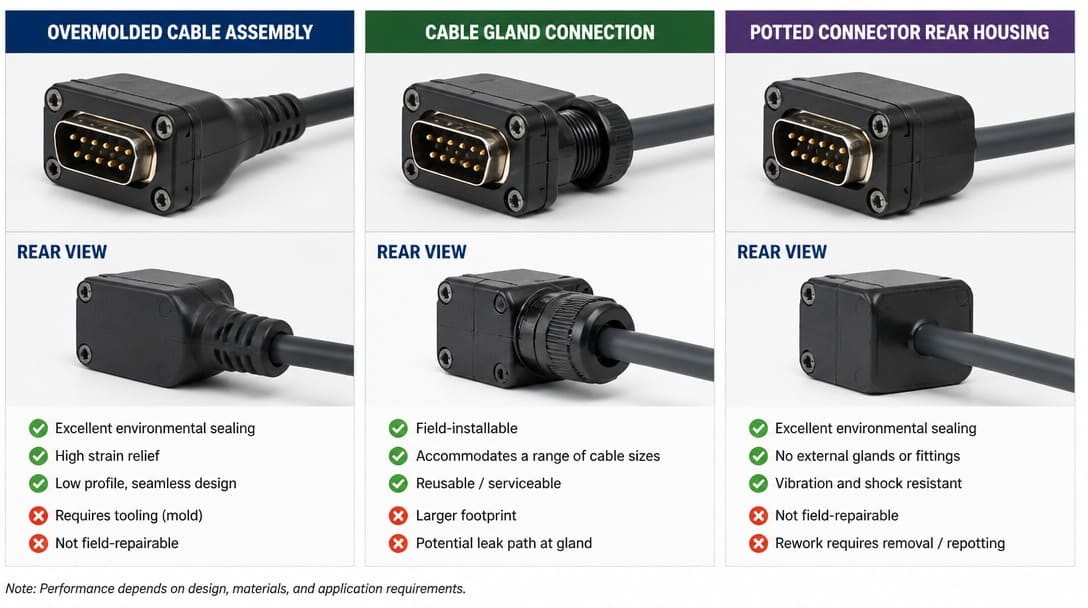
Waterproofing Methods Compared: Cable Gland vs Overmolding vs Potting Compound vs Sealed Connector Body
Each waterproofing method has distinct trade-offs for repairability, tooling cost, strain relief, IP ceiling, production throughput, and cable flex life. The correct choice follows from the cable OD, number of conductors, flexing, washdown exposure, and field repair expectations.
| Method | Sealing Principle | Tooling Cost | Reworkability | Strain Relief | Typical Use |
|---|---|---|---|---|---|
| Cable gland | Mechanical compression of an elastomer around the cable jacket | Low | High — field-installable and repairable | Moderate; depends on gland design | Panel-mount sensors, junction boxes, field wiring |
| Overmolding | Polymer jacket bonded to connector and cable | High — requires mold tooling | Low — must cut and re-terminate | Excellent — absorbs flex and pull | High-flex OEM cable assemblies, washdown equipment |
| Potting compound | Fills internal voids around terminations | Low to moderate | Low — cured compound is difficult to remove | Moderate; adds stiffness at terminations | Rear of connectors, splice areas, vibration-prone harnesses |
| Sealed connector body | O-rings and interfacial seals at the mating interface | None (standard product) | High — replace connector or seals | Limited; requires separate backshell/strain relief | M12, Deutsch DT, and similar industrial connectors |
Cable glands require the correct cable OD range; if the cable is undersized, the seal compresses but does not fill the gap. Overmolding provides strong ingress protection and strain relief, but once molded, the assembly cannot be reworked easily. Potting prevents moisture wicking and vibration failures inside the connector, but adds process time and limits future repair. Sealed connector bodies such as M12 and Deutsch DT protect the mated interface only when properly mated, torqued, and matched to panel cutout tolerances.
M12, Deutsch DT, and Generic Sealed Connectors: Matching Family to Environment
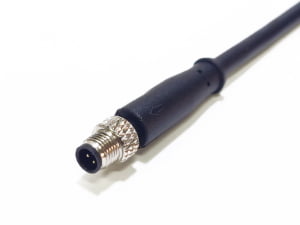
M12 connector: This standardized circular industrial interface is common in factory automation and sensor cabling. Coding prevents mis-mating, and waterproofing relies on an O-ring, thread torque, and backshell/cable exit sealing. For an M12 cable assembly to stay sealed, the installer must torque the threaded coupling correctly and use a cable OD within the backshell seal range. If the cable jacket is too hard or too smooth, the gland may not grip and seal.
Deutsch DT connector: This sealed automotive/industrial connector family uses wedge locks and silicone wire seals. Each wire entering the connector passes through a wire seal sized for the insulation diameter. Unused positions require cavity plugs. A common failure in wire harness manufacturing is using the wrong wire seal size or forgetting cavity plugs — the connector mated, but water enters through the open cavity.
Generic “waterproof connector” substitutes: Compatibility must be verified at mating interface, contact retention, wire seal, and plating stack levels — not just housing dimensions. A generic part may fit mechanically but leak because the wire seal durometer or gland compression differs. For vibration-heavy vehicle and equipment harnesses, Deutsch DT is often specified; for factory sensor cabling, M12 is common. Generic substitutes should be used only after sample-level qualification.
Compatible vs Interchangeable: Pre-Order Verification Checklist
“Compatible” means functionally adaptable with possible process changes. “Interchangeable” means drop-in without changing termination, mating behavior, or sealing path. Buyers who treat these as synonyms often discover the difference on the production line.
Before ordering a replacement or alternative connector, complete this verification checklist:
- Confirm termination method matches your assembly process. For crimp-type connectors, check the wire gauge range and insulation diameter range. For PCB-mount types, verify soldering process, footprint tolerance, and through-hole anchor requirements.
- Confirm plating specification meets environmental and mating-cycle requirements. Check material, thickness, finish, and salt-spray performance. Ask for the plating stack, not just the base material.
- Verify key dimensions with actual samples, not just datasheet drawings. Cable OD, panel cutout, thread depth, and mating face geometry all affect sealing. Datasheets often omit mounting tolerance bands.
- Confirm mating interface is fully identical. Polarization, keying, seal positions, contact arrangement, and cavity plugs must match. A connector that mates but does not key correctly can be forced, damaging seals.
- For waterproof assemblies, check unused cavity plugs, wire seal grommets, backshell torque, and strain relief travel. Each of these is a potential leak path.
Turn the Checklist into a Sourcing Specification
Use the completed checklist as a sourcing RFQ attachment. Include the part number, connector family, termination type, plating specification, sealing method, and expected operating environment. Request a drawing review that confirms termination compatibility and plating stack before tooling or volume commitment.
If no connector specialist is on the team, ask the supplier to review samples, BOM lines, or drawings against the production process — not just return a price. A supplier that only quotes on dimensions may not catch a wire gauge mismatch or a cavity plug omission. Contact a sourcing partner for drawing review and sample verification before committing to volume.
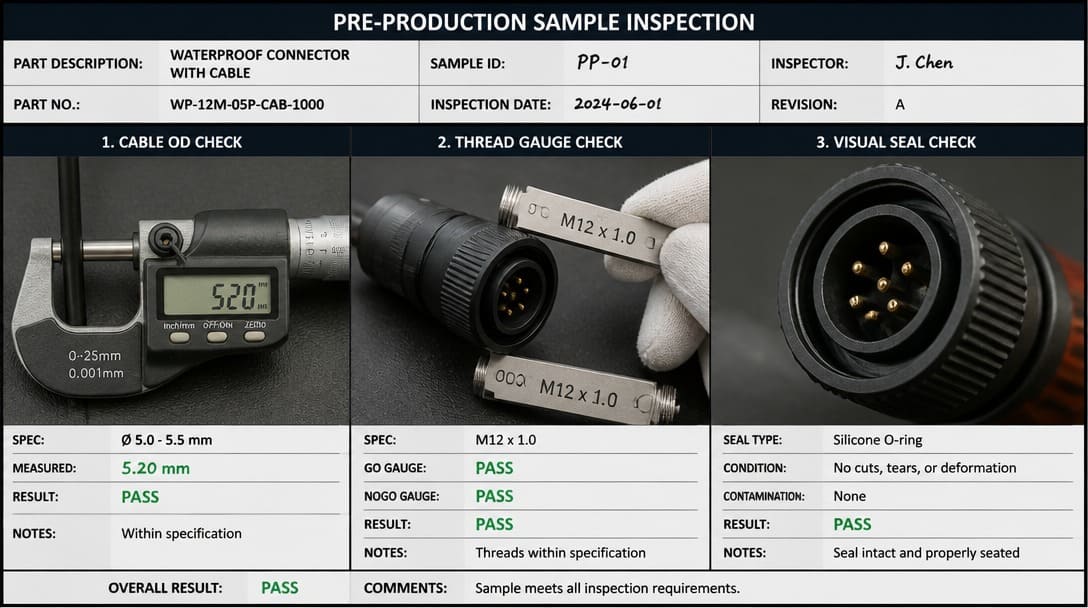
How Waterproof Assemblies Are Tested and Inspected
Waterproofing claims should be backed by test methods and inspection procedures. EIA-364 defines electrical, mechanical, and environmental test procedures for electrical connectors and sockets, including sealing and immersion tests. IEC 60529 defines the IP rating methodology. UL 94 flammability ratings apply to connector housings and cable materials, particularly for equipment that may be exposed to flame or high heat.
In production, waterproof assemblies typically undergo continuity testing, hipot testing where applicable, visual inspection of seal seating, and sample-level leak testing. Appearance checks include O-ring placement, gland compression, overmold flash, and potting voids. For export shipments, packaging must protect sealing surfaces from damage during transit. A complete quality inspection and export packaging process should cover both functional and cosmetic criteria, with documented pass/fail records for each lot.
Next Steps and Related Connector Assembly Guides
For broader connector education, the electronic connector category covers connector identification, termination, and sourcing review. This waterproofing guide is one part of a larger assembly checklist: connector selection, crimping, assembly, and waterproofing should be reviewed together before sample ordering.
Upcoming practical guides expand on assembly specifics including how to assemble Deutsch connectors, how to crimp JST connectors, and how to crimp MC4 connectors. Other relevant questions include how do electrical connectors work and whether an SMA connector can be used to transmit a clock signal.These subtopics build on the same principle: a connector is a system, not a component, and its performance depends on termination, plating, retention, and sealing working together.
For teams ready to move from connector selection into full production, explore the electronic connector sourcing and assembly resources for identification guides, termination comparisons, and sourcing checklists.
Frequently Asked Questions
Is IP67 better than IP68 for waterproof connectors?
Not necessarily. IP67 specifies immersion up to 1 meter for 30 minutes. IP68 indicates deeper or longer immersion, but the exact depth and duration vary by manufacturer. For washdown or long-term submersion, IPX9K from DIN 40050-9 / ISO 20653 may be more relevant than either code.
Can I make any connector waterproof by adding a cable gland?
A cable gland seals the cable exit, but it does not seal the mating interface or internal terminations. The connector body must have its own interfacial seal or O-ring for the mated pair. Potting or overmolding may be needed to seal the rear of the connector.
What is the difference between a sealed connector body and an overmolded assembly?
A sealed connector body relies on O-rings and interfacial seals at the mating interface. An overmolded assembly adds a polymer jacket around the connector and cable, sealing the rear exit and providing strain relief. Overmolding requires mold tooling and is difficult to rework, while sealed bodies are replaceable.
Do Deutsch DT connectors require cavity plugs for unused positions?
Yes. Each unused cavity must be filled with a cavity plug to maintain the sealed harness. If a cavity is left open, water can enter through the connector body even when mated. The correct wire seal size is also essential for occupied positions.
When should I choose potting compound instead of overmolding?
Potting is often used when the connector is inside a housing or when the cable exit is irregular and overmolding would be complex. Potting fills internal voids and blocks moisture wicking, but it adds process time and limits future repair. Overmolding is preferred for high-flex cable exits and repeated handling.
Key Takeaways
- Waterproofing is an assembly-level decision, not a connector property. Mating interface seals, cable exit sealing, and internal terminations must all be addressed.
- IP67 and IP68 ratings apply to mated connectors and specific test conditions. They do not guarantee performance with unmated connectors, open cavities, or incorrectly sized cable glands.
- Dimensions alone do not confirm compatibility. Termination wire gauge range, plating stack, mechanical retention, and sealing components often differ between visually identical parts.
- Cable glands, overmolding, potting, and sealed connector bodies each have distinct trade-offs for repairability, tooling, strain relief, and field performance.
- Before ordering, verify termination method, plating specification, key dimensions with samples, and the full mating interface. Treat “compatible” and “interchangeable” as different requirements.