Before you finalize a connector selection, answer these three questions: Will it be exposed to moisture or submersion? What is the temperature range it needs to survive? Will it experience vibration or mechanical shock? If you’re not sure about any of these, read this before ordering.
Overmolding is a molded thermoplastic elastomer (TPE) layer over the connector-to-cable transition used for IP67 environmental sealing and strain relief. Potting is an epoxy resin fill that locks internal contacts against moisture and dust. Braided sleeving is a mechanical polyamide monofilament wrap that adds abrasion resistance but no environmental seal.
How to Choose Between Overmolding, Potting, and Braided Sleeving
Protection selection fails when buyers compare only electrical parameters and outline dimensions. An electrically ideal connector can fail early if the wrong external protection is chosen. Use the three environment questions as the first filter, then move to electrical specifications, as covered in Top 10 Electrical Specifications for Cable Assembly & Wiring Harness.
Step 1: Answer the Three Environment Questions Before Comparing Options
Start by identifying the actual moisture source. Rain and washdown create surface water exposure, while condensation inside an enclosure can produce continuous humidity without a single drop falling on the connector. Temporary immersion is different from occasional splash. For each location, ask whether liquid can pool at the connector face or wick along the cable jacket.
Next, define the temperature range the assembly must survive, not just the ambient air temperature. A connector mounted near a diesel engine lives in a hotter microclimate than the weather report for the site. Include cold-start conditions and heat radiated from neighboring components. Then list all vibration sources: rotating machinery, vehicle chassis movement, pump pulsation, or rough-road transport. Vibration acts on the connector-to-cable transition and can loosen terminations even when the electrical contact remains nominally intact.
Step 2: Match the Failure Mode to the Protection Method
Overmolding uses a thermoplastic elastomer (TPE) molded over the connector-to-cable transition to create a bonded environmental seal and a flexible strain-relief boot. It is the right choice when the connector needs IP67-level protection against temporary immersion, washdowns, or outdoor moisture while still allowing repeated flexing at the cable exit point. The TPE material grade affects temperature range, chemical resistance, and flame rating, so check UL 94[1] requirements when the assembly must meet flame-performance standards. For broader context on where the connector and overmolding fit within a complete cable assembly, see what is a cable assembly: definition, components, and applications.
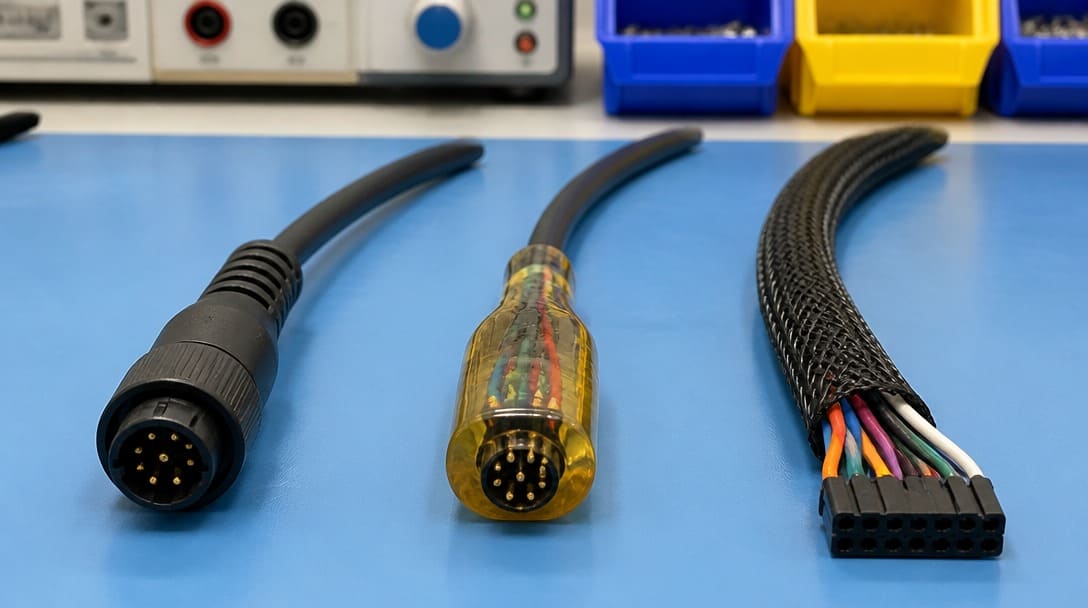
Potting fills the connector or backshell cavity with epoxy resin to encapsulate contacts and terminations, preventing moisture, dust, and corrosive gases from reaching internal conductors. Use potting when the primary failure mode is internal contamination rather than cable flex or surface abrasion. Potted assemblies typically sacrifice reworkability and add rigidity, so specify the epoxy compound carefully: cure schedule, hardness, thermal expansion, and UL 94 flame class. Not all epoxies perform the same in cycling temperature, and a rigid potting material can transfer stress to soldered joints if the assembly expands and contracts.
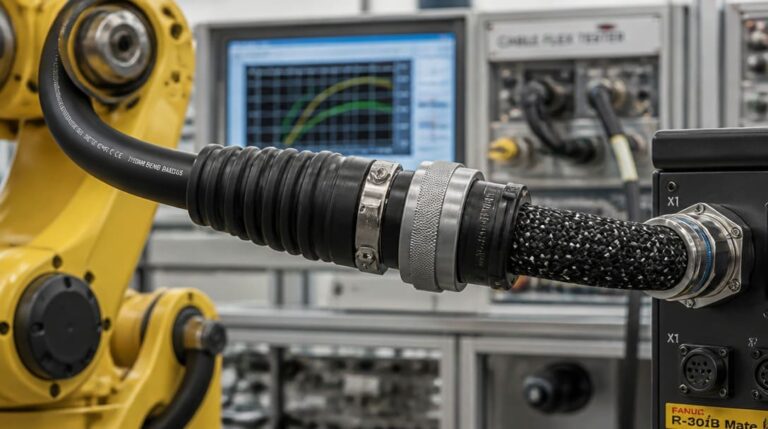
Braided sleeving made from polyamide monofilament wraps or expands over cables and connectors to add cut-through protection, abrasion resistance, and bundle organization. It is not an environmental seal. Moisture, dust, and liquid ingress still require an IP67-rated connector body or overmold/potting at the termination point. Braided sleeving is best for routing across rough enclosures, near hot engine components, or where multiple wires must be gathered without trapping heat. In wire harness production, braided polyamide sleeving is often applied during the routing and looming stage to protect bundles along the harness path — see wire harness manufacturing for the full sequence from cutting and stripping to labeling and final inspection. Unlike overmolding, braided sleeving can be removed and replaced, but it does not provide strain relief at the connector exit unless combined with a boot or backshell.
Step 3: Compare Indoor vs Outdoor/Harsh Requirements
Use the following table to separate benign indoor environments from outdoor or harsh applications. It is not a substitute for drawing review, but it forces the protection decision into the right categories.
| Parameter | Indoor / Benign Environment | Outdoor / Harsh Environment |
|---|---|---|
| Temperature range | Typically 0–40°C | Likely -40–105°C, including heat radiated from nearby equipment |
| Moisture exposure | No direct moisture; possible low humidity variation | Moisture, washdown, or temporary immersion; condensation cycles possible |
| Vibration / shock | Low vibration, stationary equipment | Vibration from diesel engines, pumps, vehicle chassis, or mobile machinery |
| Abrasion risk | Low; cables stay inside enclosure | High; routing across rough enclosures, near hot components, or through panels |
| Protection choice | Braided sleeving for bundling, standard connector hoods; no IP67 needed | TPE overmolding for IP67 strain relief plus epoxy potting if internal cavity must be sealed; braided sleeving for mechanical defense |
| Tooling & upfront cost | Zero tooling for standard braided sleeving; lowest entry barrier | Moderate-to-high NRE for overmold tooling; low tooling for potting but higher per-unit curing labor |
| Field serviceability | High; sleeving can be cut, retracted, or replaced | Zero-to-low; overmolded/potted terminations are permanent and non-repairable |
| Relevant standard / test | UL 94 for internal plastic parts if required | IEC 60529[2] for IP rating definitions; EIA-364[3] for vibration, shock, and temperature cycling |
Mid-project check: Before locking the connector part number, send your installation environment, photos, and connector drawings—specify whether it is outdoors near an engine, washdown, or inside an enclosure. This one sentence often reveals the right protection path faster than a full datasheet comparison.
Step 4: Validate Protection Using IEC 60529, EIA-364, and UL 94
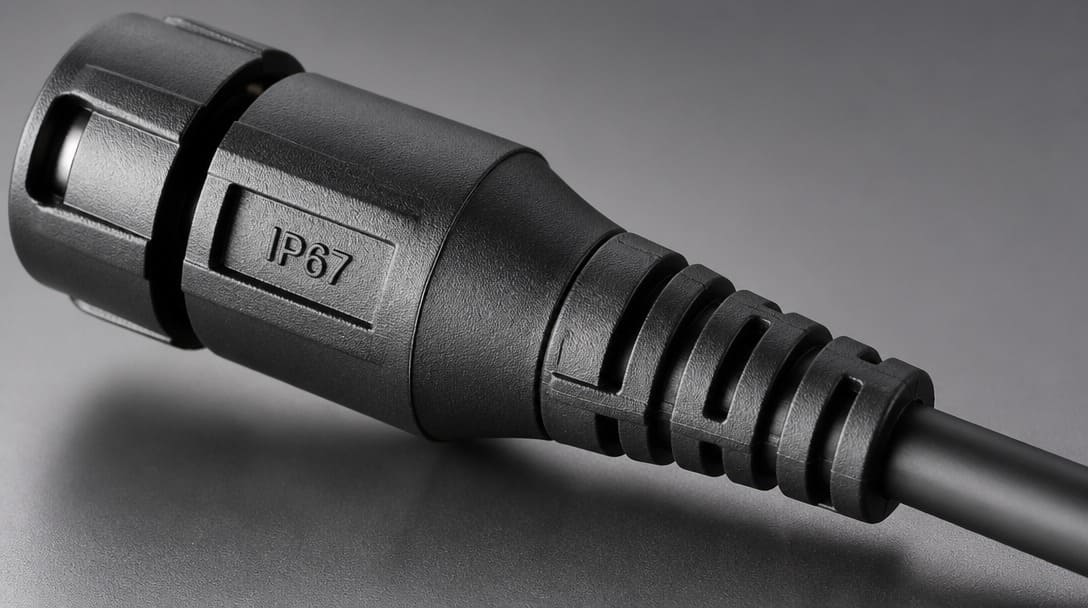
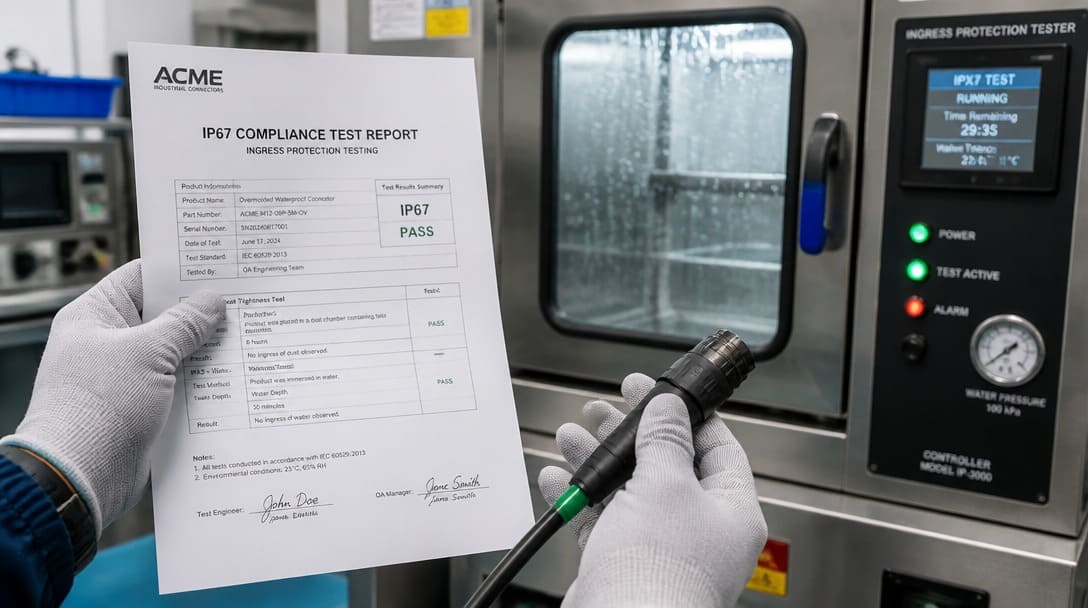
IP67 is defined by IEC 60529: dust-tight (6) and protected against temporary immersion (7). Ask for the exact test conditions rather than accepting a marketing label. IP67 does not mean the connector can sit underwater indefinitely, and the test depth and duration vary by manufacturer claim if not tied to a defined procedure.
EIA-364 covers connector test procedures such as vibration, mechanical shock, and temperature cycling. Use these to confirm that a chosen overmold or potted assembly survives the actual operating profile, not just a generic vibration sweep. For an outdoor diesel-engine installation, specify the vibration amplitude and frequency range from the equipment specification, then check it against the connector test report.
UL 94 applies to flame resistance of plastic materials. When specifying a TPE overmold or epoxy resin, confirm the minimum UL 94 rating required by the equipment standard. A UL 94 V-0 material is not automatically the right choice for every application; some housings only require HB or V-2 depending on the end product’s enclosure and fire protection strategy.
Practical rule: do not accept a protection method without asking which standard and test condition was used to support the claim.
Step 5: Tell the Supplier the Installation Environment, Not Just the Drawing
In our experience, the single most useful thing a buyer can tell us is where the connector will actually be installed. Mounted next to a diesel engine outdoors tells us more than ten pages of electrical drawings when it comes to connector selection.
Share four pieces of information before the electrical specifications: the specific installation location, the moisture source, the temperature range, and the vibration source. Then provide the drawing, BOM, and target quantity. Ask for drawing review, material options, sample confirmation, and production follow-up before locking the connector part number.
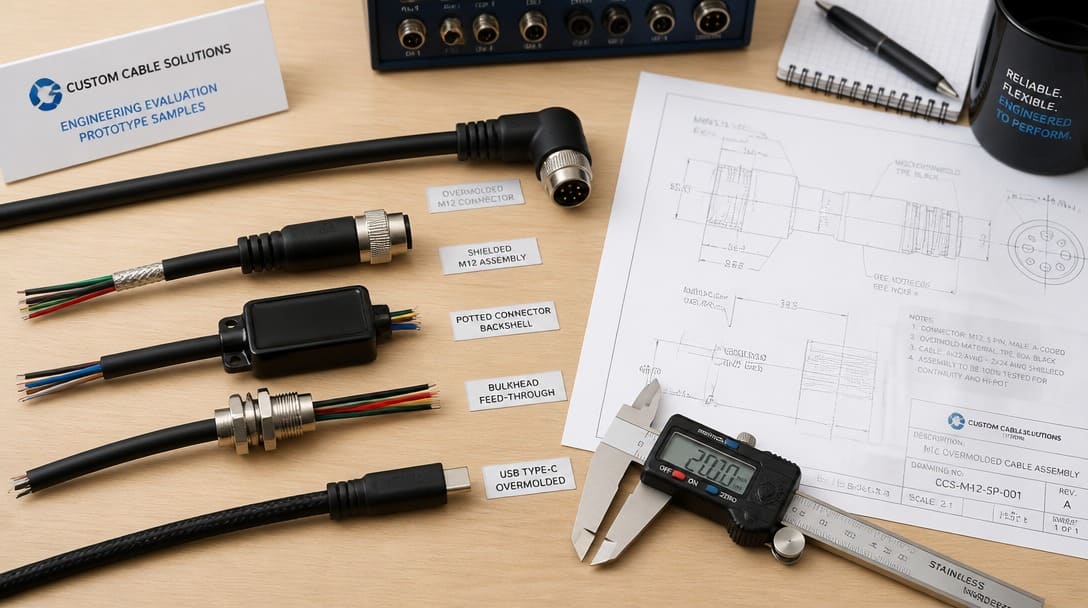
If the buyer is still split between overmolding and potting, request a sample with a TPE overmold and an epoxy-resin option to compare flexibility, serviceability, and seal performance. Suppliers such as EDOM Electronics support OEM buyers(Waterproof Cable Assembly Manufacturing & Supply for OEM Buyers) with requirement review, connector matching, sample coordination, production follow-up, inspection, and export-ready packaging for custom cable assemblies and wire harnesses.
Step 6: Confirm the Final Selection and Packaging Requirements
The final sequence is simple to state but easy to skip: answer the three environment questions, choose the protection class, match the connector body, specify the overmold or potting compound, validate against IEC 60529 and EIA-364, then confirm packaging and shipment. Overmolding, potting, and braided sleeving are not substitutes. In many outdoor or harsh designs, overmolding and braided sleeving appear together — the overmold seals the transition, while the sleeving protects the cable run from mechanical damage.
For drawing review, connector matching, sample confirmation, and export-ready packaging, use the electronic connector sourcing page. When the final assembly includes export shipment, confirm that the packaging plan protects the overmolded and potted connectors during transit — see quality inspection and export packaging for what to check before release.
Frequently Asked Questions
Is braided sleeving a substitute for overmolding?
No. Braided polyamide monofilament sleeving provides abrasion resistance and bundle organization, but it is not an environmental seal. Moisture, dust, and liquid ingress require an IP67-rated connector body or a bonded overmold at the termination point.
When should I specify epoxy potting instead of TPE overmolding?
Potting is the better choice when the primary failure mode is internal contamination of contacts and terminations, not repeated flexing or surface abrasion. Epoxy potting closes internal voids and prevents corrosive gases from reaching conductors, but it adds rigidity and usually eliminates field reworkability.
What does IP67 actually guarantee?
IP67 under IEC 60529 means the connector is dust-tight and protected against temporary water immersion under defined test conditions. Always ask the supplier for the exact test depth and duration, because unattributed IP67 claims may not match the real installation environment.
Do I need to specify UL 94 for the overmold or potting compound?
Yes, if the equipment standard or end-product approval requires a flame-performance class. Confirm the minimum UL 94 rating with the design engineer and the supplier before ordering, because the TPE overmold and epoxy resin are plastic materials subject to the same flame test criteria as other enclosure components.
Key Takeaways
- Answer the three environment questions — moisture, temperature range, and vibration — before comparing electrical specifications.
- Overmolding provides IP67 environmental sealing and strain relief at the connector-to-cable transition; potting provides internal epoxy encapsulation against contamination; braided sleeving provides mechanical abrasion resistance only.
- Use the indoor vs outdoor/harsh table to force the protection decision into the correct category before contacting a supplier.
- Validate every protection claim against IEC 60529, EIA-364, and UL 94 — do not accept an IP rating without test conditions.
- Tell the supplier where the connector will actually be installed; request TPE overmold and epoxy potted samples if the choice remains open.
Explore custom cable assembly solutions for requirement review, connector matching, sample coordination, and export-ready packaging.